Placenta growth factor expression is correlated with survival of patients with colorectal cancer
- PMID: 15831913
- PMCID: PMC1774482
- DOI: 10.1136/gut.2004.050831
Placenta growth factor expression is correlated with survival of patients with colorectal cancer
Abstract
Background: Overexpression of vascular endothelial growth factor (VEGF) correlates with vascularity, metastasis, and proliferation in colorectal cancer but the role of its homologue, placenta growth factor (PlGF), is unknown. The aim of this study was to evaluate expression and clinical implications of PlGF in colorectal cancer.
Methods: We investigated 74 tumour/non-tumour pairs of colorectal cryosections. Clinical staging was based on the UICC-TNM classification. Expression levels of mRNA for PlGF and VEGF were analysed with quantitative real time reverse transcription-polymerase chain reaction. Proteins were analysed by immunohistochemical staining and enzyme linked immunoabsorbant assay. Analysis of the differences in PlGF and VEGF levels between tumour and non-tumour tissues in the same patient were performed by paired t test; differences between localised and advanced disease patients by the Mann-Whitney, chi(2), and Fisher's exact tests and survival curves by the Kaplan-Meier method.
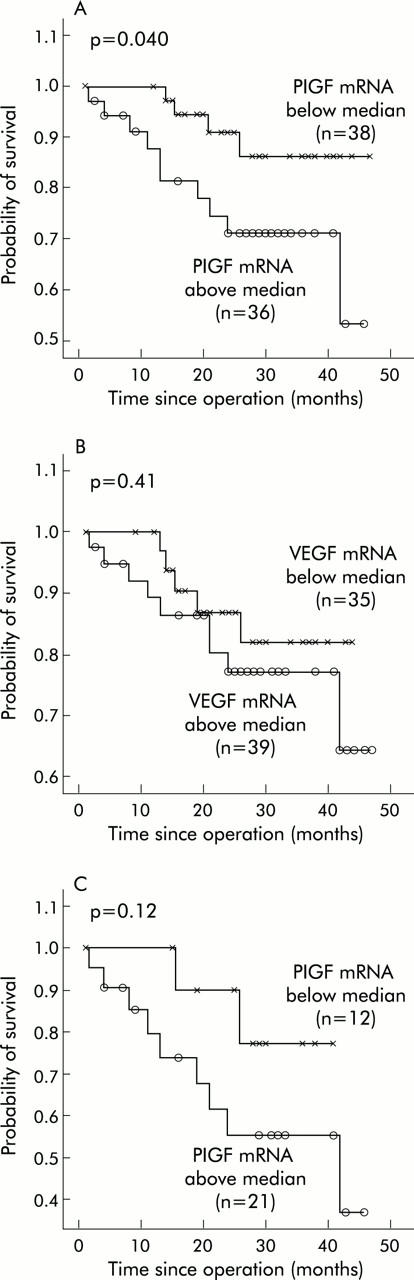
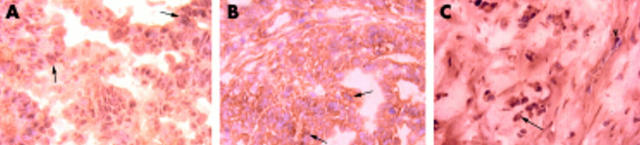
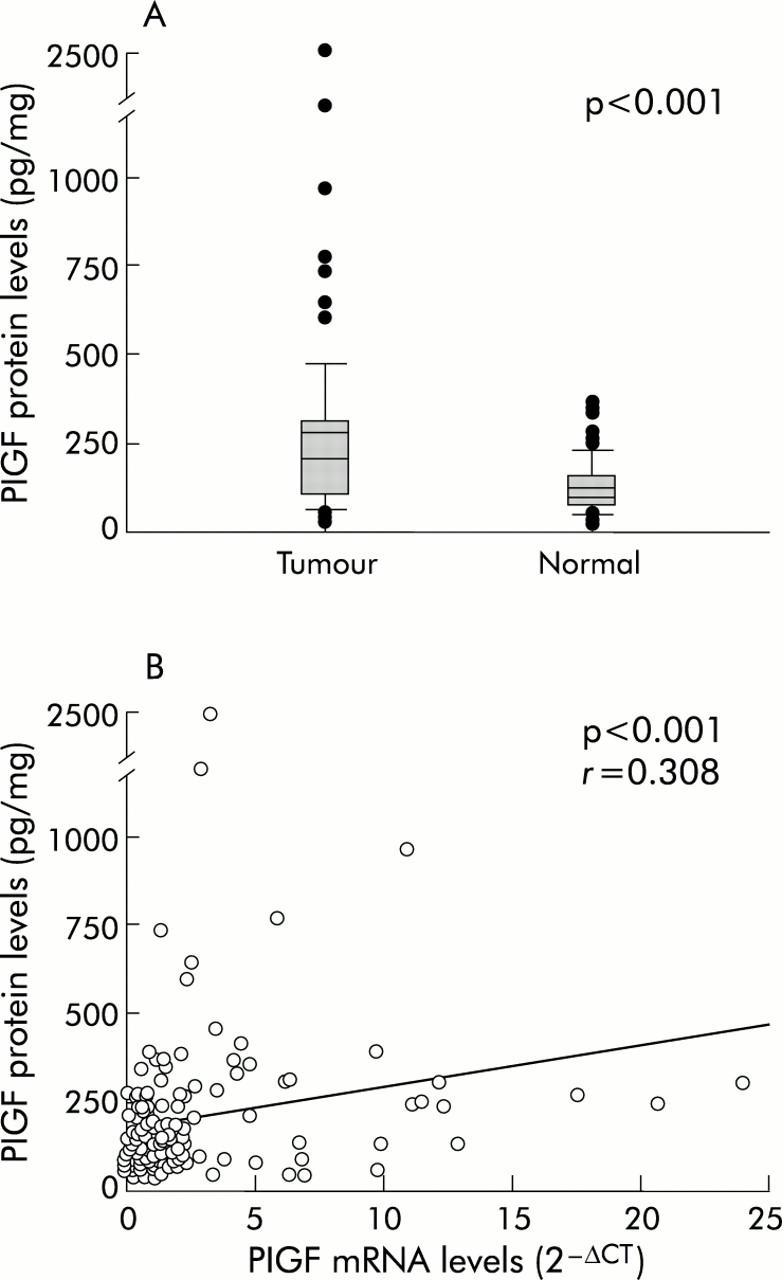
Results: Expression levels for both growth factors were significantly higher in tumour than in non-tumour tissues (p</=0.001). The ratio of PlGF expression in tumour to non-tumour in the advanced disease group was significantly higher than for the localised disease group (p = 0.009). Patients with more tumour PlGF mRNA had shorter survival (p = 0.028). The majority of PlGF was expressed in tumour cells.
Conclusions: Our results suggest that PlGF expression correlates with disease progression and patient survival and may be used as a prognostic indicator for colorectal cancer.
Figures

References
-
- Klagsbrun M, D’Amore PA. Regulators of angiogenesis. Annu Rev Physiol 1991;53:217–39. - PubMed
-
- Lee JC, Chow NH, Wang ST, et al. Prognostic value of vascular endothelial growth factor expression in colorectal cancer patients. Eur J Cancer 2000;36:748–53. - PubMed
-
- Shiraishi A, Ishiwata T, Shoji T, et al. Expression of PCNA, basic fibroblast growth factor, FGF-receptor and vascular growth factor in adenomas and carcinomas of human colon. Acta Histochem Cytochem 1995;28:21–9.
-
- Wong MP, Cheung N, Yuen ST, et al. Vascular endothelial growth factor is up-regulated in the early pre-malignant stage of colorectal tumour progression. Int J Cancer 1999;81:845–50. - PubMed
-
- Takahashi Y, Kitadai Y, Bucana CD, et al. Expression of vascular endothelial growth factor and its receptor, KDR, correlates with vascularity, metastasis, and proliferation of human colon cancer. Cancer Res 1995;55:3964–8. - PubMed
Publication types
MeSH terms
Substances
LinkOut - more resources
Full Text Sources
Other Literature Sources
Medical