


doi: 10.1186/gb-2005-6-4-108.
Epub 2005 Mar 15.
Anatomical ontologies: names and places in biology
Affiliations
- PMID: 15833128
- PMCID: PMC1088950
- DOI: 10.1186/gb-2005-6-4-108
Item in Clipboard
Anatomical ontologies: names and places in biology
Genome Biol.
2005.
Abstract
Ontology has long been the preserve of philosophers and logicians. Recently, ideas from this field have been picked up by computer scientists as a basis for encoding knowledge and with the hope of achieving interoperability and intelligent system behavior. In bioinformatics, ontologies might allow hitherto impossible query and data-mining activities. We review the use of anatomy ontologies to represent space in biological organisms, specifically mouse and human.
Figures
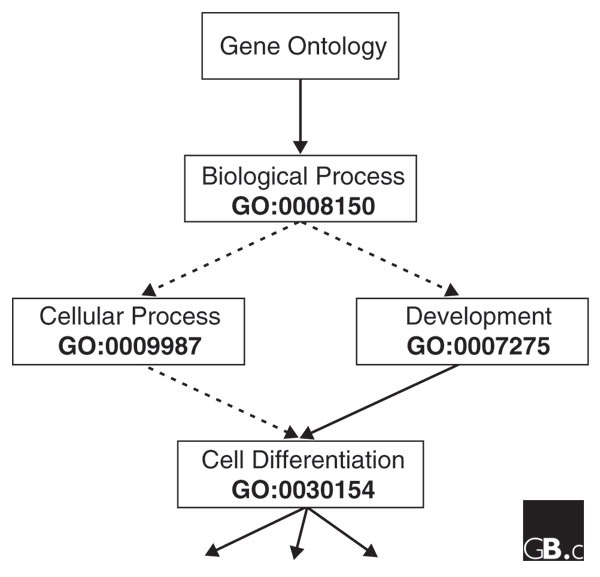
An example of a directed acyclic graph (DAG) taken from the gene ontology (GO). The solid arrows indicate the GO 'part-of' link and the dashed arrows the GO 'is-a' link. The GO unique identifiers (IDs) are printed below each term. The term 'Cell Differentiation' has two parents (Cellular Process and Development), which in turn link back to the same antecedent 'Biological Process' which is part-of the Gene Ontology. The unterminated arrows leading from Cell Differentiation indicate that it has a number of offspring terms.
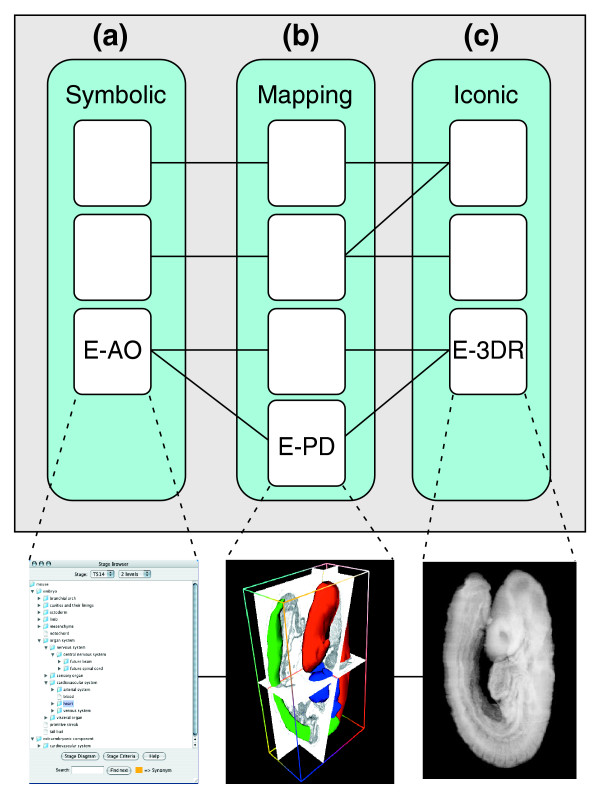
Extending the scope of an ontology. (a) Current anatomical ontologies are purely symbolic, providing a structured collection of terms each corresponding to a particular anatomical concept. An example is the EMAP Anatomy Ontology E-AO [8]. Symbolic ontologies define relationships such as 'part-of', 'is-a' or 'derives-from' (denoting a lineage). Ontologies with extended scope include graphical mapping (b) and iconic (c) representations; examples are the EMAP Painted domains (E-PD) and EMAP 3D Reconstructions (E-3DR) ontologies, respectively, from which the illustrations in (b,c) are taken. The lines between columns represent links, or mappings, between the concept symbols and other representations. A completely iconic representation of the embryo and, implicitly, of the corresponding anatomy is the reconstruction of the embryo as a three-dimensional grey-level voxel model (c) with a fully defined geometric space. This includes additional geometric and topological relationships such as 'volume', 'connected to', 'next-to', 'distance-from', and so on. The middle column (b) represents the step between concept and geometric space reconstruction and is an image representation we define in the same coordinate frame as the embryo reconstructions.
References
-
- Berners-Lee T, Hendler J, Lassila O. The semantic web. Sci Am Digital. 2001;284:34–43.
-
- de Roure D, Jennings N, Shadbolt N. The semantic grid: a future e-science infrastructure. In: Berman F, Fox G, Hey A, editor. Grid Computing - Making the Global Infrastructure a Reality. Hoboken NJ: John Wiley; 2003. pp. 437–470.
-
- Gruber T. A translation approach to portable ontology specifications. Knowledge Acquisition. 1993;5:199–220. doi: 10.1006/knac.1993.1008. - DOI
-
- Dublin Core Metadata Initiative http://www.dublincore.org
-
- Gene Ontology http://www.geneontology.org
MeSH terms
Grants and funding
LinkOut - more resources
Full Text Sources
Medical
