


The effect of metformin and intensive lifestyle intervention on the metabolic syndrome: the Diabetes Prevention Program randomized trial
- PMID: 15838067
- PMCID: PMC2505046
- DOI: 10.7326/0003-4819-142-8-200504190-00009
The effect of metformin and intensive lifestyle intervention on the metabolic syndrome: the Diabetes Prevention Program randomized trial
Abstract
Background: The metabolic syndrome is a high-risk state for diabetes and cardiovascular disease. Little is known about its prevalence and prevention in those with impaired glucose tolerance.
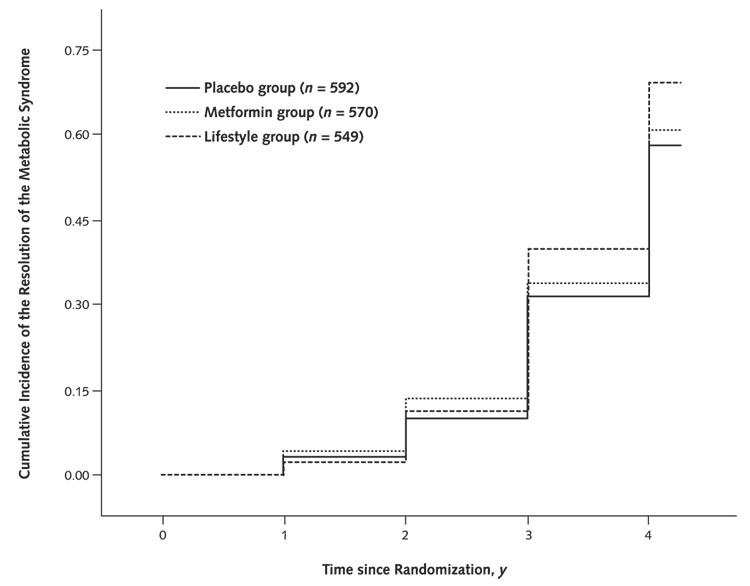
Objective: To determine the prevalence of the metabolic syndrome at baseline in the Diabetes Prevention Program and the effect of intensive lifestyle intervention and metformin therapy on the syndrome's incidence and resolution.
Design: Randomized, controlled clinical trial.
Setting: Research and community-based centers.
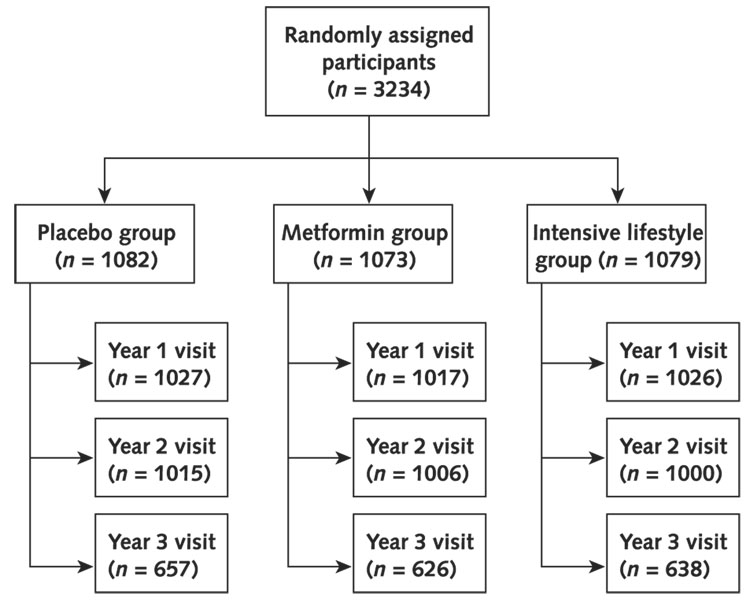
Participants: Participants had impaired glucose tolerance (World Health Organization criteria plus fasting plasma glucose level >or=5.3 mmol/L [>or=95 mg/dL]) and were followed for a mean of 3.2 years after random assignment to intensive lifestyle intervention, metformin therapy, or placebo.
Interventions: Metformin, 850 mg twice daily, or intensive lifestyle intervention designed to achieve and maintain a 7% weight loss and 150 minutes of exercise per week.
Measurements: The metabolic syndrome was defined as having 3 or more characteristics (waist circumference; blood pressure; and levels of high-density lipoprotein cholesterol, triglycerides, and fasting plasma glucose) that met criteria from the National Cholesterol Education Program Adult Treatment Panel III.
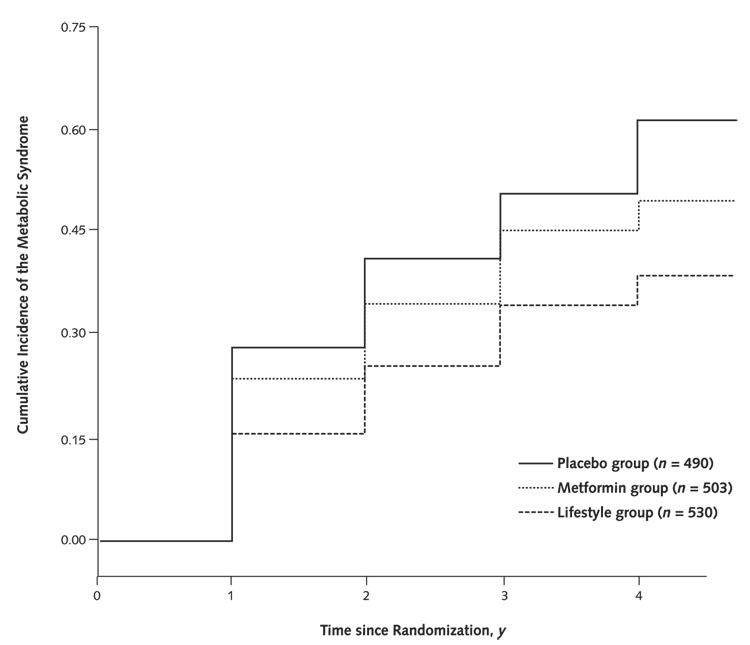
Results: Fifty-three percent of participants (n = 1711) had the metabolic syndrome at baseline; incidence did not vary substantially by age. However, low levels of high-density lipoprotein cholesterol predominated in younger participants (age 25 to 44 years), and high blood pressure predominated in older participants (age 60 to 82 years). In life-table analyses (log-rank test), incidence of the metabolic syndrome was reduced by 41% in the lifestyle group (P < 0.001) and by 17% in the metformin group (P = 0.03) compared with placebo. Three-year cumulative incidences were 51%, 45%, and 34% in the placebo, metformin, and lifestyle groups, respectively. There was no significant heterogeneity by ethnic group.
Limitations: The study involved a volunteer group with impaired glucose tolerance, which limits generalizability.
Conclusions: The metabolic syndrome affected approximately half of the participants in the Diabetes Prevention Program at baseline. Both lifestyle intervention and metformin therapy reduced the development of the syndrome in the remaining participants.
Conflict of interest statement
Figures
Comment in
-
The Diabetes Prevention Program and the metabolic syndrome.Ann Intern Med. 2005 Oct 4;143(7):544-5; author reply 545-6. doi: 10.7326/0003-4819-143-7-200510040-00021. Ann Intern Med. 2005. PMID: 16204171 No abstract available.
-
The Diabetes Prevention Program and the metabolic syndrome.Ann Intern Med. 2005 Oct 4;143(7):545; author reply 545-6. doi: 10.7326/0003-4819-143-7-200510040-00022. Ann Intern Med. 2005. PMID: 16204173 No abstract available.
-
A lifestyle intervention or metformin prevented or delayed the onset of the metabolic syndrome in persons at risk.ACP J Club. 2005 Nov-Dec;143(3):67. ACP J Club. 2005. PMID: 16262224 No abstract available.
-
Treating metabolic syndrome: lifestyle change or medication?Can Fam Physician. 2007 Jul;53(7):1203-5. Can Fam Physician. 2007. PMID: 17872820 Free PMC article. No abstract available.
Summary for patients in
-
Summaries for patients. The effect of diet and exercise or metformin on the metabolic syndrome.Ann Intern Med. 2005 Apr 19;142(8):I46. doi: 10.7326/0003-4819-142-8-200504190-00003. Ann Intern Med. 2005. PMID: 15838061 No abstract available.
References
-
- Executive Summary of The Third Report of The National Cholesterol Education Program (NCEP) Expert Panel on Detection, Evaluation, And Treatment of High Blood Cholesterol In Adults (Adult Treatment Panel III) JAMA. 2001;285:2486–2497. [PMID: 11368702] - PubMed
-
- Alberti KG, Zimmet PZ. Definition, diagnosis and classification of diabetes mellitus and its complications. Part 1: diagnosis and classification of diabetes mellitus provisional report of a WHO consultation. Diabet Med. 1998;15:539–553. [PMID: 9686693] - PubMed
-
- Ford ES, Giles WH, Dietz WH. Prevalence of the metabolic syndrome among US adults: findings from the third National Health and Nutrition Examination Survey. JAMA. 2002;287:356–359. [PMID: 11790215] - PubMed
-
- Alexander CM, Landsman PB, Teutsch SM, Haffner SM. NCEP-defined metabolic syndrome, diabetes, and prevalence of coronary heart disease among NHANES III participants age 50 years and older. Diabetes. 2003;52:1210–1214. [PMID: 12716754] - PubMed
Publication types
MeSH terms
Substances
Grants and funding
LinkOut - more resources
Full Text Sources
Other Literature Sources
Medical
Miscellaneous
