. 2005 Jun 24;280(25):23869-75.
doi: 10.1074/jbc.M502854200. Epub 2005 Apr 20.

A chaperone pathway in protein disaggregation. Hsp26 alters the nature of protein aggregates to facilitate reactivation by Hsp104

Affiliations

A chaperone pathway in protein disaggregation. Hsp26 alters the nature of protein aggregates to facilitate reactivation by Hsp104

Anil G Cashikar et al. J Biol Chem. .

Erratum in

  • J Biol Chem. 2006 Mar 31;281(13):8996

Abstract

Cellular protein folding is challenged by environmental stress and aging, which lead to aberrant protein conformations and aggregation. One way to antagonize the detrimental consequences of protein misfolding is to reactivate vital proteins from aggregates. In the yeast Saccharomyces cerevisiae, Hsp104 facilitates disaggregation and reactivates aggregated proteins with assistance from Hsp70 (Ssa1) and Hsp40 (Ydj1). The small heat shock proteins, Hsp26 and Hsp42, also function in the recovery of misfolded proteins and prevent aggregation in vitro, but their in vivo roles in protein homeostasis remain elusive. We observed that after a sublethal heat shock, a majority of Hsp26 becomes insoluble. Its return to the soluble state during recovery depends on the presence of Hsp104. Further, cells lacking Hsp26 are impaired in the disaggregation of an easily assayed heat-aggregated reporter protein, luciferase. In vitro, Hsp104, Ssa1, and Ydj1 reactivate luciferase:Hsp26 co-aggregates 20-fold more efficiently than luciferase aggregates alone. Small Hsps also facilitate the Hsp104-mediated solubilization of polyglutamine in yeast. Thus, Hsp26 renders aggregates more accessible to Hsp104/Ssa1/Ydj1. Small Hsps partially suppress toxicity, even in the absence of Hsp104, potentially by sequestering polyglutamine from toxic interactions with other proteins. Hence, Hsp26 plays an important role in pathways that defend cells against environmental stress and the types of protein misfolding seen in neurodegenerative disease.


Figures
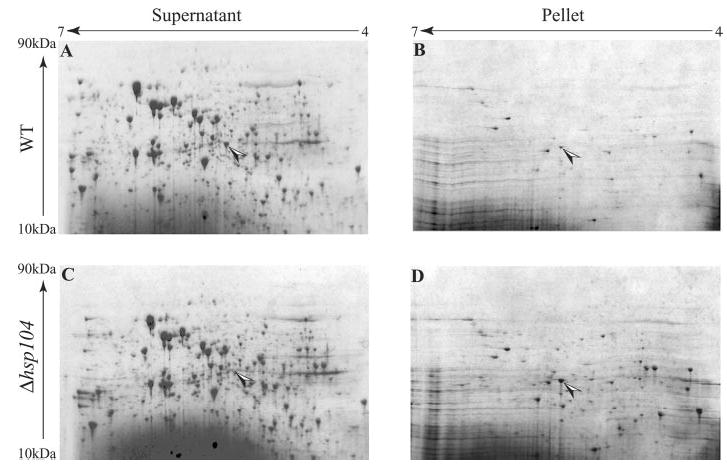
Fig. 1
Fig. 1. Two-dimensional PAGE analysis of soluble and insoluble proteins after recovery from heat shock
Wild-type and Δhsp104 cells were pretreated at 37 °C for 30 min to induce the expression of heat shock proteins followed by a sub-lethal heat shock at 46 °C for 30 min. Protein synthesis was blocked by the addition of cycloheximide (10 μg/ml). The cells were allowed to recover at 25 °C for 2 h. Soluble and insoluble proteins were analyzed by two-dimensional PAGE. The spot corresponding to Hsp26 is marked with an arrow.
Fig. 2
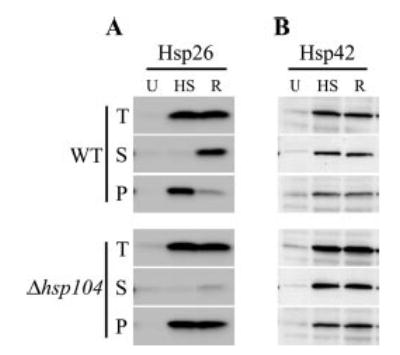
Fig. 2. Solubility of Hsp26 and Hsp42 after heat shock in WT and Δhsp104 cells
A, Western blot with Hsp26 antibody. B, Western blot with Hsp42 antibody. Samples were untreated (U), subjected to heat shock at 37 °C for 30 min followed by 46 °C for 30 min (HS) and allowed for recovery from heat shock for 1 h (R). Lysates (T, total) were centrifuged to separate supernatant (S) and pellet (P) fractions.
Fig. 3
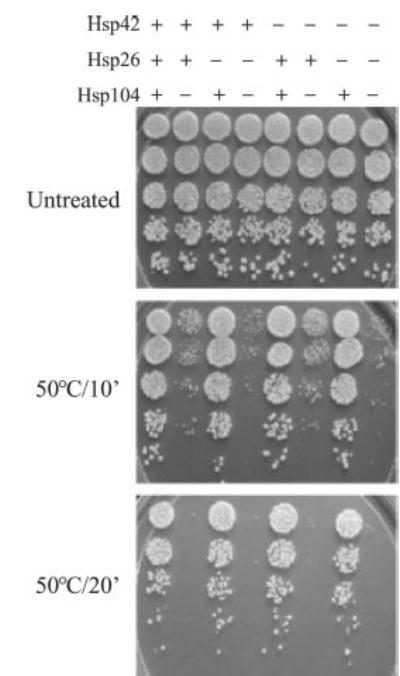
Fig. 3. Thermotolerance of various mutants
Cells were either untreated or given a tolerance-inducing pretreatment at 37 °C for 30 min followed by a 10- or 20 min lethal heat shock at 50 °C. 5 μl of cells were spotted on YPD plates after 5-fold serial dilutions. The strains are as follows: 1, WT; 2, Δhsp104; 3, Δhsp26; 4, Δhsp26Δhsp104; 5, Δhsp42; 6, Δhsp42Δhsp104; 7, Δhsp26Δhsp42; 8, Δhsp26Δhsp42Δhsp104.
Fig. 4
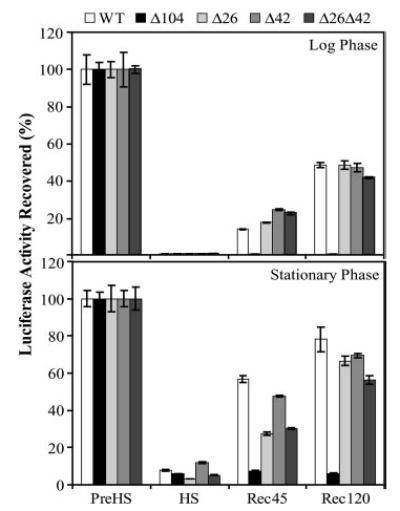
Fig. 4. In vivo reactivation of aggregated luciferase
Mutant strains (as indicated) were transformed with plasmid carrying the heat-sensitive luciferase gene. Cells were subjected to pretreatment at 37 °C for 30 min followed by sublethal heat shock at 46 °C for 60 min. Protein synthesis was inhibited by the addition of cycloheximide to a final concentration of 10 μg/ml. The disaggregation of aggregated luciferase was followed post-heat treatment by measuring luciferase activity. Luciferase activity in pretreated cells was set to 100%.
Fig. 5
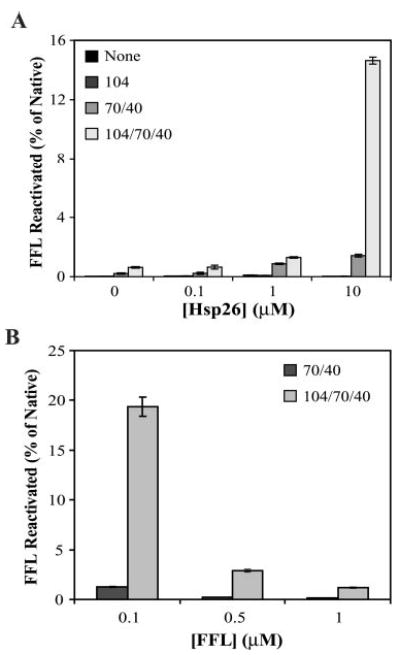
Fig. 5. Hsp26 facilitates reactivation of aggregated FFL by the Hsp104/Ssa1/Ydj1 chaperone machinery
A, titrating Hsp26 (monomer concentrations are indicated). FFL concentration was 0.1 μm. Hsp26-FFL co-complexes were made by heating them at 45 °C for 15 min and diluting 20-fold into chaperone mixtures containing 1 μm each of Hsp104, Ssa1, and Ydj1 and 5 mm ATP. Native FFL activity at the same concentration was set to 100%. B, titrating FFL (concentrations are indicated). Hsp26 monomer concentration was kept constant at 10 μm. Other conditions are as indicated for A.
Fig. 6
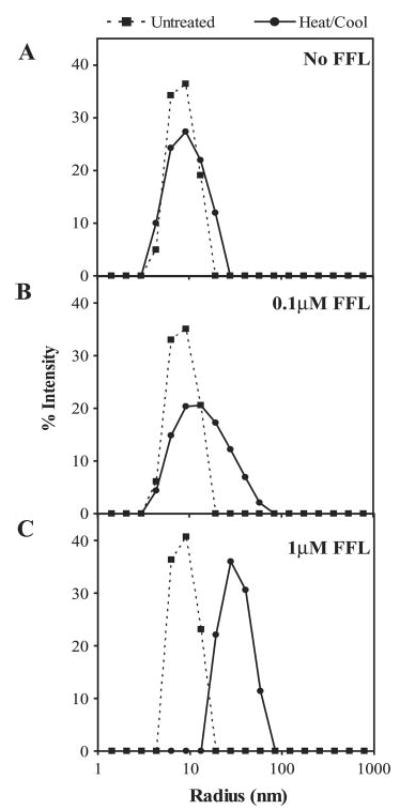
Fig. 6. Complex formation between Hsp26 and FFL monitored by dynamic light scattering
Samples were 0.42 μm Hsp26 oligomer (A), 0.42 μm Hsp26 oligomer with 0.1 μm FFL (B), and 0.42 μm Hsp26 oligomer with 1 μm FFL (C). Dotted line, untreated (25 °C); solid line, heated at 45 °C for 10 s followed by cooling to 25 °C.
Fig. 7
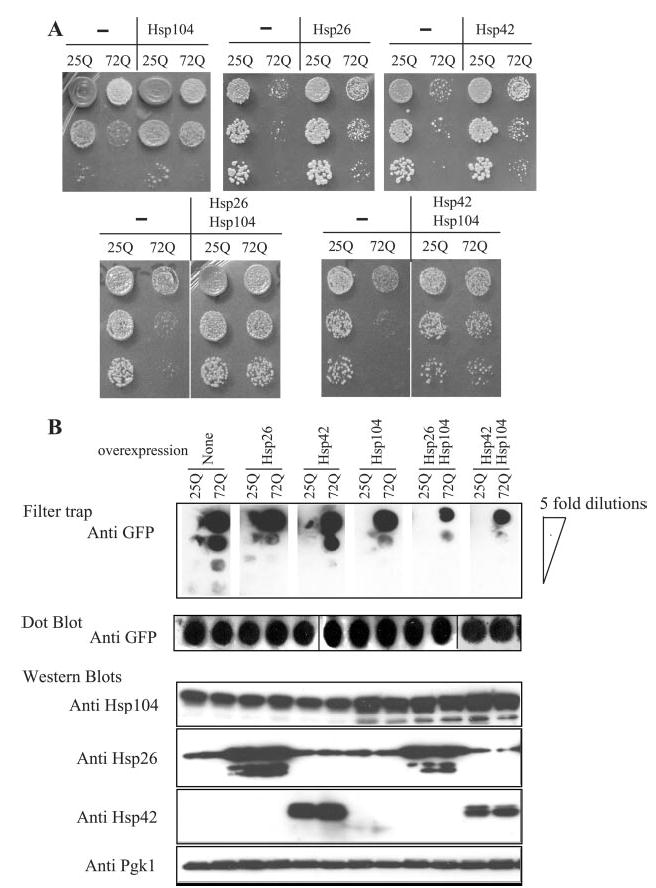
Fig. 7. sHsps and polyglutamine toxicity and aggregation
A, growth assays of yeast cells expressing Hsp104 or Hsp26 or the indicated combinations of both in addition to human huntingtin polyglutamine regions exon I containing 25Q or 72Q. B, upper panel, filter-trap assays to analyze aggregation profiles of 25Q and 72Q samples. Lower panel, dot blot and Western blots to determine the expression levels of each of the indicated proteins. Pgk1 was used as loading control. GFP, green fluorescent protein.
Fig. 8
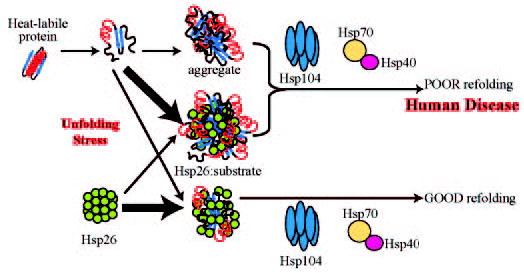
Fig. 8. Chaperone cascade model
Misfolded and aggregation-prone proteins are trapped by Hsp26 into co-complexes. The nature of the co-complexes depends on the ratio of Hsp26 to the substrate protein. At lower Hsp26 concentrations, larger (and perhaps tighter) complexes formed with misfolded proteins, which are poorly reactivated by the Hsp104/Hsp70/Hsp40 chaperone system. At higher Hsp26 concentrations smaller complexes form with the misfolded proteins, which are efficiently reactivated by the Hsp104/Hsp70/Hsp40 chaperone system. A shift in the delicate balance from the resolvable complexes to the non-resolvable aggregates could result from a reduced efficacy of the chaperone pathway. These complexes may normally serve to resolubilize aggregates, but excessive accumulation of the complexes could result in toxic inclusions.

References

    1. Jakob U, Gaestel M, Engel K, Buchner J. J Biol Chem. 1993;268:1517–1520. - PubMed
    1. Welsh MJ, Gaestel M. Ann N Y Acad Sci. 1998;851:28–35. - PubMed
    1. Narberhaus F. Microbiol Mol Biol Rev. 2002;66:64–93. - PMC - PubMed
    1. Haslbeck M. Cell Mol Life Sci. 2002;59:1649–1657. - PMC - PubMed
    1. Haslbeck M, Ignatiou A, Saibil H, Helmich S, Frenzl E, Stromer T, Buchner J. J Mol Biol. 2004;343:445–455. - PubMed

Publication types

MeSH terms

Substances