


Unmasking group III metabotropic glutamate autoreceptor function at excitatory synapses in the rat CNS
- PMID: 15845577
- PMCID: PMC1464548
- DOI: 10.1113/jphysiol.2005.086736
Unmasking group III metabotropic glutamate autoreceptor function at excitatory synapses in the rat CNS
Abstract
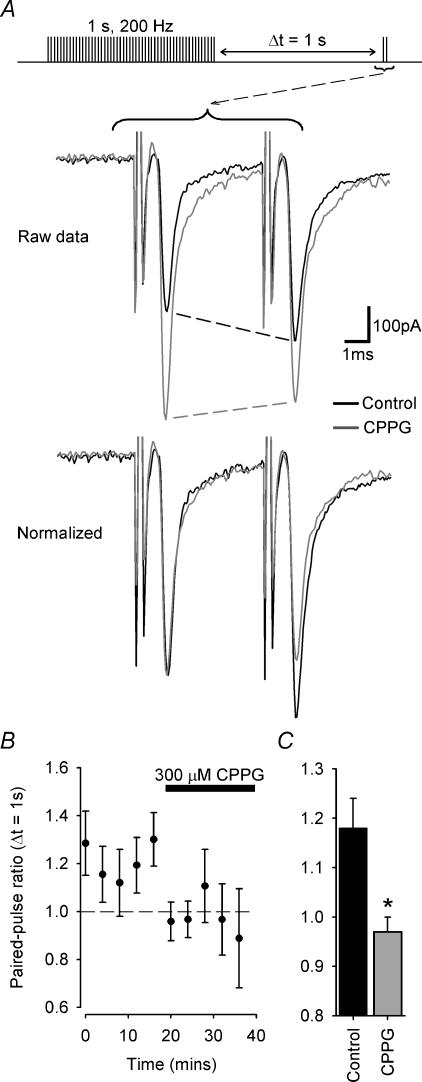
Presynaptic group III metabotropic glutamate receptor (mGluR) activation by exogenous agonists (such as L-2-amino-4-phosphonobutyrate (L-AP4)) potently inhibit transmitter release, but their autoreceptor function has been questioned because endogenous activation during high-frequency stimulation appears to have little impact on synaptic amplitude. We resolve this ambiguity by studying endogenous activation of mGluRs during trains of high-frequency synaptic stimuli at the calyx of Held. In vitro whole-cell patch recordings were made from medial nucleus of the trapezoid body (MNTB) neurones during 1 s excitatory postsynaptic current (EPSC) trains delivered at 200 Hz and at 37 degrees C. The group III mGluR antagonist (R,S)-cyclopropyl-4-phosphonophenylglycine (CPPG, 300 microm) had no effect on EPSC short-term depression, but accelerated subsequent recovery time course (tau: 4.6 +/- 0.8 s to 2.4 +/- 0.4 s, P = 0.02), and decreased paired pulse ratio from 1.18 +/- 0.06 to 0.97 +/- 0.03 (P = 0.01), indicating that mGluR activation reduced release probability (P). Modelling autoreceptor activation during repetitive stimulation revealed that as P declines, the readily releasable pool size (N) increases so that the net EPSC (NP) is unchanged and short-term depression proceeds with the same overall time course as in the absence of autoreceptor activation. Thus, autoreceptor action on the synaptic response is masked but the synapse is now in a different state (lower P, higher N). While vesicle replenishment clearly underlies much of the recovery from short-term depression, our results show that the recovery time course of P also contributes to the reduced response amplitude for 1-2 s. The results show that passive equilibration between N and P masks autoreceptor modulation of the EPSC and suggests that mGluR autoreceptors function to change the synaptic state and distribute metabolic demand, rather than to depress synaptic amplitude.
Figures




References
-
- Abbott LF, Varela JA, Sen K, Nelson SB. Synaptic depression and cortical gain control. Science. 1997;275:220–224. - PubMed
-
- Anwyl R. Metabotropic glutamate receptors: electrophysiological properties and role in plasticity. Brain Res Brain Res Rev. 1999;29:83–120. - PubMed
-
- Attwell D, Laughlin SB. An energy budget for signaling in the grey matter of the brain. J Cereb Blood Flow Metab. 2001;21:1133–1145. - PubMed
Publication types
MeSH terms
Substances
Grants and funding
LinkOut - more resources
Full Text Sources
Miscellaneous
