. 2005 May;49(5):1679-87.
doi: 10.1128/AAC.49.5.1679-1687.2005.

Antileishmanial activity of the terpene nerolidol

Affiliations

Antileishmanial activity of the terpene nerolidol

Denise C Arruda et al. Antimicrob Agents Chemother. 2005 May.

Abstract

The activity of nerolidol, a sesquiterpene used as a food-flavoring agent and currently under testing as a skin penetration enhancer for the transdermal delivery of therapeutic drugs, was evaluated against Leishmania species. Nerolidol inhibited the growth of Leishmania amazonensis, L. braziliensis, and L. chagasi promastigotes and L. amazonensis amastigotes with in vitro 50% inhibitory concentrations of 85, 74, 75, and 67 microM, respectively. The treatment of L. amazonensis-infected macrophages with 100 microM nerolidol resulted in 95% reduction in infection rates. Inhibition of isoprenoid biosynthesis, as shown by reduced incorporation of [2-(14)C]mevalonic acid (MVA) or [1-(14)C]acetic acid precursors into dolichol, ergosterol, and ubiquinone, was observed in nerolidol-treated promastigotes. This drug effect can be attributed to the blockage of an early step in the mevalonate pathway, since incorporation of the precursor [1(n)-(3)H]farnesyl pyrophosphate in polyisoprenoids is not inhibited by nerolidol. L. amazonensis-infected BALB/c mice were treated with intraperitoneal doses of 100 mg/kg/day for 12 days or topically with 5 or 10% ointments for 4 weeks. Significant reduction of lesion sizes in nerolidol treated mice was observed for both treatment routes. However, long-term follow up indicated that the disease was not cured in this highly susceptible animal model. Nonetheless, the in vitro activity of nerolidol against these parasites may prove a useful tool for the development of new drugs for the treatment of leishmaniasis. In addition, biosynthesis of dolichols with 11 and 12 isoprene units was identified in Leishmania, as described for other trypanosomatids and Apicomplexa.


Figures
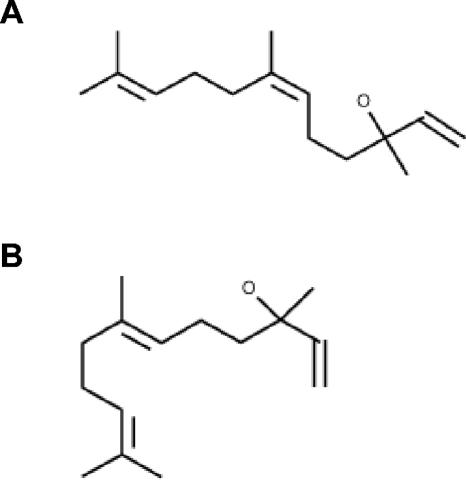
FIG. 1.
FIG. 1.
Chemical structure of nerolidol. (A) cis-3,7,11-Trimethyl-1,6,10-dodecatrien-3-ol and (B) trans-3,7,11-Trimethyl-1,6,10-dodecatrien-3-ol.
FIG. 2.
FIG. 2.
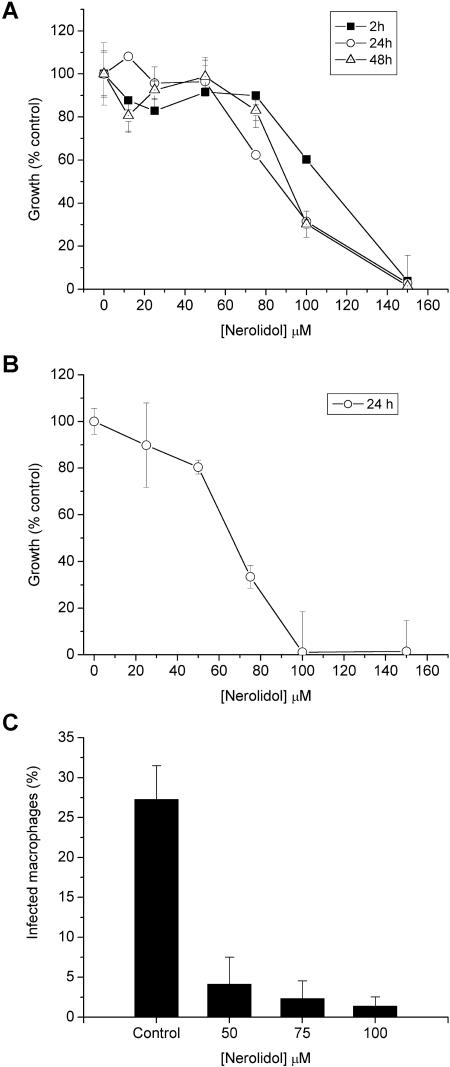
Effect of nerolidol on the survival of L. amazonensis. The cell viability of promastigotes (A) and amastigotes (B) was evaluated after the indicated periods of incubation with different concentrations of nerolidol. The growth of treated cultures is shown as the percentage of control parasites incubated in medium alone. (C) Effect of nerolidol on intracellular amastigotes. Macrophages were infected with L. amazonensis promastigotes for 3 h. After infection, nerolidol was added at final concentrations of 50, 75, or 100 μM for 48 h. Cells were fixed and stained, and the percentage of infected macrophages was determined by counting at least 100 cells/coverslip in triplicate coverslips. Cultures were tested in triplicates, and the results shown are the average of at least three independent experiments.
FIG. 3.
FIG. 3.
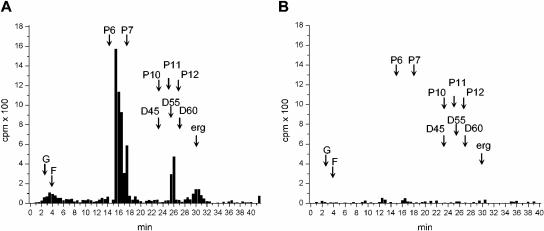
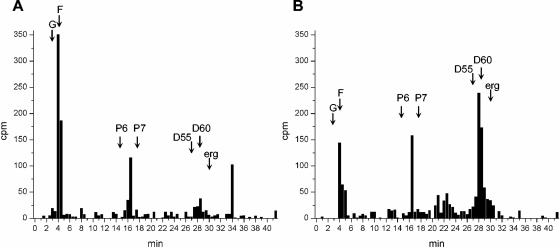
HPLC analysis of [14C]MVA-labeled L. amazonensis promastigotes. Labeled parasite extracts were analyzed by RP-HPLC by using methanol-water-hexane-propan-2-ol-methanol as a solvent system. The retention times of coinjected standards are indicated by arrows as follows: G, geraniol; F, farnesol; Pn, prenols of “n” isoprene units; D45, D55, and D60, dolichols with 45, 55, and 60 C; erg, ergosterol. Fractions of 0.5 ml (0.5 min) were collected and monitored for radioactivity. (A) Control; (B) promastigotes treated with 30 μM nerolidol. Identical numbers of cells were used to prepare the extracts analyzed in panels A and B.
FIG. 4.
FIG. 4.
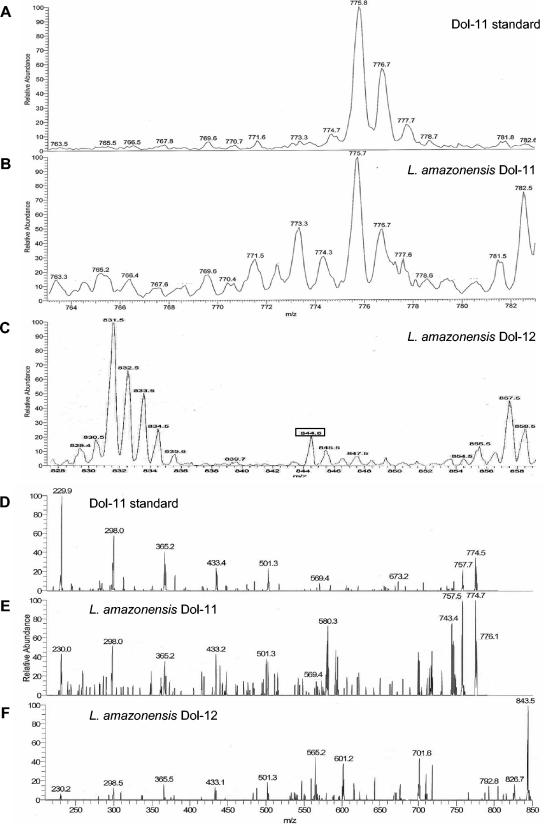
ESI-MS analysis of dolichol. ESI-MS (A to C) and MS/MS (D to F) spectra of an authentic dolichol standard composed of 11 isoprene units (A and D), L. amazonensis sample with the same retention time of the dolichol standard of 11 isoprene units (B and E), and L. amazonensis sample with the same retention time of a polyisoprenoid standard of 60 carbons (C and F). (A and B, m/z 775.8 [M + Li]+; C, m/z 844.6 [M + Li]+).
FIG. 5.
FIG. 5.
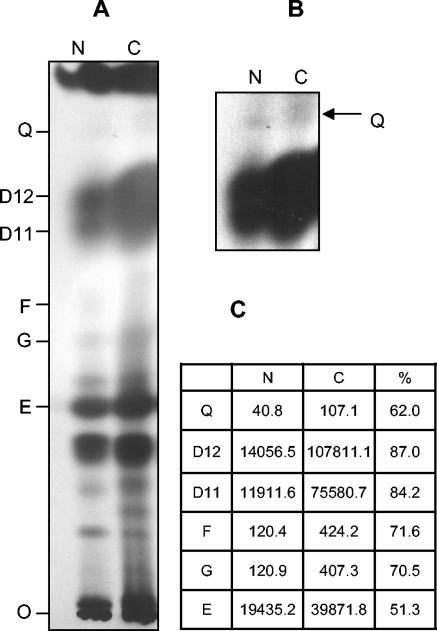
HPTLC analysis of the synthesis of isoprenoids in the presence of nerolidol. (A) Hexane extracts from L. amazonensis promastigotes incubated in the absence (C) or in the presence of 30 μM nerolidol (N) and metabolically labeled with [1-14C]acetic acid were separated by HPTLC. The position of the authentic standards ran in the same plate is shown (E, ergosterol; G, geraniol; F, farnesol; D11 and D12, dolichol of 11 and 12 isoprene units; Q, mixture of standards of CoQ7-10). Identical numbers of cells were used to prepare the extracts loaded in each lane. Exposure time, 4 weeks. (B) The upper region of the plate after 8 weeks of exposure. The arrow indicates bands with Rf values equivalent to the ubiquinone standards. (C) Counts measured for radioactive spots, scanned after 10 days of exposure in a phosphor screen, for the nerolidol-treated sample (N) and control parasites (C) and the calculated percentage of inhibition (%).
FIG. 6.
FIG. 6.
HPLC analysis of [3H]FPP-labeled L. amazonensis promastigotes. Labeled parasite extracts were analyzed by RP-HPLC by using methanol-water-hexane-propan-2-ol-methanol as a solvent system. The retention times of coinjected standards are indicated by arrows: G, geraniol; F, farnesol; Pn, prenols of “n” isoprene units; D55 and D60, dolichols with 55 and 60 C; erg, ergosterol. Fractions of 0.5 ml (0.5 min) were collected and monitored for radioactivity. (A) Control; (B) promastigotes treated with 30 μM nerolidol. Identical numbers of cells were used to prepare the extracts analyzed in panels A and B.
FIG. 7.
FIG. 7.
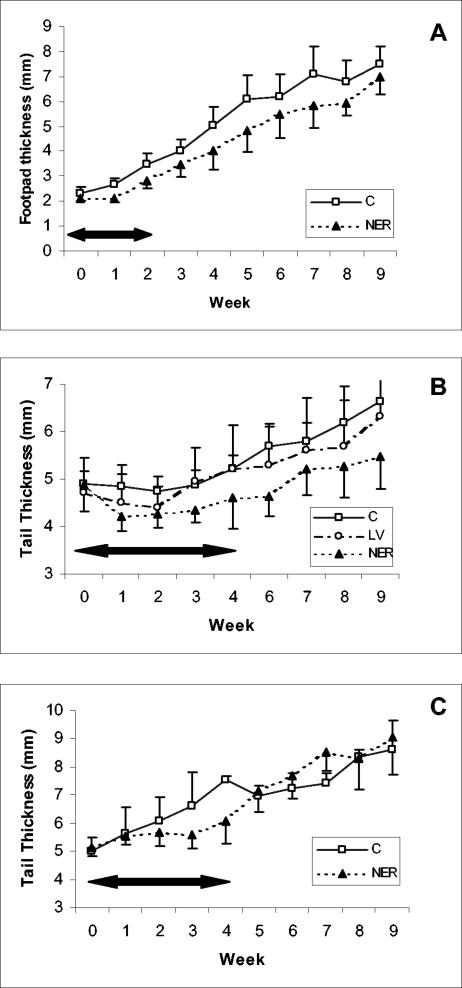
Treatment of infected mice with nerolidol. Mice were infected with L. amazonensis at the left hind footpad (A) or at the basis of the tail (B and C) and treated with nerolidol for the periods indicated by horizontal arrows. (A) Mice treated intraperitoneally with 100 mg of nerolidol/kg/day (NER, ▴) or 10% ethanol in phosphate-buffered saline (C, □) for 12 days. The results shown are the mean and standard deviations for groups of five animals. Standard deviations are shown as half bars for clarity (above the symbols for control treated mice and below the symbols for nerolidol-treated mice). (B) Mice treated with ointment containing 5% (wt/wt) nerolidol in a 70% vaseline, 30% lanolin basis (LV) for 4 weeks. Control infected mice treated with the ointment basis without drug are indicated as open circles (LV). The mean for groups of five animals is shown. (C) Mice treated with ointment containing 10% (wt/wt) nerolidol in 70% vaseline, and 30% lanolin basis for 4 weeks. The mean for groups of five animals is shown. Symbols are as defined for panel A.

References

    1. Barcinski, M. A., D. Schechtman, L. G. Quintao, D. de A. Costa, L. R. Soares, M. E. Moreira, and R. Charlab. 1992. Granulocyte-macrophage colony-stimulating factor increases the infectivity of Leishmania amazonensis by protecting promastigotes from heat-induced death. Infect. Immun. 60:3523-3527. - PMC - PubMed
    1. Beach, D. H., L. J. Goad, and G. G. Holz, Jr. 1988. Effects of antimycotic azoles on growth and sterol biosynthesis of Leishmania promastigotes. Mol. Biochem. Parasitol. 31:149-162. - PubMed
    1. Berhe, N., D. Wolday, A. Hailu, Y. Abraham, A. Ali, T. Gebre-Michael, P. Desjeux, A. Sonnerborg, H. Akuffo, and S. Britton. 1999. HIV viral load and response to antileishmanial chemotherapy in coinfected patients. AIDS 13:1921-1925. - PubMed
    1. Chojnacki, T., and G. Dallner. 1988. The biological role of dolichol. Biochem. J. 251:1-9. - PMC - PubMed
    1. Cornwell, P. A., and B. W. Barry. 1994. Sesquiterpene components of volatile oils as skin penetration enhancers for the hydrophilic permeant 5-fluorouracil. J. Pharm. Pharmacol. 46:261-269. - PubMed

Publication types

MeSH terms

LinkOut - more resources