


Immunomodulatory activities of small host defense peptides
- PMID: 15855488
- PMCID: PMC1087655
- DOI: 10.1128/AAC.49.5.1727-1732.2005
Immunomodulatory activities of small host defense peptides
Abstract
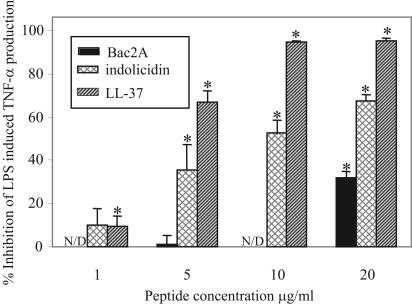
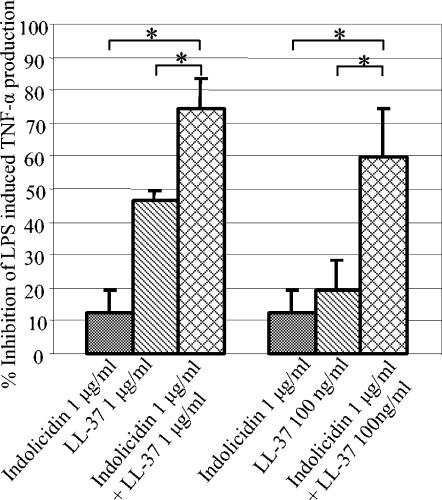
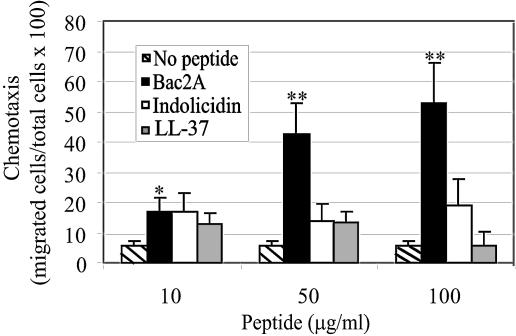
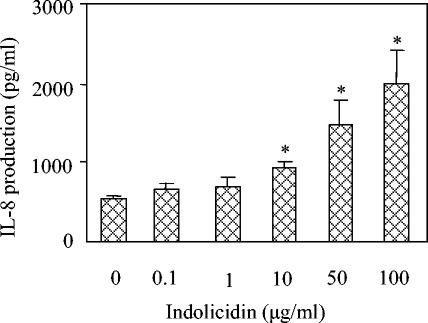
Recent studies have demonstrated that in addition to their antimicrobial activity, cationic host defense peptides, like the human cathelicidin LL-37, perform many activities relating to innate immunity, including the induction or modulation of chemokine and cytokine production, alteration of gene expression in host cells, and inhibition of proinflammatory responses of host cells to bacterial components such as lipopolysaccharide (LPS) in vitro and in vivo. To investigate if these properties are shared by smaller peptides, two cathelicidin peptides derived from bovine neutrophils, the 13-mer indolicidin and Bac2A, a linear 12-amino-acid derivative of bactenecin, were compared to the 37-amino-acid peptide LL-37. Indolicidin, like LL-37, inhibited LPS-induced tumor necrosis factor alpha (TNF-alpha) secretion, even when added up to an hour after the addition of Escherichia coli O111:B4 LPS to the human macrophage/monocyte-like THP-1 cell line. In contrast, Bac2A demonstrated no significant antiendotoxin activity. At low concentrations, indolicidin and LL-37 acted synergistically to suppress LPS-induced production of TNF-alpha. Indolicidin was analogous to LL-37 in its ability to induce the production of the chemokine interleukin-8 (IL-8) in a human bronchial cell line, 16HBE14o(-), but it was unable to induce production of IL-8 in THP-1 cells. In contrast, Bac2A was unable to induce IL-8 in either cell type. Conversely, Bac2A was chemotactic for THP-1 cells at concentrations between 10 and 100 mug/ml, while indolicidin and LL-37 were not chemotactic at these concentrations for THP-1 cells. This indicates that in addition to the potential for direct microbicidal activity, cationic host defense peptides may have diverse and complementary abilities to modulate the innate immune response.
Figures
References
-
- Bowdish, D. M. E., D. J. Davidson, and R. E. W. Hancock. 2005. A re-evaluation of the role of host defence peptides in mammalian immunity. Curr. Protein Pept. Sci. 6:35-51. - PubMed
-
- Bowdish, D. M. E., D. J. Davidson, D. P. Speert, and R. E. W. Hancock. 2004. The human cationic peptide LL-37 induces activation of the extracellular signal-regulated kinase and p38 kinase pathways in primary human monocytes. J. Immunol. 172:3758-3765. - PubMed
-
- Ciornei, C. D., A. Egesten, M. Engstrom, K. Tornebrandt, and M. Bodelsson. 2002. Bactericidal/permeability-increasing protein inhibits endotoxin-induced vascular nitric oxide synthesis. Acta Anaesthesiol. Scand. 46:1111-1118. - PubMed
-
- Cozens, A. L., M. J. Yezzi, K. Kunzelmann, T. Ohrui, L. Chin, K. Eng, W. E. Finkbeiner, J. H. Widdicombe, and D. C. Gruenert. 1994. CFTR expression and chloride secretion in polarized immortal human bronchial epithelial cells. Am. J. Respir. Cell Mol. Biol. 10:38-47. - PubMed
-
- De, Y., Q. Chen, A. P. Schmidt, G. M. Anderson, J. M. Wang, J. Wooters, J. J. Oppenheim, and O. Chertov. 2000. LL-37, the neutrophil granule- and epithelial cell-derived cathelicidin, utilizes formyl peptide receptor-like 1 (FPRL1) as a receptor to chemoattract human peripheral blood neutrophils, monocytes, and T cells. J. Exp. Med. 192:1069-1074. - PMC - PubMed
Publication types
MeSH terms
Substances
LinkOut - more resources
Full Text Sources
Other Literature Sources
Miscellaneous
