


A modified Inflammatory Bowel Disease questionnaire and the Vaizey Incontinence questionnaire are simple ways to identify patients with significant gastrointestinal symptoms after pelvic radiotherapy
- PMID: 15856043
- PMCID: PMC2362022
- DOI: 10.1038/sj.bjc.6602552
A modified Inflammatory Bowel Disease questionnaire and the Vaizey Incontinence questionnaire are simple ways to identify patients with significant gastrointestinal symptoms after pelvic radiotherapy
Abstract
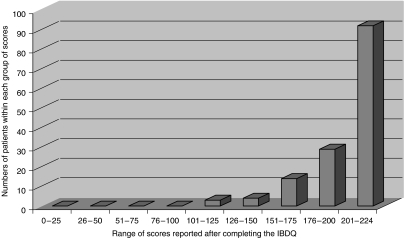
After radiotherapy for pelvic cancer, chronic gastrointestinal problems may affect quality of life (QOL) in 6-78% of patients. This variation may be due to true differences in outcome in different diseases, and may also represent the inadequacy of the scales used to measure radiotherapy-induced gastrointestinal side effects. The aim of this study was to assess whether outcome measures used for nonmalignant gastrointestinal disease are useful to detect gastrointestinal morbidity after radiotherapy. Results obtained from a Vaizey Incontinence questionnaire and a modified Inflammatory Bowel Disease questionnaire (IBDQ)--both patient completed--were compared to those from a staff administered Late Effects on Normal Tissue (LENT)--Subjective, Objective, Management and Analytic (SOMA) questionnaire in patients who had completed radiotherapy for a pelvic tumour at least 3 months previously. In all, 142 consecutive patients were recruited, 72 male and 70 female, median age 66 years (range 26-90 years), a median of 27 (range 3-258) months after radiotherapy. In total, 62 had been treated for a gynaecological, 58, a urological and 22, a gastrointestinal tract tumour. Of these, 21 had undergone previous gastrointestinal surgery and seven suffered chronic gastrointestinal disorders preceding their diagnosis of cancer. The Vaizey questionnaire suggested that 27% patients were incontinent for solid stools, 35% for liquid stools and 37% could not defer defaecation for 15 min. The IBDQ suggested that 89% had developed a chronic change in bowel habit and this change significantly affected 49% patients: 44% had more frequent or looser bowel movements, 30% were troubled by abdominal pain, 30% were troubled by bloating, 28% complained of tenesmus, 27% were troubled by their accidental soiling and 20% had rectal bleeding. At least 34% suffered emotional distress and 22% impairment of social function because of their bowels. The small intestine/colon SOMA median score was 0.1538 (range 0-1) and the rectal SOMA median score was 0.1428 (range 0-1). Pearson's correlations for the IBDQ score and small intestine/colon SOMA score was -0.630 (P<0.001), IBDQ and rectum SOMA -0.616 (P<0.001), IBDQ and Vaizey scores -0.599 (P<0.001), Vaizey and small intestine/colon SOMA 0.452 (P<0.001) and Vaizey and rectum SOMA 0.760 (P<0.001). After radiotherapy for a tumour in the pelvis, half of all patients develop gastrointestinal morbidity, which affects their QOL. A modified IBDQ and Vaizey questionnaire are reliable in assessing new gastrointestinal symptoms as well as overall QOL and are much easier to use than LENT SOMA.
Figures
References
-
- Anacak Y, Yalman D, Ozsaran Z, Haydaroglu A (2001) Late radiation effects to the rectum and bladder in gynecologic cancer patients: the comparison of LENT/SOMA and RTOG/EORTC late-effects scoring systems. Int J Radiat Oncol Biol Phys 50(5): 1107–1112 - PubMed
-
- Cella D, Chang C, Lai J, Webster K (2002) Advances in quality of life measurements in oncology patients. Semin Oncol 29(3 Suppl 8): 60–68 - PubMed
-
- Cheung W, Garratt A, Russell I, Williams J (2000) The UK IBDQ – a British version of the Inflammatory Bowel Disease questionnaire: development and validation. J Clin Epidemiol 53(3): 297–306 - PubMed
-
- Dahlberg M, Glimelius B, Graf W, Pahlman L (1998) Preoperative irradiation affects functional results after surgery for rectal cancer. Dis Colon Rectum 41(5): 543–551 - PubMed
-
- Faithfull S (1995) Just grin and bear it and hope that it will go away: coping with urinary symptoms from pelvic radiotherapy. Eur J Cancer Care (Engl) 4(4): 158–165 - PubMed
Publication types
MeSH terms
LinkOut - more resources
Full Text Sources
Medical
