


Identification of glyoxalase-I as a protein marker in a mouse model of extremes in trait anxiety
- PMID: 15858064
- PMCID: PMC6725100
- DOI: 10.1523/JNEUROSCI.0115-05.2005
Identification of glyoxalase-I as a protein marker in a mouse model of extremes in trait anxiety
Abstract
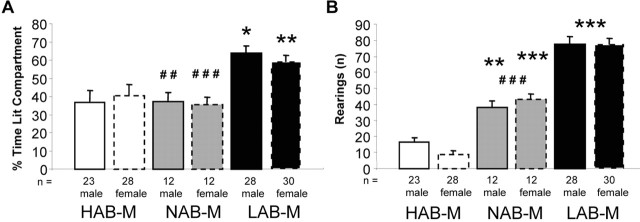
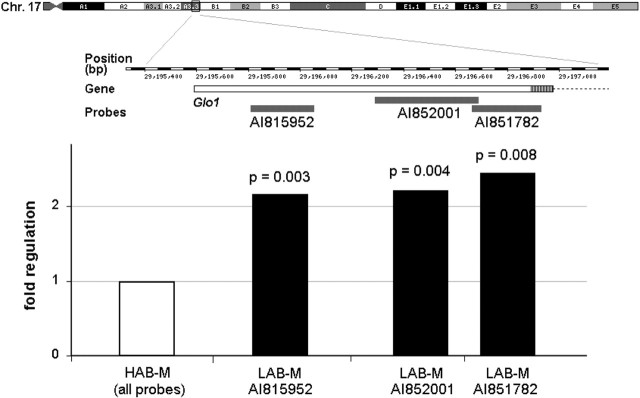
For >15 generations, CD1 mice have been selectively and bidirectionally bred for either high-anxiety-related behavior (HAB-M) or low-anxiety-related behavior (LAB-M) on the elevated plus-maze. Independent of gender, HAB-M were more anxious than LAB-M animals in a variety of additional tests, including those reflecting risk assessment behaviors and ultrasound vocalization, with unselected CD1 "normal" control (NAB-M) and cross-mated (CM-M) mice displaying intermediate behavioral scores in most cases. Furthermore, in both the forced-swim and tail-suspension tests, LAB-M animals showed lower scores of immobility than did HAB-M and NAB-M animals, indicative of a reduced depression-like behavior. Using proteomic and microarray analyses, glyoxalase-I was identified as a protein marker, which is consistently expressed to a higher extent in LAB-M than in HAB-M mice in several brain areas. The same phenotype-dependent difference was found in red blood cells with NAB-M and CM-M animals showing intermediate expression profiles of glyoxalase-I. Additional studies will examine whether glyoxalase-I has an impact beyond that of a biomarker to predict the genetic predisposition to anxiety- and depression-like behavior.
Figures




References
-
- Bai F, Li X, Clay M, Lindstrom T, Skolnick P (2001) Intra- and interstrain differences in models of “behavioral despair.” Pharmacol Biochem Behav 70: 187-192. - PubMed
-
- Benton D, Nastiti K (1988) The influence of psychotropic drugs on the ultrasonic calling of mouse pups. Psychopharmacology (Berl) 95: 99-102. - PubMed
-
- Branchi I, Santucci D, Puopolo M, Alleva E (2004) Neonatal behaviors associated with ultrasonic vocalizations in mice (mus musculus): a slowmotion analysis. Dev Psychobiol 44: 37-44. - PubMed
-
- Brunelli SA, Vinocur DD, Soo-Hoo D, Hofer MA (1997) Five generations of selective breeding for ultrasonic vocalization (USV) responses in N:NIH strain rats. Dev Psychobiol 31: 255-265. - PubMed
-
- Brush FR (2003) The Syracuse strains, selectively bred for differences in active avoidance learning, may be models of genetic differences in trait and state anxiety. Stress 6: 77-85. - PubMed
Publication types
MeSH terms
Substances
LinkOut - more resources
Full Text Sources
Medical
Molecular Biology Databases
Miscellaneous
