Assisted cough and pulmonary compliance in patients with Duchenne muscular dystrophy
- PMID: 15861496
- PMCID: PMC2823019
- DOI: 10.3349/ymj.2005.46.2.233
Assisted cough and pulmonary compliance in patients with Duchenne muscular dystrophy
Abstract
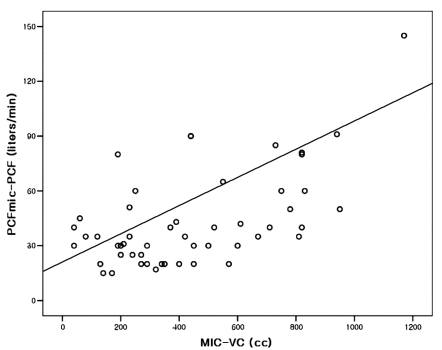
The aim of this study was to investigate the factors affecting cough ability, and to compare the assisted cough methods in patients with Duchenne muscular dystrophy (DMD). A total seventy-one male patients with DMD were included in the study. The vital capacity (VC) and maximum insufflation capacity (MIC) were measured. The unassisted peak cough flow (UPCF) and three different techniques of assisted peak cough flow were evaluated. UPCF measurements were possible for all 71 subjects. But when performing the three different assisted cough techniques, peak cough flows (PCFs) could be obtained from only 51 subjects. The mean value of MICs (1801 +/- 780 cc) was higher than that of VCs (1502 +/- 765 cc) (p< 0.01). All three assisted cough methods showed a significantly higher value than the unassisted method (F=80.92, p< 0.01). The manual assisted PCF under MIC (MPCFmic) significantly exceeded those produced by manual assisted PCF (MPCF) or PCF under MIC (PCFmic). The positive correlation between the MIC, VC difference (MIC-VC), and the difference between PCFmic and UPCF (PCFmic-UPCF) was seen (r=0.572, p< 0.01). The preservation of pulmonary compliance is important for the development of an effective cough as well as assisting the compression and expulsive phases. Thus, the clinical importance of the inspiratory phase and pulmonary compliance in assisting a cough should be emphasized.
Figures
References
-
- Inkley SR, Oldenburg FC, Vignos PJ. Pulmonary function in Duchenne muscular dystrophy related to stage of disease. Am J Med. 1974;56:297–306. - PubMed
-
- Estenne A, Heilporn A, Delhez L, Yernalt JC, Troyer A. Chest wall stiffness in patients with chronic respiratory muscle weakness. Am Rev Respir Dis. 1983;128:1002–1007. - PubMed
-
- Suarez AA, Pessolano FA, Monteiro SG, Ferreyra G, Capria ME, Mesa L, et al. Peak flow and peak cough flow in the evaluation of expiratory muscle weakness and bulbar impairment in patients with neuromuscular disease. Am J Phys Med Rehabil. 2002;81:506–511. - PubMed
-
- Scanlan C, Myslinski MJ. Bronchial hygiene therapy. In: Scanlan CL, Wilkins RL, Stoller JK, editors. Egan's Fundamentals of Respiratory Care. 7th ed. St. Louis: Mosby; 1999. pp. 792–793.
MeSH terms
LinkOut - more resources
Full Text Sources
Medical