. 2005 May;25(10):3896-905.
doi: 10.1128/MCB.25.10.3896-3905.2005.

Efficiency of RNA interference in the mouse hematopoietic system varies between cell types and developmental stages

Affiliations

Efficiency of RNA interference in the mouse hematopoietic system varies between cell types and developmental stages

Philipp Oberdoerffer et al. Mol Cell Biol. 2005 May.

Abstract

RNA interference (RNAi) is a naturally occurring posttranscriptional gene-silencing mechanism that has been adapted as a genetic tool for loss-of-function studies of a variety of organisms. It is more widely applicable than classical gene targeting and allows for the simultaneous inactivation of several homologous genes with a single transgene. Recently, RNAi has been used for conditional and conventional gene inactivation in mice. Unlike gene targeting, RNAi is a dynamic process, and its efficiency may vary both between cell types and throughout development. Here we demonstrate that RNAi can be used to target three separately encoded isoforms of the bcl-2 family gene bfl-1/A1 in a conditional manner in mice. The extent of gene inactivation varies between different cell types and is least efficient in mature lymphocytes. Our data suggest that RNAi is affected by factors beyond small interfering RNA-mRNA stoichiometry.


Figures

FIG. 1.
FIG. 1.
Targeted insertion of U6-STOP-shA1 cassette into the mouse HPRT locus. (A) Scheme of conditional shRNA expression construct U6-STOP-shA1 before and after Cre-mediated recombination. Since transcriptional initiation at +1, 26 bp downstream of the TATA box, is crucial for the precise generation of short RNAs by PolIII, and STOP deletion will leave one loxP site, the shA1-proximal loxP site was modified as shown. The first 3 bp of the loxP site (ATA) are part of the U6 TATA box (shown in capital letters), and the last 5 bp of the loxP site were replaced by the first 5 bp of the shRNA coding sequence (in grey letters), resulting in a mutant loxP site. U6lox stands for a modified U6 promoter that contains a loxP site downstream of the TATA box, STOP symbolizes a PolIII transcription termination cassette, and triangles represent loxP sites flanking the STOP cassette. (B) Targeting strategy for U6-STOP-shA1 insertion into the HPRT locus. Partial restriction endonuclease maps of the HPRT wild-type locus, the mutant HM1 locus lacking HPRT exons 1 and 2, and the targeted U6-STOP-shA1 locus are shown. Roman numerals indicate exons; hI, human exon 1. Dashed arrows depict fragment sizes as revealed with probe RSA. A Southern blot analysis to verify homologous recombination is shown. Genomic DNA from two targeted clones and HM1 ES cells was digested with StuI and hybridized to probe RSA. Expected fragments before and after homologous recombination are indicated. B, BamHI; S, StuI.
FIG. 2.
FIG. 2.
Efficient and Cre-dependent A1 knockdown in ES cells. (A) Since endogenous A1 expression is not detectable in ES cells, the indicated (A1)IRES-GFP transgenes were introduced into U6-STOP-shA1 ES cells. mutA1 stands for mutated A1 cDNA. This cDNA contains six mutations in the siA1 target sequence (shown in the lower part of the panel; mutations are shown in grey letters). siA1 targets the 3′ end of the A1 coding sequence. pA, rabbit β-globin poly(A). (B) FACS analysis of GFP expression in the indicated ES cell lines transduced (open histograms) or untransduced (shaded histograms) with adenoviral Cre (Av-Cre). GFP knockdown is detected only in ES cells bearing A1-IRES-GFP with a wild-type shA1 target sequence and depends on Cre expression. (C) PCR analysis to detect Cre-mediated deletion of the STOP cassette. A schematic of the targeted HPRT locus is shown, and half arrows depict primers flanking the inserted U6-STOP-shA1 cassette. The arrow represents the human HPRT promoter, the grey box depicts human exon 1, and the white box depicts mouse exon 2; the map is not drawn to scale. PCR results are shown for transduced and untransduced ES cells transgenic for IRES-GFP (IRES), A1-IRES-GFP (A1), or mutA1-IRES-GFP (mutA1). A1-IRES-GFP transgenic ES cells were sorted according to GFP expression levels. DNA from GFPhigh cells and GFPlow cells was also subjected to PCR. The expected sizes for PCR fragments before (U6-STOP-shA1) and after (U6Δ-shA1) STOP deletion are indicated. The asterisks indicate hybrids between U6-STOP-shA1 and U6Δ-shA1 fragments. (D) Northern blot analysis of siA1 expression in transduced and untransduced ES cells carrying the indicated transgene. Total RNA (20 μg per lane) was loaded. Synthetic ds siRNA of identical sequence was loaded as indicated to estimate siRNA expression levels. An EtBr staining of the gel before Northern blotting served as a loading control. (E) Northern blot analysis of siA1 sense (siA1) and siA1 antisense(siA1-as) strand expression in transduced and untransduced mutA1-IRES-GFP transgenic U6-STOP-shA1 ES cells. Total RNA (20 μg per lane) was loaded. Synthetic ds siRNA served as an internal control. EtBr staining was performed as a loading control. (F) Northern blot analysis of (A1)IRES-GFP mRNA expression levels before and after transduction. Total RNA (20 μg per lane) was loaded. Cre-transduced A1-IRES-GFP transgenic ES cells were sorted according to GFP expression levels, and total RNA from 106 cells was loaded for GFPhigh and GFPlow samples. Targeted ES cells without IRES-GFP transgenes served as a negative control (−). Blots were hybridized to a GFP probe. To account for loading differences, blots were stripped and rehybridized to a GAPDH probe. The efficiency of siA1-mediated A1-IRES-GFP knockdown was determined using a phosphorimager.
FIG. 3.
FIG. 3.
Tightly regulated and reproducible siA1 expression in vivo. (A) Northern blot analysis of siA1 expression in U6-STOP-shA1 × CD19-cre mice and U6Δ-shA1 mice. Ten or 5 μg (*) of total RNA from unsorted thymocytes or MACS-enriched, ∼95% pure splenic B cells was loaded per lane. Synthetic ds siRNA served as an internal control. An EtBr staining of the gel before Northern blotting is shown as a loading control. (B) Semiquantitative PCR to determine deletion efficiency in bone marrow (BM) and splenic B cells from U6-STOP-shA1 × CD19-cre mice (bottom panel). CD19+ B cells were MACS-enriched, and genomic DNA was PCR amplified as described in the legend for Fig. 2C. The top panel represents a titration using DNA from U6-STOP-shA1 and U6Δ-shA1 mice mixed at the indicated ratios.
FIG. 4.
FIG. 4.
Cell-type-specific differences in RNAi efficiency. (A) QRT-PCR analysis to determine expression of all A1 isoforms in thymocytes and FACS-sorted splenic B and T cells. Relative A1 expression levels are shown as the ratios of A1 mRNA to L32 mRNA for wild-type (light grey), U6Δ-shA1 (black), and U6-STOP-shA1 × CD19-cre mice (dark grey). (B) Downregulation of A1 mRNA in indicated cell types from indicated mouse strains. Black circles represent U6-STOP-shA1 × CD19-cre mice, and white symbols represent individual U6Δ-shA1 mice. Light grey bars show the average percentages of wild-type A1 mRNA levels. (C) Distribution of A1 isoforms A1a (black, not detected), A1b (grey), and A1d (white) in thymocytes and splenic B cells from U6Δ-shA1 mice or wild-type littermates. A1 cDNA from eachsample was PCR amplified using primers A1-s and A1-as (see Materials and Methods) and subcloned into a TOPO-TA cloning vector (Invitrogen). Individual clones were sequenced to distinguish between A1 isoforms.
FIG. 5.
FIG. 5.
Differences in RNAi efficiency are not determined solely by the siRNA-to-mRNA ratio. Real-time PCR analysis of A1 mRNA levels (A) and Northern blot analysis for siA1 expression (B) in unstimulated (ex vivo) or anti-CD3/anti-CD28 stimulated (CD3/CD28) thymocytes from wild-type (light grey), U6Δ-shA1 (black), and U6-STOP-shA1 × CD19-cre mice (dark grey).
FIG. 6.
FIG. 6.
Comparison of siRNA-mRNA stoichiometry between mature lympocytes, macrophages, and ES cells. (A) Analysis of siA1 expression and A1 mRNA knockdown in splenic B cells from U6-STOP-shA1 × CD19-cre mice and sorted GFPhigh or GFPlow A1-IRES-GFP transgenic U6-STOP-shA1 ES cells (Fig. 2). A1 mRNA was detected by QRT-PCR as described above. To detect siA1, 20 μg or 10 μg (*) of the respective samples was analyzed by Northern blotting. Synthetic ds siRNA served as an internal control. Each histogram bar corresponds to the sample on the Northern blot shown below it. (B) QRT-PCR analysis of A1 mRNA expression levels in resting, mature BMDΜ from U6Δ-shA1 mice (black) or wild-type controls (grey). (C) Comparison of A1 mRNA levels in wild-type BMDM and splenic B cells (CD19+) by QRT-PCR. (D) Northern blot analysis of siA1 expression levels in BMDM and splenic B cells. Total RNA (10 μg per lane) was loaded. Synthetic ds siRNA served as an internal control. An EtBr staining of the gel before blotting is shown as a loading control.
FIG. 7.
FIG. 7.
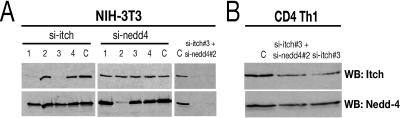
Inefficient RNAi in mature T cells is not limited to siA1. (A) NIH 3T3 cells were retrovirally transduced with sets of siRNA expression vectors directed against Itch (si-itch 1 to 4) or Nedd-4 (si-nedd4 1 to 4) or with a control vector encoding a scrambled, unspecific siRNA (C). Equal amounts of cell lysates were analyzed by Western blotting for Itch (top panel) and Nedd-4 expression (bottom panel). Nedd-4 serves as a loading control for si-itch samples and vice versa. The most efficient RNAi constructs (si-itch 3 and si-nedd4 2) were used for simultaneous infection in two samples as indicated. (B) Ex vivo-isolated CD4 T cells were transduced with si-itch 3 alone or si-itch 3 and si-nedd4 2 simultaneously as indicated. The control is as described for panel A. Cells were kept in Th1-conditioned medium and analyzed 1 week after retroviral infection. Equal amounts of cell lysates were analyzed by Western blotting (WB) for Itch (top panel) and Nedd-4 expression (bottom panel).
FIG. 8.
FIG. 8.
Expression of argonaute genes in mature lymphocytes and BMDM. (A) RT-PCR for ago 1 to 4. β-Actin was amplified as a loading control. Total RNA from MACS-purified CD19+ and Thy1+ splenic lymphocytes was analyzed for expression of the indicated mRNAs. (B) QRT-PCR for ago2. Relative ago2 expression levels are shown as the ratio of ago2 to L32 for FACS-sorted splenic B cells, thymocytes, and cultured BMDM.
FIG. 9.
FIG. 9.
Thymocyte subsets show efficient knockdown of A1 mRNA but no changes in their distribution. (A) Thymocyte numbers from U6Δ-shA1 (n = 3) and wild-type (n = 4) mice. (B) FACS analysis of thymocytes from wild-type and U6Δ-shA1 mice. Thymocytes were stained for CD4 and CD8 (top panels). To stain for DN thymocyte subsets, cells positive for CD4, CD8, CD19, and NK1.1 were excluded from the analysis. Negative cells were analyzed for CD25 and CD44 expression (bottom panels). The percentage of each subset is indicated. This result is representative of three independent experiments. (C) Sizes of DN1 (CD44+/CD25), DN2 (CD44+/CD25+), DN3 (CD44/CD25+), and DN4 (CD44/CD25) subsets in U6Δ-shA1 mice relative to WT littermates. DN subsets were identified by FACS as described for panel B. The percentage represents the ratio of U6Δ-shA1 to WT DN subset. Results are based on three independent experiments. (D) QRT-PCR to determine A1 mRNA levels in sorted CD25+/CD44 DN3 and CD25/C44 DN4 thymocyte subsets. Percentages of wild-type A1 mRNA levels are indicated. Unsorted thymocytes (Thymus) represent predominantly CD4+/CD8+ DP thymocytes. The scheme at the top of the panel depicts the pre-TCR-induced developmental progression from DN3 to DN4 via a proliferating and hence large DN3 subpopulation (DN3L). (E) RNase protection assay of total thymocytes to determine expression levels of several bcl-2 family genes. Portions of total RNA (2.5 μg) were loaded for each sample; identities of the protected bands are indicated.

References

    1. Bassing, C. H., K. F. Chua, J. Sekiguchi, H. Suh, S. R. Whitlow, J. C. Fleming, B. C. Monroe, D. N. Ciccone, C. Yan, K. Vlasakova, D. M. Livingston, D. O. Ferguson, R. Scully, and F. W. Alt. 2002. Increased ionizing radiation sensitivity and genomic instability in the absence of histone H2AX. Proc. Natl. Acad. Sci. USA 99:8173-8178. - PMC - PubMed
    1. Bernstein, E., A. A. Caudy, S. M. Hammond, and G. J. Hannon. 2001. Role for a bidentate ribonuclease in the initiation step of RNA interference. Nature 409:363-366. - PubMed
    1. Bronson, S. K., E. G. Plaehn, K. D. Kluckman, J. R. Hagaman, N. Maeda, and O. Smithies. 1996. Single-copy transgenic mice with chosen-site integration. Proc. Natl. Acad. Sci. USA 93:9067-9072. - PMC - PubMed
    1. Brummelkamp, T. R., R. Bernards, and R. Agami. 2002. A system for stable expression of short interfering RNAs in mammalian cells. Science 296:550-553. - PubMed
    1. Das, G., D. Henning, D. Wright, and R. Reddy. 1988. Upstream regulatory elements are necessary and sufficient for transcription of a U6 RNA gene by RNA polymerase III. EMBO J. 7:503-512. - PMC - PubMed

Publication types

MeSH terms

LinkOut - more resources