. 2005 May;46(5):807-15.

Structural requirements for in vivo detection of cell death with 99mTc-annexin V

Affiliations

Structural requirements for in vivo detection of cell death with 99mTc-annexin V

Jonathan F Tait et al. J Nucl Med. 2005 May.

Abstract

(99m)Tc-Annexin V is used to image cell death in vivo via high-affinity binding to exposed phosphatidylserine. We investigated how changes in membrane-binding affinity, molecular charge, and method of labeling affected its biodistribution in normal mice and its uptake in apoptotic tissues.

Methods: An endogenous Tc chelation site (Ala-Gly-Gly-Cys-Gly-His) was added to the N-terminus of annexin V to create annexin V-128. The membrane-binding affinity of annexin V-128 was then progressively reduced by 1-4 mutations in calcium-binding sites. In addition, mutations were made in other residues that altered molecular charge without altering membrane-binding affinity. All mutant proteins were labeled with (99m)Tc at the same N-terminal endogenous chelation site. Wild-type annexin V was also labeled with (99m)Tc after derivatization with hydrazinonicotinamide (HYNIC). Radiolabeled proteins were tested for biodistribution in normal mice and in mice treated to induce apoptosis of the liver.

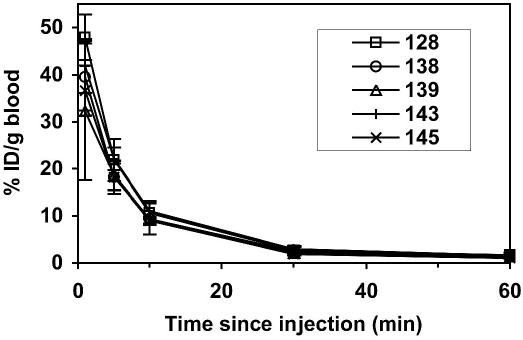
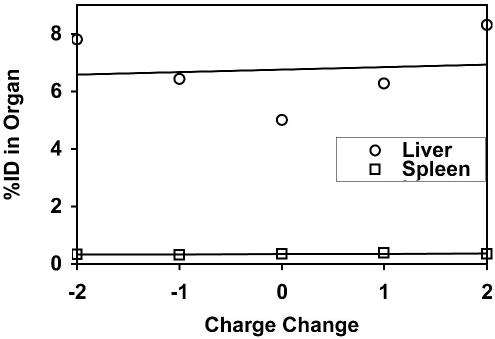
Results: Comparison of (99m)Tc-annexin V-128 with (99m)Tc-HYNIC-annexin V showed that the protein labeled at the endogenous chelation site had the same or higher uptake in apoptotic tissues, while showing 88% lower renal uptake at 60 min after injection. The blood clearance of annexin V was unaffected by changes in either the membrane-binding affinity or the molecular charge. Kidney uptake was unaffected by changes in binding affinity. In marked contrast, uptake in normal liver and spleen decreased markedly as affinity decreased. The same pattern was observed in animals treated with cycloheximide to induce apoptosis. Control experiments with charge mutants showed that the effects seen with the affinity mutants were not due to the concomitant change in molecular charge that occurs in these mutants.

Conclusion: (a) All four domains of annexin V are required for optimal uptake in apoptotic tissues; molecules with only 1 or 2 active domains are unlikely to be suitable for imaging of cell death in vivo. (b) Uptake in normal liver and spleen is specific (dependent on phosphatidylserine-binding affinity), whereas renal uptake is nonspecific. (c) (99m)Tc-Annexin V-128 detects cell death as well as (99m)Tc-HYNIC-annexin V, while showing 88% less renal retention of radioactivity due to much more rapid urinary excretion of radioactivity.


Figures
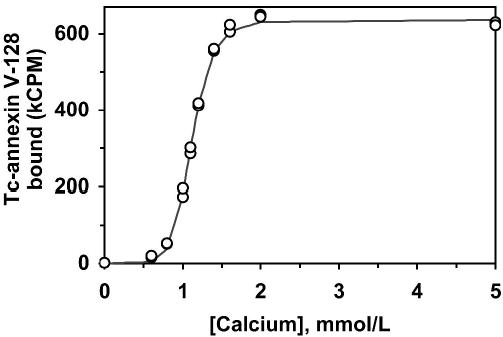
FIGURE 1
FIGURE 1
Calcium titration of 99mTc-annexin V-128 binding to RBC with exposed PS. The line is the fitted function used to determine the EC50 and Hill coefficient values, from which the logarithm of the binding constant (pK value) is calculated (20).
FIGURE 2
FIGURE 2
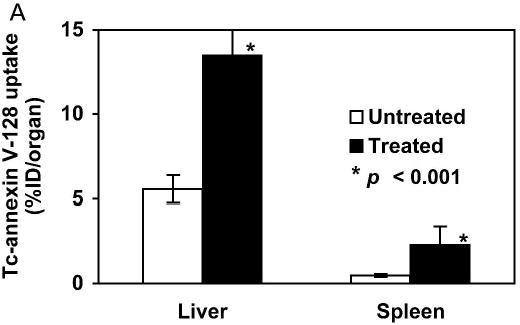
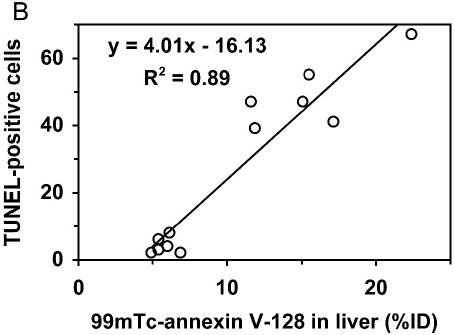
(A) Uptake of 99mTc-annexin V-128 in liver and spleen of mice treated with cycloheximide. Groups of six mice were either untreated or treated with cycloheximide (50 mg/kg intraperitoneal). Two hours later, 99mTc-annexin V-128 was injected via the tail vein, and organs were harvested 60 min after the injection. Significance of the difference between treated and untreated animals was assessed by a two-tailed t-test assuming unequal variances; error bars indicate SD. (B) Correlation between TUNEL positivity and 99mTc-annexin V-128 uptake in liver for treated and untreated mice (six in each group).
FIGURE 2
FIGURE 2
(A) Uptake of 99mTc-annexin V-128 in liver and spleen of mice treated with cycloheximide. Groups of six mice were either untreated or treated with cycloheximide (50 mg/kg intraperitoneal). Two hours later, 99mTc-annexin V-128 was injected via the tail vein, and organs were harvested 60 min after the injection. Significance of the difference between treated and untreated animals was assessed by a two-tailed t-test assuming unequal variances; error bars indicate SD. (B) Correlation between TUNEL positivity and 99mTc-annexin V-128 uptake in liver for treated and untreated mice (six in each group).
FIGURE 3
FIGURE 3
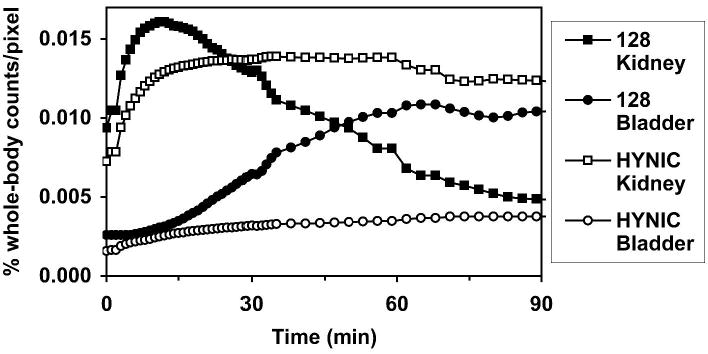
Serial dynamic imaging of kidney and bladder uptake of 99mTc-annexin V-128 and 99mTc-HYNIC-annexin V. Each curve is the mean of four animals; the coefficient of variation at each point is approximately 20%.
FIGURE 4
FIGURE 4
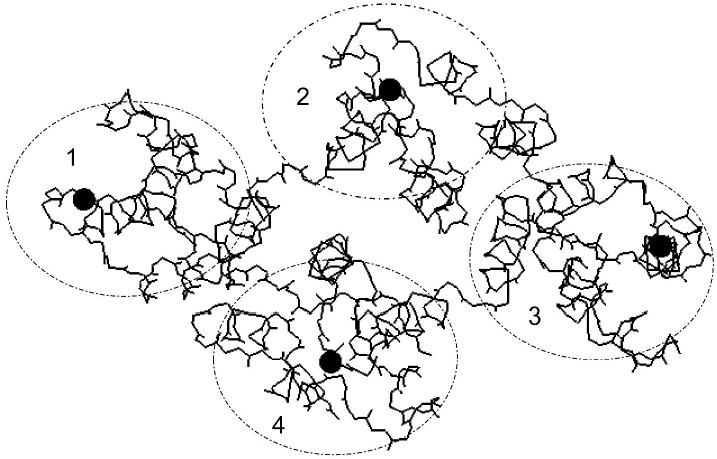
Schematic view of the three-dimensional structure of annexin V-128. The view is downward onto the membrane binding face of the protein. The four domains of the protein are numbered, and their approximate locations are indicated by the ellipses. Black spheres indicate the approximate locations of calcium ions bound to the AB-helix calcium binding sites that have been mutated in this study. The polypeptide backbone is shown as a continuous black line. The location of the N-terminal technetium chelation site can not be seen in this projection because it is on the opposite face of the molecule, beneath the plane of the page. (Structure is based on preliminary coordinates provided by Dr. Barbara Seaton (personal communication.)
FIGURE 5
FIGURE 5
Blood clearance of affinity mutants. Groups of four mice received intravenous injections of Tc-labeled protein at time zero. Results are given as mean ± SD for each mutant.
FIGURE 6
FIGURE 6
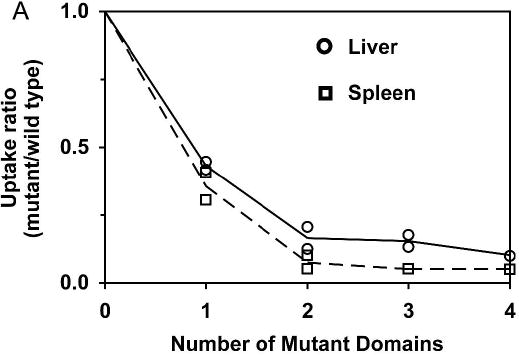
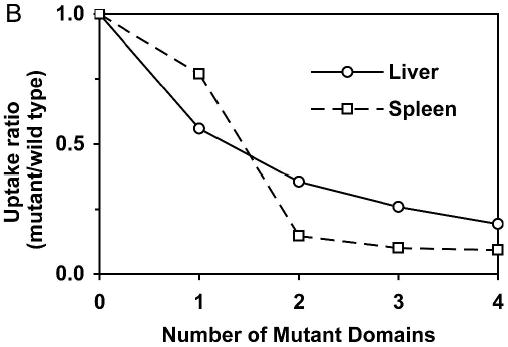
(A) Dose-response relationship between number of affinity-reducing mutations and liver and spleen uptake in mice treated with cycloheximide. Each affinity mutant in Table 2 was tested in groups of 4–5 mice. Mean values are given for liver (○) and spleen (□) uptake, normalized to the uptake observed with wild-type protein. Mutants tested were 128 (wild-type/zero mutations); 131 and 138 (one mutation); 136 and 139 (two mutations); 137 and 143 (three mutations); 145 (four mutations). (B) Dose-response relationship between number of affinity-reducing mutations and liver and spleen uptake in normal mice.
FIGURE 6
FIGURE 6
(A) Dose-response relationship between number of affinity-reducing mutations and liver and spleen uptake in mice treated with cycloheximide. Each affinity mutant in Table 2 was tested in groups of 4–5 mice. Mean values are given for liver (○) and spleen (□) uptake, normalized to the uptake observed with wild-type protein. Mutants tested were 128 (wild-type/zero mutations); 131 and 138 (one mutation); 136 and 139 (two mutations); 137 and 143 (three mutations); 145 (four mutations). (B) Dose-response relationship between number of affinity-reducing mutations and liver and spleen uptake in normal mice.
FIGURE 7
FIGURE 7
Effect of molecular charge on liver and spleen uptake of Tc-annexin V-128 in normal mice. Each charge mutant in Table 2 was tested in groups of 4–5 mice. Mean values are given for liver (○) and spleen (□) uptake.
FIGURE 8
FIGURE 8
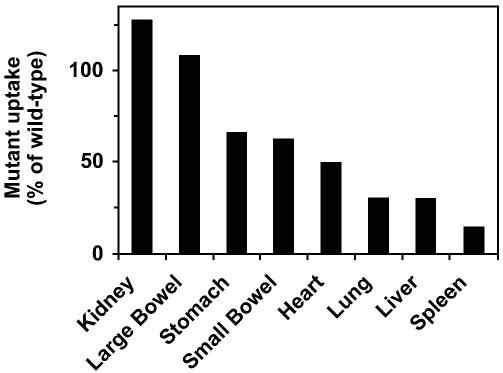
Organ uptake of affinity mutants in normal mice. The triple and quadruple mutants in Table 2 (annexin V-137,-143, and -145) were tested in groups of 4–5 mice for each mutant. Results were averaged for all three mutant proteins and expressed as a percentage of the organ uptake observed with the wild-type protein (annexin V-128).

References

    1. Blankenberg FG, Katsikis PD, Tait JF, et al. In vivo detection and imaging of phosphatidylserine expression during programmed cell death. Proc Natl Acad Sci U S A. 1998;95:6349–6354. - PMC - PubMed
    1. Blankenberg FG, Katsikis PD, Tait JF, et al. Imaging of apoptosis (programmed cell death) with 99mTc annexin V. J Nucl Med. 1999;40:184–191. - PubMed
    1. Thiagarajan P, Tait JF. Binding of annexin V/placental anticoagulant protein I to platelets. Evidence for phosphatidylserine exposure in the procoagulant response of activated platelets. J Biol Chem. 1990;265:17420–17423. - PubMed
    1. Fadok VA, Voelker DR, Campbell PA, Cohen JJ, Bratton DL, Henson PM. Exposure of phosphatidylserine on the surface of apoptotic lymphocytes triggers specific recognition and removal by macrophages. J Immunol. 1992;148:2207–2216. - PubMed
    1. Huber R, Berendes R, Burger A, et al. Crystal and molecular structure of human annexin V after refinement. Implications for structure, membrane binding and ion channel formation of the annexin family of proteins. J Mol Biol. 1992;223:683–704. - PubMed

Publication types

MeSH terms

LinkOut - more resources