


Clinician assessment of the driving competence of patients with dementia
- PMID: 15877559
- PMCID: PMC3292185
- DOI: 10.1111/j.1532-5415.2005.53265.x
Clinician assessment of the driving competence of patients with dementia
Abstract
Objectives: To determine the validity and reliability of clinician ratings of the driving competence of patients with mild dementia.
Design: Observational study of a cross-section of drivers with mild dementia based on chart review by clinicians with varying types of expertise and experience.
Setting: Outpatient dementia clinic.
Participants: Fifty dementia subjects from a longitudinal study of driving and dementia.
Measurements: Each clinician reviewed information from the clinic charts and the first study visit. The clinician then rated the drivers as safe, marginal, or unsafe. A professional driving instructor compared these ratings with total driving scores on a standardized road test and categorical ratings of driving competence. Clinicians also completed a visual analog scale assessment of variables that led to their determinations of driving competence.
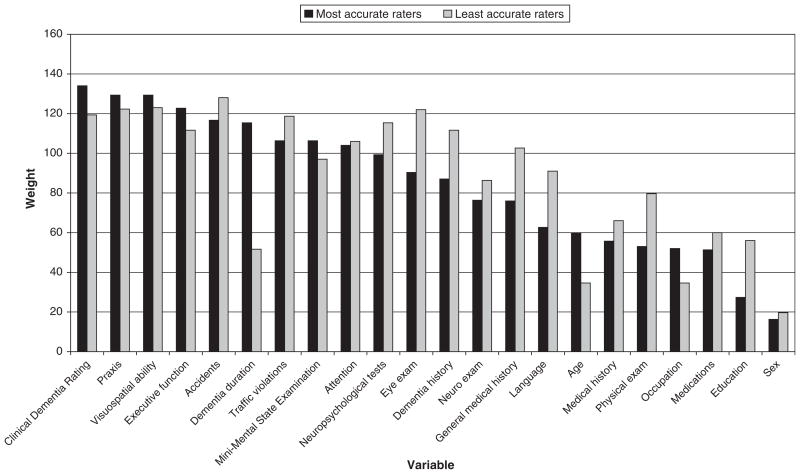
Results: Accuracy of clinician ratings ranged from 62% to 78% for the instructor's global rating of safe versus marginal or unsafe. In general, there was moderate accuracy and interrater reliability. Accuracy could have been improved in the least-accurate raters by greater attention to dementia duration and severity ratings, as well as less reliance on the history and physical examination. The most accurate predictors were clinicians specially trained in dementia assessment, who were not necessarily the most experienced in their years of clinical experience.
Conclusion: Although a clinician may be able to identify many potentially hazardous drivers, accuracy is insufficient to suggest that a clinician's assessment alone is adequate to determine driving competence in those with mild dementia.
Figures
References
-
- Wild K, Cotrell V. Identifying driving impairment in Alzheimer disease: A comparison of self and observer reports versus driving evaluation. Alzheimer Dis Assoc Disord. 2003;17:27–34. - PubMed
-
- Gilley DW, Wilson RS, Bennett DA, et al. Cessation of driving and unsafe motor vehicle operation by dementia patients. Arch Intern Med. 1991;151:941–946. - PubMed
-
- Hunt LA, Morris JC, Edwards D, et al. Driving performance in persons with mild senile dementia of the Alzheimer type. J Am Geriatr Soc. 1993;41:747–753. - PubMed
-
- Bedard M, Molloy DW, Lever JA. Factors associated with motor vehicle crashes in cognitively impaired older adults. Alzheimer Dis Assoc Disord. 1998;12:135–139. - PubMed
Publication types
MeSH terms
Grants and funding
LinkOut - more resources
Full Text Sources
Medical
