Fordyce granules and hereditary non-polyposis colorectal cancer syndrome
- PMID: 15879014
- PMCID: PMC1774669
- DOI: 10.1136/gut.2005.064881
Fordyce granules and hereditary non-polyposis colorectal cancer syndrome
Abstract
Background: Germline mutations in mismatch repair (MMR) genes are found in only about half of clinically diagnosed families with hereditary non-polyposis colorectal cancer syndrome (HNPCC) (or Lynch syndrome). Early identification of gene carriers is essential to reduce cancer incidence and overall mortality.
Aims: Recent evidence indicates an increase in size and number of sebaceous glands following activation of the hedgehog pathway, a crucial signalling pathway for animal development that is aberrantly activated in several types of cancer. Here we sought to assess a possible association between Fordyce granules (FGs-that is, ectopic sebaceous glands on the oral mucosa) and HNPCC.
Methods: A total of 15 members of five different genetically unrelated HNPCC kindreds (MLH1 gene mutation n = 8; undetectable MLH1 protein at immunochemistry n = 4; clinical diagnosis n = 3) and 630 genetically unrelated age and sex matched healthy controls were examined. Following examination of the oral mucosa surface, subjects were categorised as either FGs positive or FGs negative.
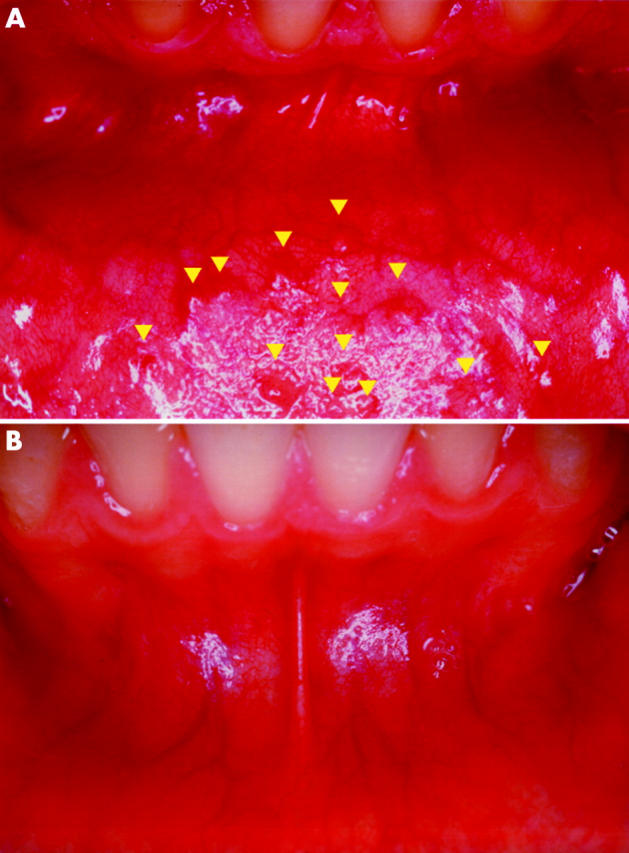
Results: Evidence of FGs was significantly associated with HNPCC (13/15 (86.7%) affected patients v 6/630 (0.95%) controls; p<0.0001), with a relative risk of 91.0 (95% confidence interval 40.05-206.76). The observed difference remained significant when carriers of germline mutations in MMR genes were considered (8/15 v 6/630; p<0.0001). The most common site for the FGs in HNPCC patients was the lower gingival and vestibular oral mucosa.
Conclusions: Our findings suggest that a previously unrecognised activation of the sebaceous glands system occurs in HNPCC. The observation could be of value for attending physicians in identifying affected families and/or increase the accuracy of the currently available molecular genetics screenings.
Figures
References
-
- Lynch HT, de la Chapelle A. Hereditary colorectal cancer. N Engl J Med 2003;348:919–32. - PubMed
-
- Lynch HT, Lynch PM, Pester JA, et al. Sebaceous neoplasia and visceral cancer (Torre’s syndrome) and its relationship to the cancer family syndrome. In: Lynch HT, Fusaro RM, eds. Cancer-associated genodermatoses. New York: van Nostrand Reinhold, 1982:366–93.
MeSH terms
Substances
LinkOut - more resources
Full Text Sources
Molecular Biology Databases