


Cellulose utilization by Clostridium thermocellum: bioenergetics and hydrolysis product assimilation
- PMID: 15883376
- PMCID: PMC1129095
- DOI: 10.1073/pnas.0408734102
Cellulose utilization by Clostridium thermocellum: bioenergetics and hydrolysis product assimilation
Erratum in
- Proc Natl Acad Sci U S A. 2005 Jun 28;102(26):9430
Abstract
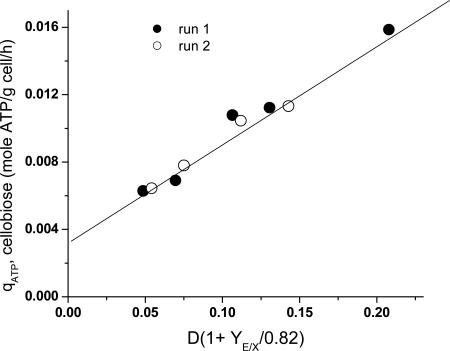
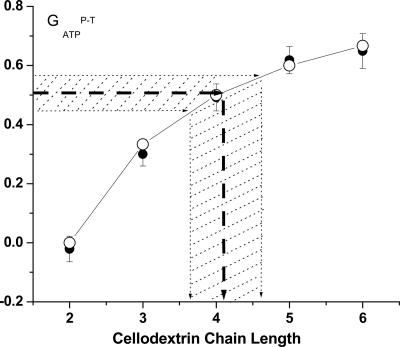
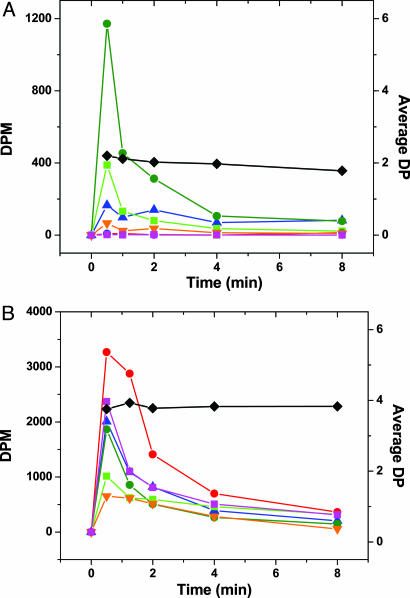
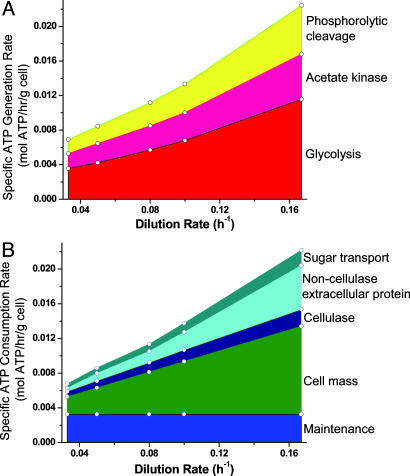
The bioenergetics of cellulose utilization by Clostridium thermocellum was investigated. Cell yield and maintenance parameters, Y(X/ATP)True = 16.44 g cell/mol ATP and m = 3.27 mmol ATP/g cell per hour, were obtained from cellobiose-grown chemostats, and it was shown that one ATP is required per glucan transported. Experimentally determined values for G(ATP)P-T (ATP from phosphorolytic beta-glucan cleavage minus ATP for substrate transport, mol ATP/mol hexose) from chemostats fed beta-glucans with degree of polymerization (DP) 2-6 agreed well with the predicted value of (n-2)/n [corrected] (n = mean cellodextrin DP assimilated). A mean G(ATP)(P-T) value of 0.52 +/- 0.06 was calculated for cellulose-grown chemostat cultures, corresponding to n = 4.20 +/- 0.46. Determination of intracellular beta-glucan radioactivity resulting from 14C-labeled substrates showed that uptake is different for cellulose and cellobiose (G2). For 14C-cellobiose, radioactivity was greatest for G2; substantially smaller but measurable for G1, G3, and G4; undetectable for G5 and G6; and n was approximately 2. For 14C-cellulose, radioactivity was greatest for G5; lower but substantial for G6, G2, and G1; very low for G3 and G4; and n was approximately 4. These results indicate that: (i) C. thermocellum hydrolyzes cellulose by a different mode of action from the classical mechanism involving solubilization by cellobiohydrolase; (ii) bioenergetic benefits specific to growth on cellulose are realized, resulting from the efficiency of oligosaccharide uptake combined with intracellular phosphorolytic cleavage of beta-glucosidic bonds; and (iii) these benefits exceed the bioenergetic cost of cellulase synthesis, supporting the feasibility of anaerobic biotechnological processing of cellulosic biomass without added saccharolytic enzymes.
Figures
References
-
- Berner, R. A. (2003) Nature 426, 323-326. - PubMed
-
- Melillo, J. M., Steudler, P. A., Aber, J. D., Newkirk, K., Lux, H., Bowles, F. P., Catricala, C., Magill, A., Ahrens, T. & Morrisseau, S. (2002) Science 298, 2173-2176. - PubMed
-
- Russell, J. B. & Rychlik, J. L. (2001) Science 292, 1119-1122. - PubMed
-
- Kamm, B. & Kamm, M. (2004) Appl. Microbiol. Biotechnol. 64, 137-145. - PubMed
-
- Wahlaud, B., Yan, J. & Westermark, M. (2004) Biomass Bioenerg. 26, 531-544.
Publication types
MeSH terms
Substances
LinkOut - more resources
Full Text Sources
Other Literature Sources
Research Materials
Miscellaneous
