


Do patients with non-ulcer dyspepsia respond differently to Helicobacter pylori eradication treatments from those with peptic ulcer disease? A systematic review
- PMID: 15884111
- PMCID: PMC4305905
- DOI: 10.3748/wjg.v11.i18.2726
Do patients with non-ulcer dyspepsia respond differently to Helicobacter pylori eradication treatments from those with peptic ulcer disease? A systematic review
Abstract
Aim: It is controversial whether patients with non-ulcer dyspepsia (NUD) respond differently to Helicobacter pylori (H pylori) eradication treatment than those with peptic ulcer disease (PUD). To review the evidence for any difference in H pylori eradication rates between PUD and NUD patients.
Methods: A literature search for full articles and meeting abstracts to July 2004 was conducted. We included studies evaluating the efficacy of a proton pump inhibitor (P) or ranitidine bismuth citrate (RBC) plus two antibiotics of clarithromycin (C), amoxicillin (A), metronidazole (M), or P-based quadruple therapies for eradicating the infection.
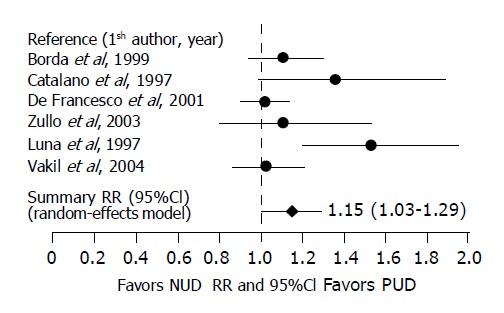
Results: Twenty-two studies met the criteria. No significant difference in eradication rates was found between PUD and NUD patients when treated with 7-d RBCCA, 10-d PCA or P-based quadruple therapies. When the 7-d PCA was used, the pooled H pylori eradication rate was 82.1% (431/525) and 72.6% (448/617) for PUD and NUD patients, respectively, yielding a RR of 1.15 (95%CI 1.01-1.29). However, the statistically significant difference was seen only in meeting abstracts, but not in full publications.
Conclusion: There is no convincing evidence to suggest that NUD patients respond to H pylori eradication treatments differently from those with PUD, although a trend exists with the 7-d PCA therapy.
Figures
References
-
- Peterson WL, Fendrick AM, Cave DR, Peura DA, Garabedian-Ruffalo SM, Laine L. Helicobacter pylori-related disease: guidelines for testing and treatment. Arch Intern Med. 2000;160:1285–1291. - PubMed
-
- Lam SK, Talley NJ. Report of the 1997 Asia Pacific Consensus Conference on the management of Helicobacter pylori infection. J Gastroenterol Hepatol. 1998;13:1–12. - PubMed
-
- Malfertheiner P, Mégraud F, O'Morain C, Hungin AP, Jones R, Axon A, Graham DY, Tytgat G. Current concepts in the management of Helicobacter pylori infection--the Maastricht 2-2000 Consensus Report. Aliment Pharmacol Ther. 2002;16:167–180. - PubMed
Publication types
MeSH terms
Substances
LinkOut - more resources
Full Text Sources
Medical
Miscellaneous
