. 2005 Jun;54(6):782-8.
doi: 10.1136/gut.2004.056358.

Patient defined dichotomous end points for remission and clinical improvement in ulcerative colitis

Affiliations

Patient defined dichotomous end points for remission and clinical improvement in ulcerative colitis

P D R Higgins et al. Gut. 2005 Jun.

Abstract

Background and aims: Ulcerative colitis disease activity indices offer good statistical power but small changes in these indices may not be clinically important. There are no validated definitions of remission or of significant improvement for these indices. The use of clinically important end points would strengthen the validity of study outcomes. Our aims were to identify objective end points in standard disease activity indices for remission and for improvement in ulcerative colitis.

Methods: Sixty six consecutive patients with ulcerative colitis provided information about remission status and their disease activity. At a return visit 1-14 months later, these patients provided information about the change in their disease activity, and non-invasive indices were measured.

Results: Specific objective end points for determining remission with four standard indices and a quality of life instrument were determined (St Mark's <3.5, ulcerative colitis disease activity index <2.5, simple clinical colitis activity index (SCCAI) <2.5, Seo <120, and inflammatory bowel disease quality of life index (IBDQ) >205). These cut offs also identified patients who met a regulatory definition of remission. Specific objective end points for clinical improvement in two non-invasive indices and a quality of life instrument were determined with good sensitivity and specificity (SCCAI decrease >1.5, Seo decrease >30, IBDQ increase >20).

Conclusions: We found specific cut off values for disease activity indices that identify patients who have significantly improved or achieved remission in an objective, sensitive, and specific manner. These cut offs should help in the interpretation of the outcomes of clinical trials in ulcerative colitis.


Figures
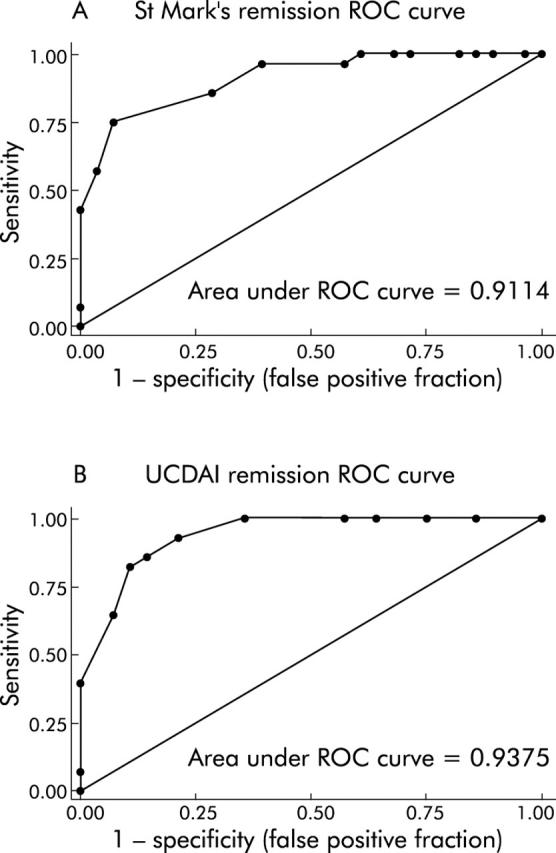
Figure 1
Figure 1
Receiver operating characteristic (ROC) curves demonstrate that invasive indices predict patient defined remission accurately. ROC curves (sensitivity v 1−specificity plots) for the St Mark’s index (A) and ulcerative colitis disease activity index (UCDAI) (B) for the end point of remission are presented. Areas under the ROC curve were 0.91 and 0.94, respectively.
Figure 2
Figure 2
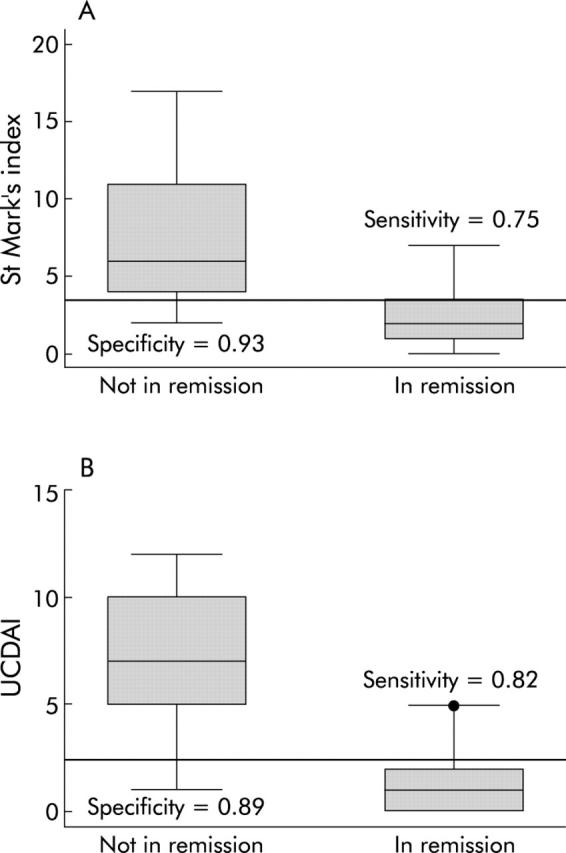
Optimal remission cut offs for the invasive indices are sensitive and specific. The cut offs were chosen to optimise sensitivity and specificity for remission. For the St Mark’s index (A), this cut off was <3.5 points, resulting in a sensitivity of 0.75 and a specificity of 0.93 for patient defined remission. For the ulcerative colitis disease activity index (UCDAI) (B), the optimal cut off was <2.5 points, resulting in a sensitivity of 0.82 and a specificity of 0.89 for patient defined remission.
Figure 3
Figure 3
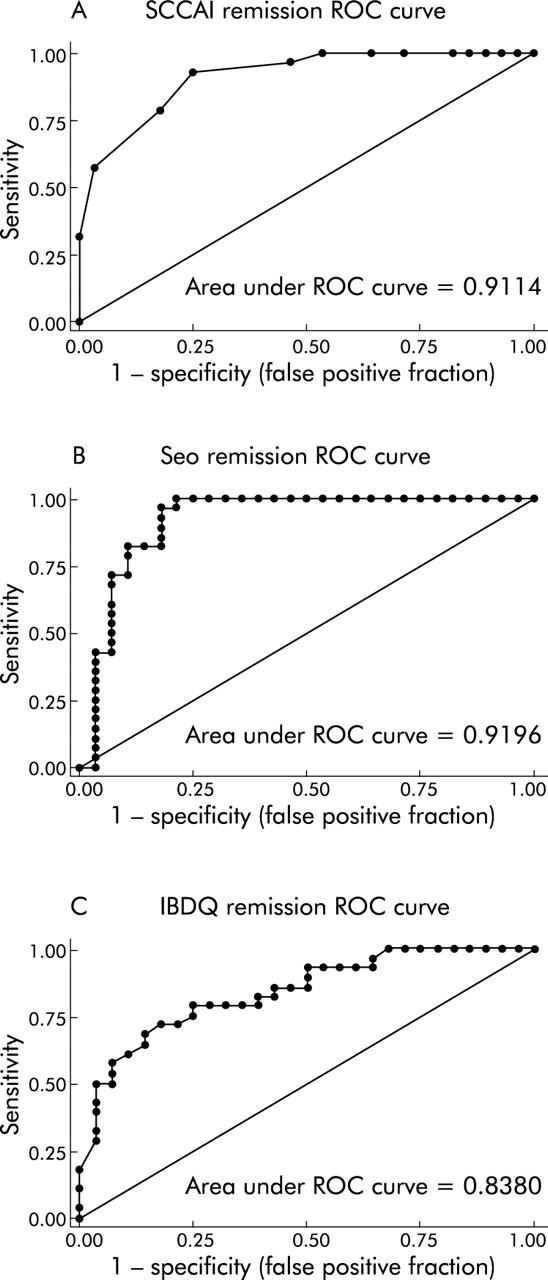
Receiver operating characteristic (ROC) curves demonstrate that non-invasive indices predict patient defined remission accurately. ROC curves (sensitivity v 1−specificity plots) for the simple clinical colitis activity index (SCCAI) (A), Seo index (B), and inflammatory bowel disease quality of life index (IBDQ) (C) for the end point of remission are presented. Areas under the ROC curve were 0.91, 0.92, and 0.84, respectively.
Figure 4
Figure 4
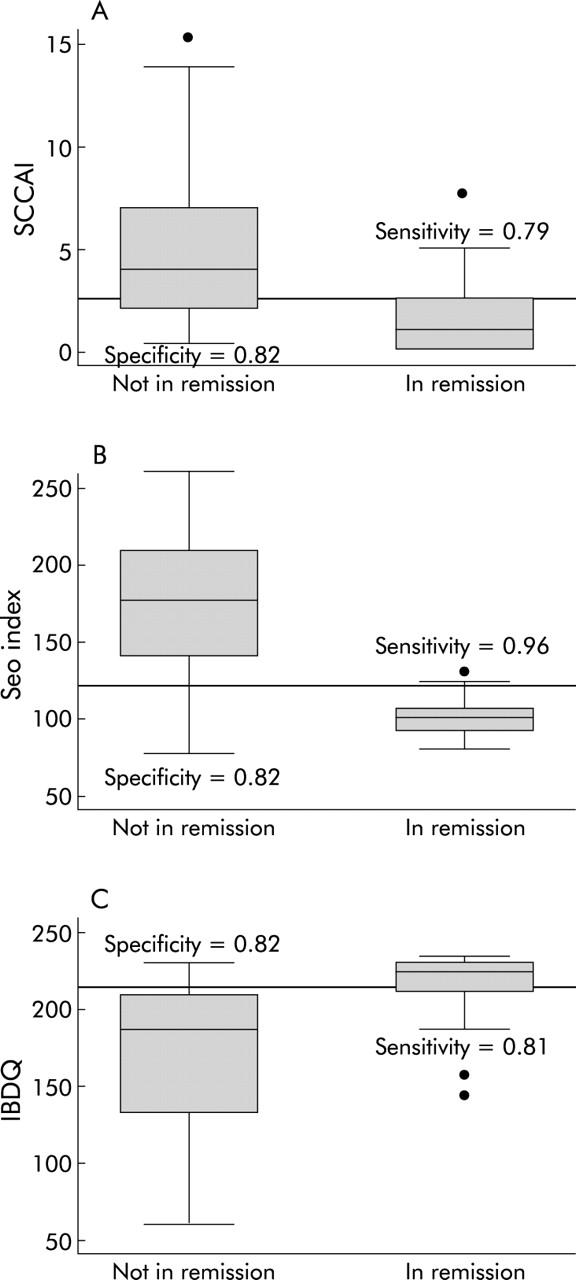
Optimal remission cut offs for the non-invasive indices are sensitive and specific. The cut offs were chosen to optimise sensitivity and specificity for remission. For the simple clinical colitis activity index (SCCAI) (A), this cut off was <2.5 points, resulting in a sensitivity of 0.79 and a specificity of 0.82. For the Seo index (B), this cut off was <120 points, resulting in a sensitivity of 0.96 and a specificity of 0.82. For the inflammatory bowel disease quality of life index (IBDQ) (C), this cut off was ⩾ 205 points, resulting in a sensitivity of 0.81 and a specificity of 0.82.
Figure 5
Figure 5
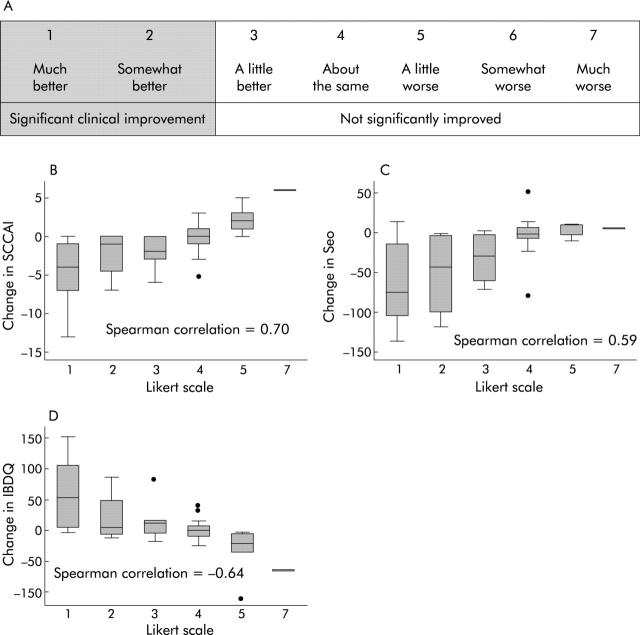
Likert scale and correlation of scores with patient defined improvement. (A) Likert scale used at the return visits, showing that scores of 1 (much better) and 2 (somewhat better) were grouped as clinically significant improvement, while scores in the range of 3–7 were considered to represent no significant improvement. (B–D) Correlation between the Likert scale improvement scores and changes in the scores on the simple clinical colitis activity index (SCCAI) (B), Seo index (C), and the inflammatory bowel disease quality of life index (IBDQ) (D).
Figure 6
Figure 6
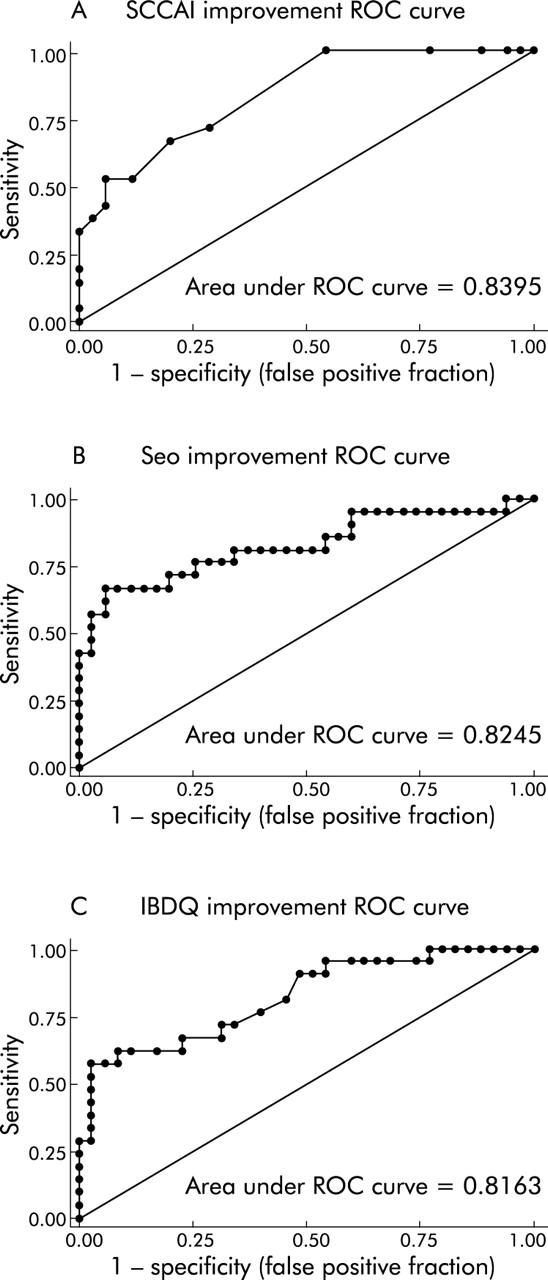
Receiver operating characteristic (ROC) curves demonstrate that non-invasive indices predict improvement accurately. ROC curves for the simple clinical colitis activity index (SCCAI) (A), the Seo index (B), and the inflammatory bowel disease quality of life index (IBDQ) (C) for the end point of improvement are presented. Areas under the ROC curves were 0.84, 0.82, and 0.82, respectively.
Figure 7
Figure 7
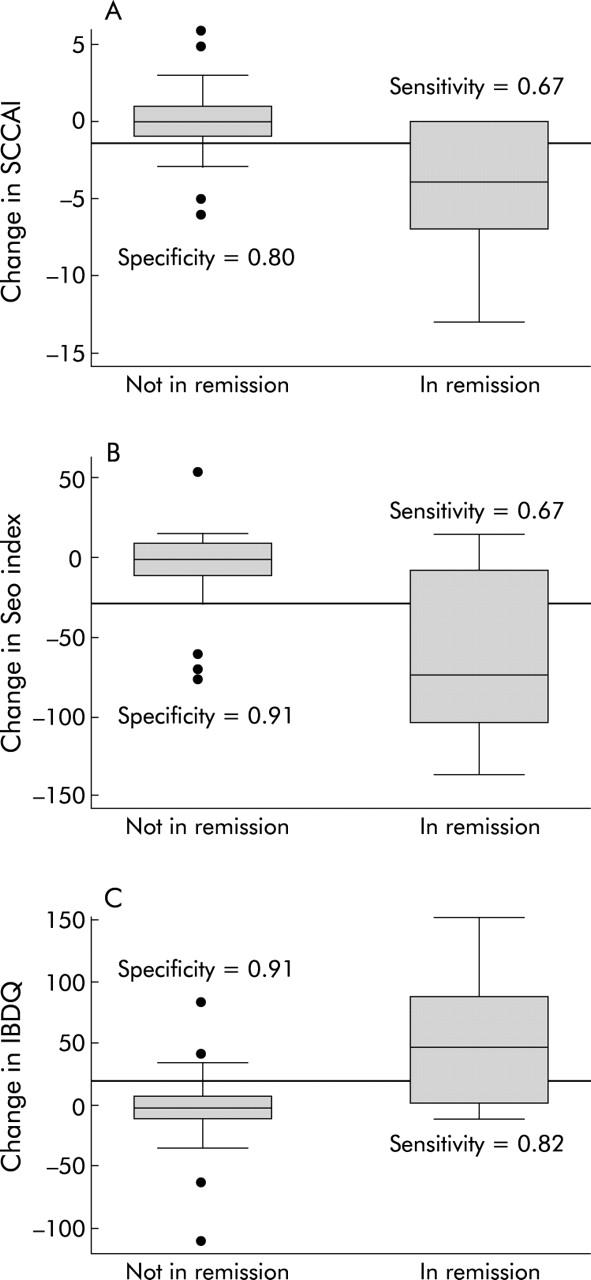
Optimal improvement cut offs for the non-invasive indices are sensitive and specific. The cut offs were chosen to optimise sensitivity and specificity for improvement. For the simple clinical colitis activity index (SCCAI) (A) this cut off was a decrease by >1.5 points, resulting in a sensitivity of 0.67 and a specificity of 0.80. For the Seo index (B), this cut off was a decrease by >30 points, resulting in a sensitivity of 0.67 and a specificity of 0.91. For the inflammatory bowel disease quality of life index (IBDQ) (C), this cut off was an increase by >20 points, resulting in a sensitivity of 0.82 and a specificity of 0.91.

References

    1. Truelove SC, Witts LJ. Cortisone in ulcerative colitis; final report on a therapeutic trial. BMJ 1955;4949:1041–8. - PMC - PubMed
    1. Powell-Tuck J, Bown RL, Lennard-Jones JE. A comparison of oral prednisolone given as single or multiple daily doses for active proctocolitis. Scand J Gastroenterol 1978;13:833–7. - PubMed
    1. Sutherland LR, Martin F, Greer S, et al. 5-Aminosalicylic acid enema in the treatment of distal ulcerative colitis, proctosigmoiditis, and proctitis. Gastroenterology 1987;92:1894–8. - PubMed
    1. Schroeder KW, Tremaine WJ, Ilstrup DM. Coated oral 5-aminosalicylic acid therapy for mildly to moderately active ulcerative colitis. A randomized study. N Engl J Med 1987;317:1625–9. - PubMed
    1. Seo M, Okada M, Yao T, et al. An index of disease activity in patients with ulcerative colitis. Am J Gastroenterol 1992;87:971–6. - PubMed

Publication types