. 2005 Jun;79(11):6690-702.
doi: 10.1128/JVI.79.11.6690-6702.2005.

Receptor binding, fusion inhibition, and induction of cross-reactive neutralizing antibodies by a soluble G glycoprotein of Hendra virus

Affiliations

Receptor binding, fusion inhibition, and induction of cross-reactive neutralizing antibodies by a soluble G glycoprotein of Hendra virus

Katharine N Bossart et al. J Virol. 2005 Jun.

Abstract

Hendra virus (HeV) and Nipah virus (NiV) are closely related emerging viruses comprising the Henipavirus genus of the Paramyxovirinae, which are distinguished by their ability to cause fatal disease in both animal and human hosts. These viruses infect cells by a pH-independent membrane fusion event mediated by their attachment (G) and fusion (F) glycoproteins. Previously, we reported on HeV- and NiV-mediated fusion activities and detailed their host-cell tropism characteristics. These studies also suggested that a common cell surface receptor, which could be destroyed by protease, was utilized by both viruses. To further characterize the G glycoprotein and its unknown receptor, soluble forms of HeV G (sG) were constructed by replacing its cytoplasmic tail and transmembrane domains with an immunoglobulin kappa leader sequence coupled to either an S-peptide tag (sG(S-tag)) or myc-epitope tag (sG(myc-tag)) to facilitate purification and detection. Expression of sG was verified in cell lysates and culture supernatants by specific affinity precipitation. Analysis of sG by size exclusion chromatography and sucrose gradient centrifugation demonstrated tetrameric, dimeric, and monomeric species, with the majority of the sG released as a disulfide-linked dimer. Immunofluorescence staining revealed that sG specifically bound to HeV and NiV infection-permissive cells but not to a nonpermissive HeLa cell line clone, suggesting that it binds to virus receptor on host cells. Preincubation of host cells with sG resulted in dose-dependent inhibition of both HeV and NiV cell fusion as well as infection by live virus. Taken together, these data indicate that sG retains important native structural features, and we further demonstrate that administration of sG to rabbits can elicit a potent cross-reactive neutralizing antibody response against infectious HeV and NiV. This HeV sG glycoprotein will be exceedingly useful for structural studies, receptor identification strategies, and vaccine development goals for these important emerging viral agents.


Figures
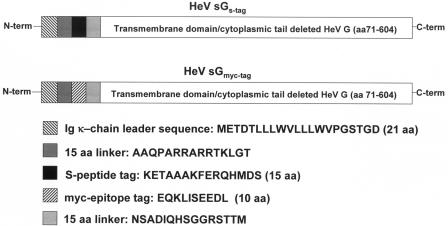
FIG. 1.
FIG. 1.
HeV sG constructs. The HeV coding sequence with the transmembrane-cytoplasmic tail deleted was generated by PCR and cloned in frame into the pSecTag2B vector, which contained the Ig κ leader sequence. The modified epitope-tagged pSecTag2B vectors were subsequently generated using overlapping oligonucleotides and cloned in frame into pSecTag2B-HeV sG. The figure shows the S-peptide-tagged and c-myc-tagged versions of HeV sG. The linker amino acids were derived from vector sequences.
FIG. 2.
FIG. 2.
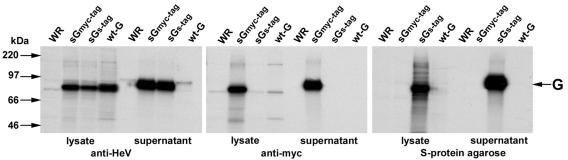
Expression of recombinant sGS-tag and sGmyc-tag glycoproteins. HeLa cells were infected with WR, a control vaccinia virus, sGS-tag- or sGmyc-tag-encoding viruses, or a recombinant vaccinia virus encoding HeV G and incubated 16 h at 37°C. Beginning at 6 h postinfection, the cells were labeled overnight with [35S]methionine-cysteine. Supernatants were removed and clarified by centrifugation. Lysates were prepared in buffer containing Triton X-100 and clarified by centrifugation. Immunoprecipitations were performed with rabbit anti-HeV or mouse anti-myc MAb 9E10 followed by protein G-Sepharose or with S-protein-agarose. The metabolically labeled proteins were resolved by 10% SDS-PAGE under reducing conditions and detected by autoradiography.
FIG. 3.
FIG. 3.
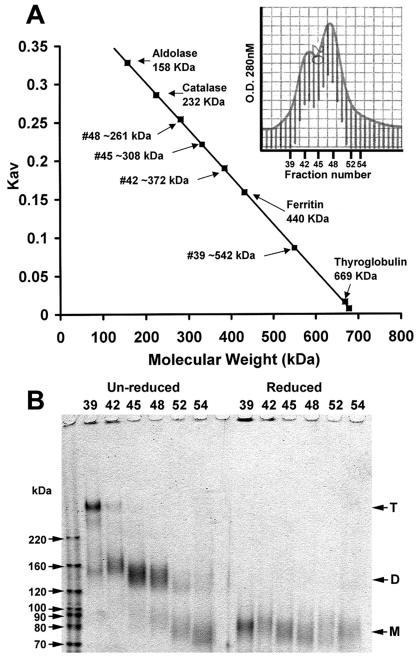
Size exclusion chromatography analysis of HeV sG. A panel of high-molecular-weight standards was separated on a Superdex 200 size exclusion column, and a calibration curve was generated. Samples of purified sGS-tag were separated on the calibrated Superdex 200 column and fractionated. A. The Kav values of major sG peaks were calculated, and the apparent molecular weight estimates of several fractions were determined using the calibration curve from the molecular weight standards. The inset in panel A shows the elution profile by absorbance of sGS-tag and the locations of several individual fractions. B. Selected fractions shown from panel A were analyzed by 3-to-8% gradient SDS-PAGE under both reduced and unreduced conditions and stained with SymplyBlue SaveStain Coomassie G-250. The sGS-tag species are as follows: M, monomer; D, dimer; T, tetramer.
FIG. 4.
FIG. 4.
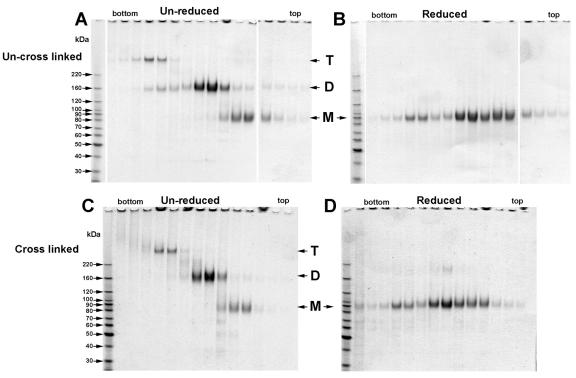
Oligomeric forms of sG. HeLa cells (two T-162-cm2 cultures) were infected with sGS-tag-encoding vaccinia virus and incubated for 40 h at 37°C in serum-free OptiMEM medium. Supernatants were removed (40 ml), clarified by centrifugation, concentrated, and buffer exchanged into PBS to a final volume of 1.0 ml. One-half (0.5 ml) of the sGS-tag was then cross-linked with the reducible reagent DTSSP as described in Materials and Methods and quenched with 100 mM Tris, pH 7.5. The cross-linked and un-cross-linked preparations were layered onto continuous (5-to-20%) sucrose gradients (two gradients) and fractioned. All fractions were precipitated with S-protein agarose, split into two tubes (for reducing and nonreducing SDS-PAGE conditions), and boiled in SDS sample buffer with and without β-mercaptoethanol, the sG products were resolved by 4-to-12% gradient SDS-PAGE, and the protein was visualized by staining with SymplyBlue SaveStain Coomassie G-250. The bottom and top of the gradient fractions are indicated. (A) Non-cross-linked and unreduced; (B) non-cross-linked and reduced; (C) cross-linked and unreduced; (D) cross-linked and reduced. The sGS-tag species are as follows: M, monomer; D, dimer; T, tetramer.
FIG. 5.
FIG. 5.
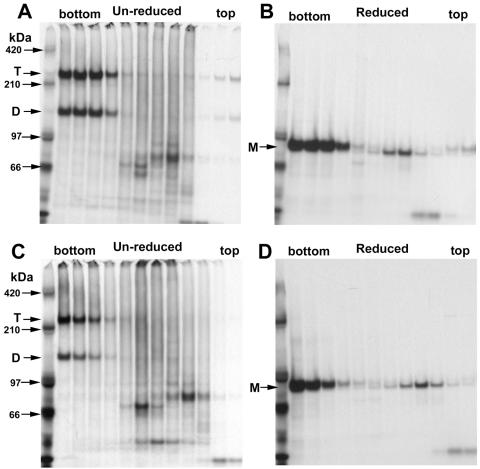
Oligomeric forms of full-length HeV G. HeLa cells were infected with HeV G-encoding vaccinia virus and incubated for 18 h at 37°C. Beginning at 6 h postinfection, the cells were metabolically labeled overnight with [35S]methionine. Supernatants were removed, and cells were chased for 2 h in complete medium, washed twice in PBS, and recovered. One-half (0.2 ml) of the cell suspension was cross-linked with 1 mM DTSSP as described in Materials and Methods. The cross-linked and non-cross-linked HeV G-expressing cells were lysed in Triton-X buffer and clarified by centrifugation, and each portion was layered onto a continuous sucrose gradient (5 to 20%) and fractioned. The fractions were precipitated with an anti-HeV sGS-tag mouse antiserum followed by protein G-Sepharose, and all fractions were split into two tubes (for reducing and nonreducing SDS-PAGE conditions). The samples of metabolically labeled HeV G were boiled in SDS sample buffer with and without β-mercaptoethanol, resolved by 3-to-8% gradient SDS-PAGE, and visualized by autoradiography. The bottom and top of the gradient fractions are indicated. (A) Non-cross-linked and unreduced; (B) non-cross-linked and reduced; (C) cross-linked and unreduced; (D) cross-linked and reduced.
FIG. 6.
FIG. 6.
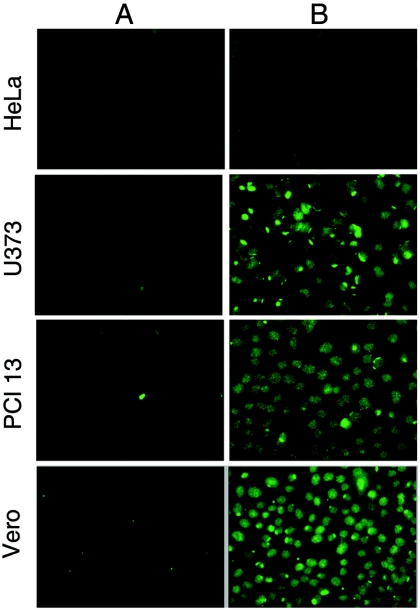
Immunofluorescence staining of receptor-negative and -positive cells. Cells were plated into eight-well Lab-Tek II chamber slides in the appropriate medium and incubated for 3 days. The cells were fixed with acetone for 2 min. HeLa cells represent a fusion-nonpermissive cell line, whereas U373, PCI 13, and Vero cells represent fusion-permissive cell lines. The cells were stained with sGS-tag followed by an anti-HeV G peptide-specific rabbit antiserum and a donkey anti-rabbit Alexa Fluor 488 conjugate. Samples were examined with an Olympus microscope with a reflected light fluorescence attachment and an Olympus U-M41001 filter. All images were obtained with a SPOT RT charge-coupled device digital camera at an original magnification of ×40. A. sGS-tag and donkey anti-rabbit Alexa Fluor 488 conjugate. B. sGS-tag, anti-HeV G peptide-specific antiserum, and donkey anti-rabbit Alexa Fluor 488 conjugate.
FIG. 7.
FIG. 7.
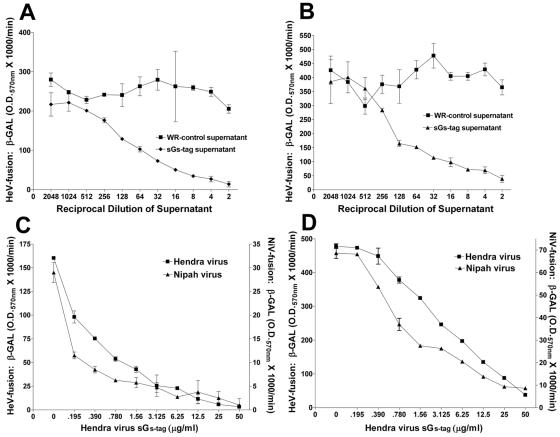
Inhibition of HeV- and NiV-mediated fusion by sG. HeLa cells were infected with vaccinia virus recombinants encoding HeV F and HeV G or NiV F and NiV G glycoproteins, along with a vaccinia recombinant encoding T7 RNA polymerase (effector cells). Each designated target cell type was infected with the E. coli LacZ-encoding reporter vaccinia virus vCB21R. Each target cell type (1 × 10⁵) was plated in duplicate wells of a 96-well plate. Inhibition was carried out using either cell culture supernatants from either sGS-tag-expressing or control vaccinia virus-infected HeLa cell cultures (prepared from 36-h infections), or with purified sGS-tag preparations at the concentrations indicated, and incubated for 30 min at 37°C. The HeV or NiV glycoprotein-expressing cells (1 × 10⁵) were then mixed with each target cell type. The cell fusion assay was performed for 2.5 h at 37°C, followed by lysis in Nonidet P-40 (1%), and β-Gal activity was quantified. (A and B) Inhibition of HeV-mediated fusion by sGS-tag supernatant or WR control supernatant in U373 (A) or PCI 13 (B) cells. (C and D) Inhibition of HeV- and NiV-mediated fusion by sGS-tag in U373 (C) or PCI 13 (D) cells.
FIG. 8.
FIG. 8.
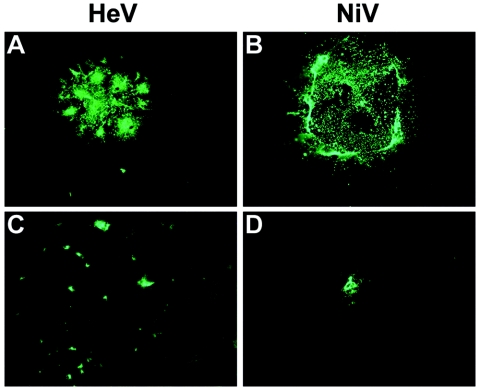
Immunofluorescence-based syncytium assay of HeV and NiV. Vero cells were plated into 96-well plates and grown to 90% confluence. Cells were pretreated with sGS-tag for 30 min at 37°C prior to infection with 1.5 × 10³ TCID50/ml and 7.5 × 10² TCID50/ml of live HeV or NiV (combined with sGS-tag). Cells were incubated for 24 h, fixed in methanol, and immunofluorescently labeled for P protein prior to digital microscopy. Images were obtained using an Olympus IX71 inverted microscope coupled to an Olympus DP70 high-resolution color camera, and all images were obtained at an original magnification of ×85. Shown are representative images of FITC immunofluorescence of anti-P-labeled HeV and NiV. (A) Untreated HeV control infections; (B) untreated NiV control infections; (C) HeV infections in the presence of 100 μg/ml sGS-tag; (D) NiV infections in the presence of 100 μg/ml sGS-tag.
FIG. 9.
FIG. 9.
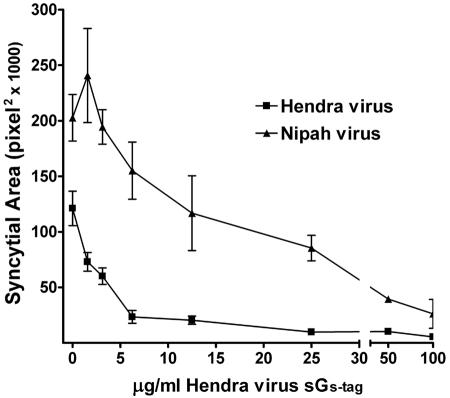
Inhibition of HeV and NiV infection by sG. Vero cells were plated into 96-well plates and grown to 90% confluence. Cells were pretreated with sGS-tag for 30 min at 37°C prior to infection with 1.5 × 10³ TCID50/ml and 7.5 × 10² TCID50/ml of live HeV or NiV (combined with sGS-tag). Cells were incubated for 24 h, fixed in methanol, and immunofluorescently labeled for P protein prior to digital microscopy and image analysis to determine the relative area of each syncytium (see Materials and Methods). The figure shows the relative syncytial area (pixels squared) versus sGS-tag concentration for HeV (circles) and NiV (triangles).

References

    1. Anonymous. 2004. Nipah virus outbreak(s) in Bangladesh, January-April 2004. Wkly. Epidemiol. Rec. 79:168-171. - PubMed
    1. Anonymous. 2004. Hendra virus—Australia (Queensland). International Society for Infectious Diseases, 14 Dec. 2004. Pro-med. no. 20041214.3307.
    1. Anonymous. 2004. Person-to-person transmission of Nipah virus during outbreak in Faridpur District, 2004. ICDDR,B Health Sci. Bull. 2:5-9.
    1. Berger, E. A., O. Nussbaum, and C. C. Broder. 1995. HIV envelope glycoprotein/CD4 interactions: studies using recombinant vaccinia virus vectors, p. 123-145. In J. Karn (ed.), HIV: a practical approach, vol. 2. Oxford University Press, Cambridge, United Kingdom.
    1. Bossart, K. N., and C. C. Broder. 2004. Viral glycoprotein-mediated cell fusion assays using vaccinia virus vectors. Methods Mol. Biol. 269:309-332. - PubMed

Publication types

MeSH terms

LinkOut - more resources