Review
. 2005 Nov;34(3):170-8.
doi: 10.1016/j.jcv.2005.03.005.

Expanding the frontiers of existing antiviral drugs: possible effects of HIV-1 protease inhibitors against SARS and avian influenza

Affiliations
Review

Expanding the frontiers of existing antiviral drugs: possible effects of HIV-1 protease inhibitors against SARS and avian influenza

Andrea Savarino. J Clin Virol. 2005 Nov.

Abstract

When unexpected diseases such as the severe acute respiratory syndrome (SARS) and avian influenza become a serious threat to public health, an immediate response is imperative. This should take into consideration existing licensed antiviral drugs against other viral diseases already known to be safe for use in humans. In this report, evidence is presented that HIV-1 protease inhibitors (PIs) currently used in anti-HIV-1 therapies might exert some effects on SARS and perhaps, on avian influenza. Evidence for the potential benefits of PIs against the SARS coronavirus (SARS-CoV) is provided by empirical clinical studies, in vivo viral inhibition assays and computational simulations of the docking of these compounds to the active site of the main SARS-CoV protease. As suggested by in silico docking of these molecules to a theoretical model of a subunit of type A influenza virus RNA-dependent RNA polymerase, there also exists a remote possibility that these PIs may have an effect on avian influenza viruses. Although this evidence is still far from being definitive, the results so far obtained suggest that PIs should be seriously taken into consideration for further testing as potential therapeutic agents for SARS and avian influenza.


Figures
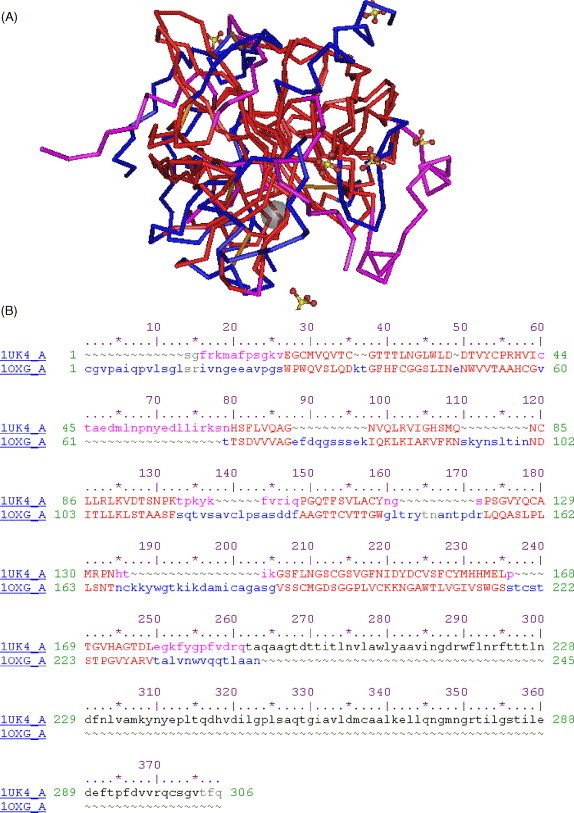
Fig. 1
Fig. 1
Structural similarity between the SARS coronavirus (SARS-CoV) main protease (3CLpro) and bovine α-chymotrypsin. (A) Three-dimensional structural superimposition between the HIV-1 protease (accession number in the Protein Data Bank: 1UK4) and α-chymotrypsin (accession number: 1OXG). The residues significantly aligned and corresponding to the catalytic site of both molecules are shown in red. The other regions of the catalytic domains of 3CLpro are shown in violet. Unaligned regions of α-chymotrypsin are shown in blue. (B) Sequence alignment corresponding to the structural alignment in (A). The colours of the residues in (B) strictly correspond to those of (A). This alignment was obtained using the VAST algorithm and visualised using the Cn3d 4.1 program (www.ncbi.nlm.nih.gov).
Fig. 2
Fig. 2
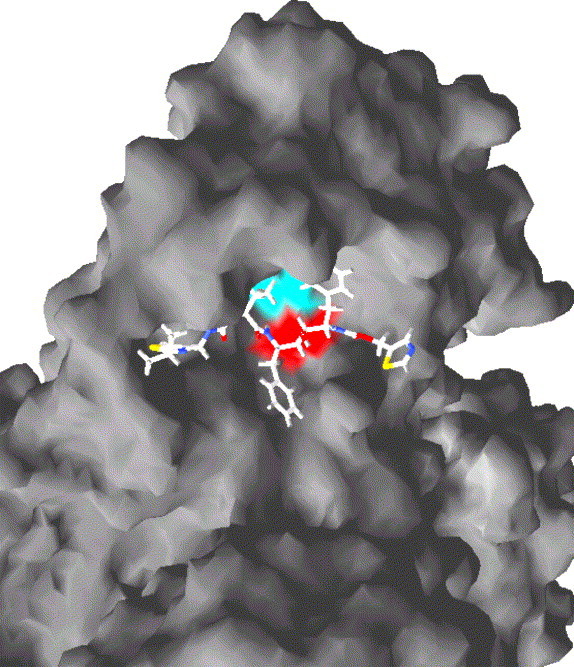
Docking of the HIV-1 protease inhibitor (PI) saquinavir to the active site of the severe acute respiratory syndrome coronavirus (SARS-CoV) main protease. The molecular surface corresponding to the catalytic His41 and Cys145 residues is shown in blue and red, respectively. Molecular docking was computed using the genetic algorithm GOLD (Cambridge Crystallographic Data Centre, Cambridge, UK) and visualised using the program SWISSpdbviewer (available at www.expasy.org). (For interpretation of the references to colour in this figure legend, the reader is referred to the web version of this article.)
Fig. 3
Fig. 3
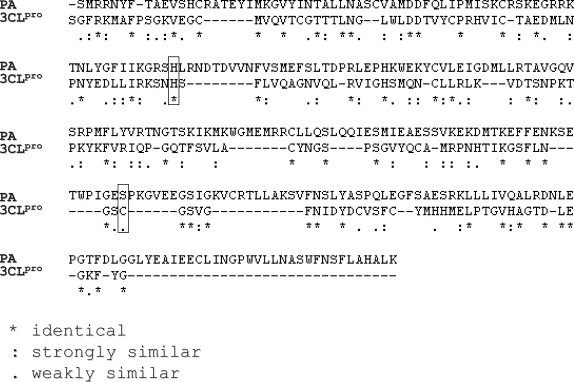
Sequence alignment between the COOH-terminal region of the PA subunit of the RNA-dependent RNA polymerase of a H5N1 avian influenza virus (NCBI accession number: AAV48550), and the first two domains of the severe acute respiratory syndrome coronavirus (SARS-CoV) main protease (3CLpro; NCBI accession number: P59641). The alignment was generated using the CLUSTALW software (http://npsa-pbil.ibcp.fr/cgi-bin/npsa_automat.pl?page=npsa_clustalw.html). The boxes evidence the perfect alignment between the catalytic His41 and Cys145 of SARS-CoV 3CLpro and the putatively catalytic His510 and Cys145 of influenza A PA.
Fig. 4
Fig. 4
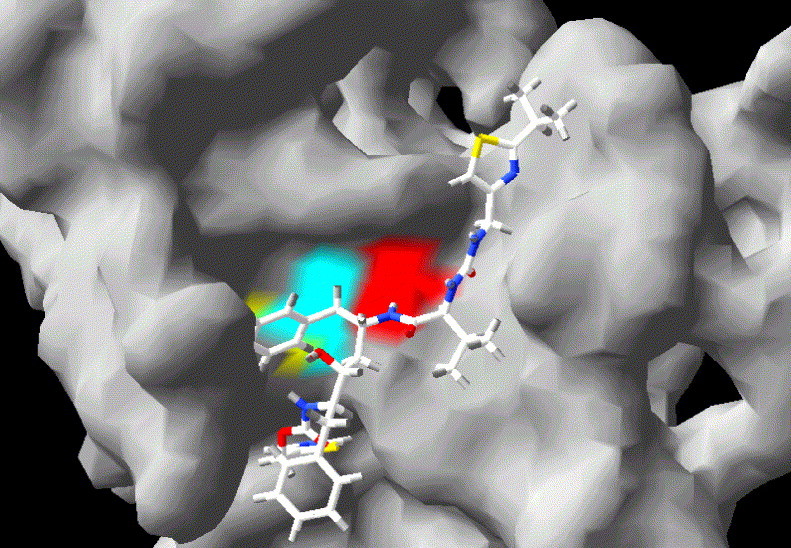
Theoretical docking of an HIV-1 protease inhibitor (ritonavir) to the active site of the chymotrypsin-like protease domains of the PA subunit of the RNA-dependent RNA polymerase of an H5N1 avian influenza virus. The three-dimensional structure of the COOH-terminal portion of PA was obtained by homology molecular modelling using the software tool SWISS MODEL (available at www.expasy.org). The model was then adjusted manually so as to match the distances between the catalytic amino acids determined by X-ray in bovine α-chymotrypsin (Protein Data Bank accession number: 1OXG). The molecular surface corresponding to His510, Asp547 and Ser624 is shown in blue, yellow and violet, respectively. Molecular docking and its visualisation were obtained as described in the caption for Fig. 2. (For interpretation of the references to colour in this figure legend, the reader is referred to the web version of this article.)

References

    1. Anand K., Ziebuhr J., Wadhwani P., Mesters J.R., Hilgenfeld R. Coronavirus main proteinase (3CLpro) structure: basis for design of anti-SARS drugs. Science. 2003;300:1763–1767. - PubMed
    1. Cassone A., De Bernardis F., Torosantucci A., Tacconelli E., Tumbarello M., Cauda R. In vitro and in vivo anticandidal activity of human immunodeficiency virus protease inhibitors. J Infect Dis. 1999;180:448–453. - PubMed
    1. Chan K.S., Lai S.T., Chu C.M., Tsui E., Tam C.Y., Wong M.M. Treatment of severe acute respiratory syndrome with lopinavir/ritonavir: a multicentre retrospective matched cohort study. Hong Kong Med J. 2003;9:399–406. - PubMed
    1. Chen X.P., Cao Y. Consideration of highly active antiretroviral therapy in the prevention and treatment of severe acute respiratory syndrome. Clin Infect Dis. 2004;38:1030–1032. - PubMed
    1. Chen X.P., Li G.H., Tang X.P., Xiong Y., Chen X.J., Cao Y. Lack of severe acute respiratory syndrome in 19 AIDS patients hospitalised together. J Acquir Immun Defic Syndr. 2003;34:242–243. - PubMed