


Prognostic value of bronchiolitis obliterans syndrome stage 0-p in single-lung transplant recipients
- PMID: 15894603
- PMCID: PMC2718475
- DOI: 10.1164/rccm.200501-097OC
Prognostic value of bronchiolitis obliterans syndrome stage 0-p in single-lung transplant recipients
Abstract
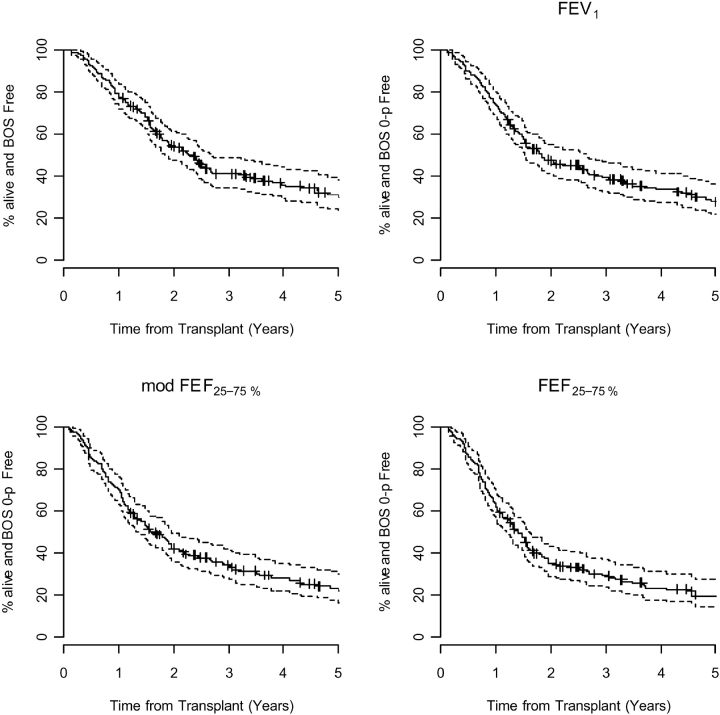
Rationale: Early diagnosis of bronchiolitis obliterans syndrome (BOS) is critical in understanding pathogenesis and devising therapeutic trials. Although potential-BOS stage (BOS 0-p), encompassing early changes in FEV(1) and forced expiratory flow, midexpiratory phase (FEF(25-75%)), has been proposed, there is a paucity of data validating its utility in single-lung transplantation.
Objective: The aim of this study was to define the predictive ability of BOS 0-p in single-lung transplantation.
Methods: We retrospectively analyzed spirometric data for 197 single-lung recipients. Sensitivity, specificity, and positive predictive value of BOS 0-p were examined over time using Kaplan-Meier methodology.
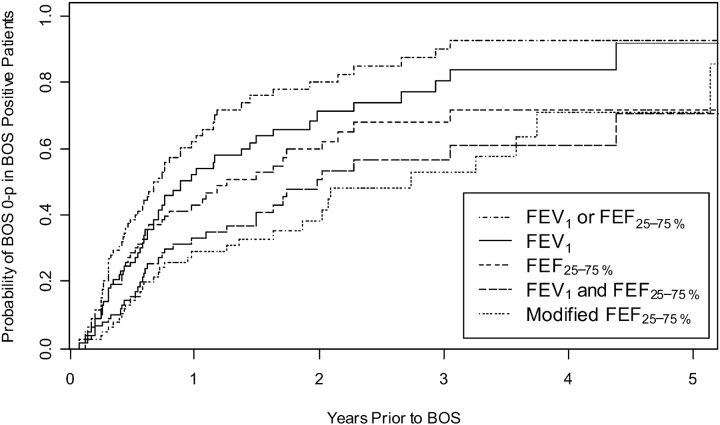
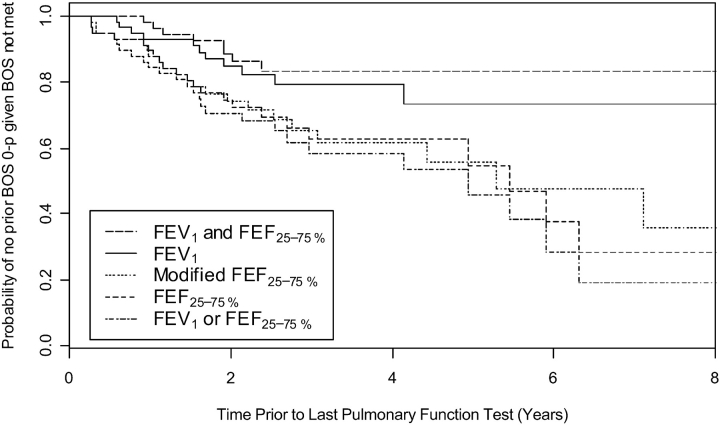
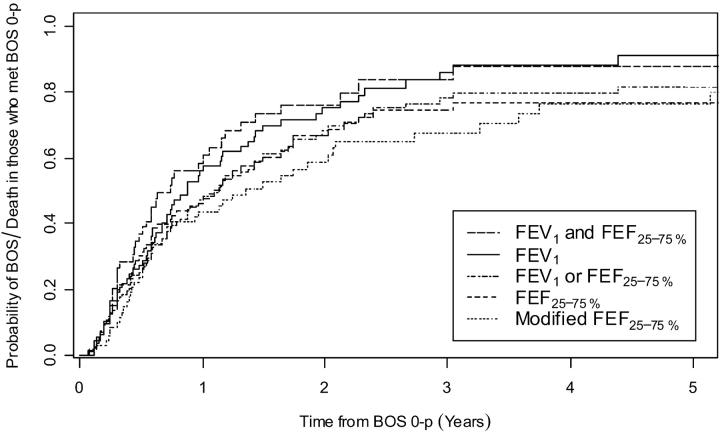
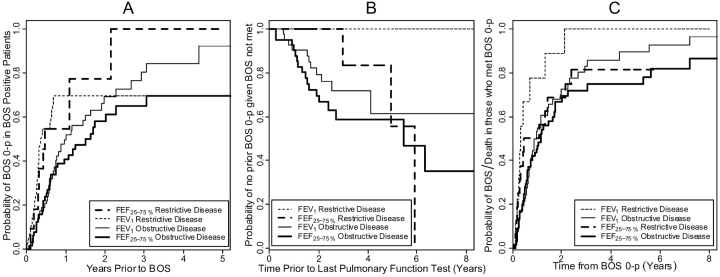
Results: BOS 0-p FEV(1) was associated with higher sensitivity, specificity, and positive predictive value than the FEF(25-75%) criterion over different time periods investigated. The probability of testing positive for BOS 0-p FEV(1) in patients with BOS (sensitivity) was 71% at 2 years before the onset of BOS. The probability of being free from development of BOS 0-p FEV(1) in patients free of BOS at follow-up (specificity) was 93% within the last year. Of patients who met the BOS 0-p FEV(1) criterion, 81% developed BOS or died within 3 years. The specificity and positive predictive value curves for the BOS 0-p FEV(1) were significantly different between patients with underlying restrictive versus obstructive physiology (p = 0.05 and 0.01, respectively).
Conclusion: The FEV(1) criterion for BOS 0-p provides useful predictive information regarding the risk of development of BOS or death in single-lung recipients. The predictive value of this criterion is higher in patients with underlying restriction and is superior to the FEF(25-75%) criterion.
Figures
References
-
- Boehler A, Kesten S, Weder W, Speich R. Bronchiolitis obliterans after lung transplantation: a review. Chest 1998;114:1411–1426. - PubMed
-
- Estenne M, Hertz MI. Bronchiolitis obliterans after human lung transplantation. Am J Respir Crit Care Med 2002;166:440–444. - PubMed
-
- Trulock EP, Edwards LB, Taylor DO, Boucek MM, Mohacsi PJ, Keck BM, Hertz MI. The Registry of the International Society for Heart and Lung Transplantation: twentieth official adult lung and heart-lung transplant report—2003. J Heart Lung Transplant 2003;22:625–635. - PubMed
-
- Estenne M, Maurer JR, Boehler A, Egan JJ, Frost A, Hertz M, Mallory GB, Snell GI, Yousem S. Bronchiolitis obliterans syndrome 2001: an update of the diagnostic criteria. J Heart Lung Transplant 2002;21:297–310. - PubMed
-
- Hertz MI, Henke CA, Nakhleh RE, Harmon KR, Marinelli WA, Fox JM, Kubo SH, Shumway SJ, Bolman RM III, Bitterman PB. Obliterative bronchiolitis after lung transplantation: a fibroproliferative disorder associated with platelet-derived growth factor. Proc Natl Acad Sci USA 1992;89:10385–10389. - PMC - PubMed
Publication types
MeSH terms
Grants and funding
LinkOut - more resources
Full Text Sources
Medical
Miscellaneous
