. 2005 May-Jun;12(3):307-17.
doi: 10.1101/lm.89605. Epub 2005 May 16.

Fos protein expression in olfactory-related brain areas after learning and after reactivation of a slowly acquired olfactory discrimination task in the rat

Affiliations

Fos protein expression in olfactory-related brain areas after learning and after reactivation of a slowly acquired olfactory discrimination task in the rat

Florence Roullet et al. Learn Mem. 2005 May-Jun.

Abstract

Fos protein immunodetection was used to investigate the neuronal activation elicited in some olfactory-related areas after either learning of an olfactory discrimination task or its reactivation 10 d later. Trained rats (T) progressively acquired the association between one odor of a pair and water-reward in a four-arm maze. Two groups of pseudotrained rats were used: PO rats were not water restricted and were submitted to the olfactory stimuli in the maze without any reinforcement, whereas PW rats were water-deprived and systematically received water in the maze without any odorous stimulation. When the discrimination task was well mastered, a significantly lower Fos immunoreactivity was observed in T rats compared to PW and PO rats in most of the analyzed brain areas, which could reflect the post-acquisition consolidation process. Following memory reactivation, differences in Fos immunoreactivity between trained and some pseudotrained rats were found in the anterior part of piriform cortex, CA3, and orbitofrontal cortex. We also observed that Fos labeling was significantly higher in trained rats after memory reactivation than after acquisition of the olfactory task in most of the brain areas examined. Our results support the assumption of a differential involvement of neuronal networks after either learning or reactivation of an olfactory discrimination task.


Figures
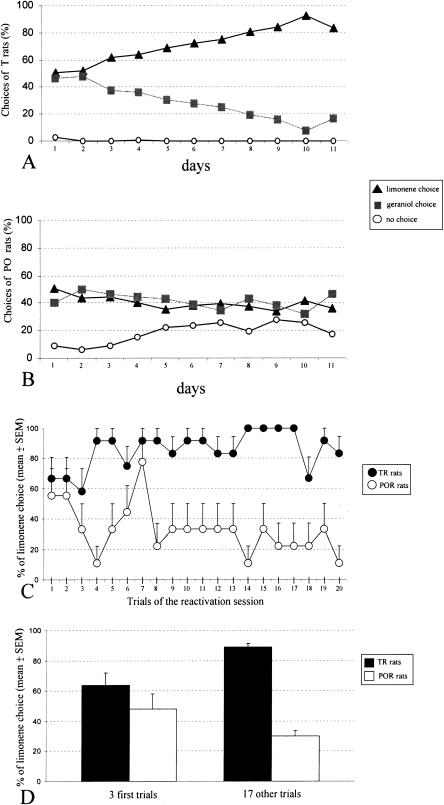
Figure 1.
Figure 1.
Behavioral data. (A) The evolution of the T rats' behavior throughout the daily sessions in the maze. On each trial, these rats could choose the geraniol-odorized arm (“geraniol choice”), the limoneneodorized arm (“limonene choice”), or to stay in the starting chamber (“no choice”) of the maze. The choices are expressed as percentages of the 20-trial daily sessions. Note that the trained rats progressively improved their performance and reached the learning criterion of 80% correct choices. (B) The evolution of PO rats' behavior throughout the daily sessions in the maze. For these rats, which were not water-deprived, the number of “no choice” responses progressively increased through the daily sessions in the maze. (C) The evolution of the percentage of “limonene choices” through the 20 trials of the reactivation session. (D) The percentage of “limonene choices” in TR and POR rats in the three first trials and the last 17 trials of the 20-trial reactivation session in the maze.
Figure 2.
Figure 2.
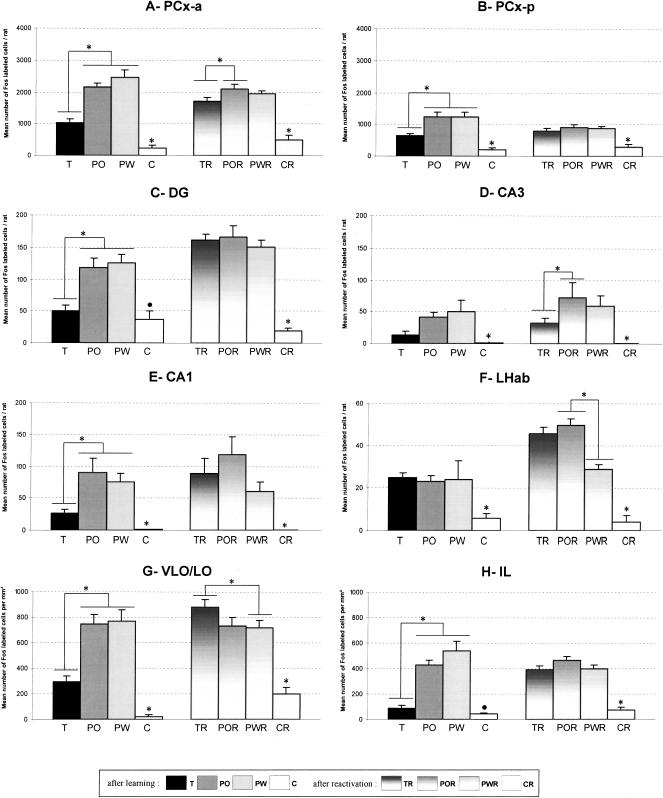
The number of Fos-immunoreactive cells (mean ± SEM) in the brain areas analyzed in all the experimental groups after either initial conditioning in the maze or mnesic reactivation. Asterisks (*) indicate a significant difference (P < 0.05). Note that, except in LHab, Fos expression was higher in the PO and PW compared to the T rats. (A,B) Fos expression in the PCx-a and PCx-p. In all experimental groups except home-cage controls, the number of labeled cells in the PCx-a was significantly higher than in the PCx-p. In the PCx-a, the number of immunoreactive cells was significantly decreased in the TR rats compared to POR rats. (C-E) Fos immunoreactivity in the hippocampus subfields DG, CA3, and CA1, respectively. In the DG, as indicated by the circle (•), the C rats were significantly different from the PO and PW rats but not from the T rats. In the DG and CA1, no difference was found among the TR, POR, and PWR rats. In contrast, the number of immunoreactive cells in CA3 was significantly decreased in the TR rats compared to the POR rats. (F) Fos expression in the LHab. (G,H) Fos immunoreactivity in the frontal regions VLO/LO and IL, respectively. In the VLO/LO, Fos immunoreactivity was significantly increased in the TR rats compared to POR, PWR, and T rats. In the IL, as indicated by the circle (•), the C rats exhibited a significantly lower number of Fos-positive cells compared to the PO and PW rats but were not different from the T rats.
Figure 3.
Figure 3.
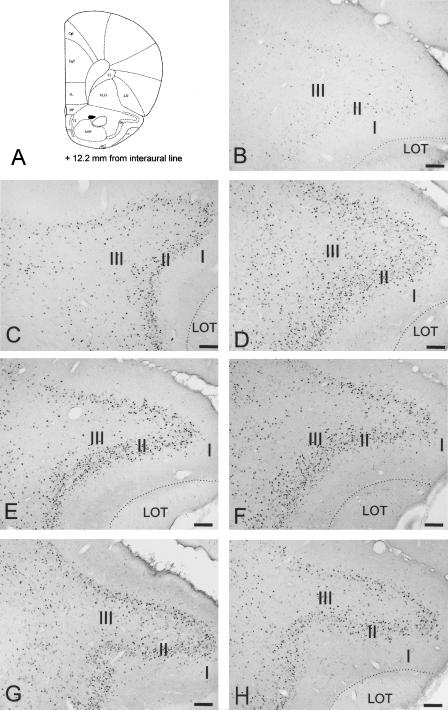
(A) Schematic drawing (Paxinos and Watson 1986) of a coronal section taken at +12.2 mm from the interaural line, illustrating the location of the PCx-a. (B-H) Photomicrographs illustrating the Fos immunoreactivity in the three layers (I, II, III) of the PCx-a in a C rat, a T rat, a TR rat, a PO rat, a POR rat, a PW rat, and a PWR rat, respectively. LOT: lateral olfactory tract. Scale bar, 100 μm.
Figure 4.
Figure 4.
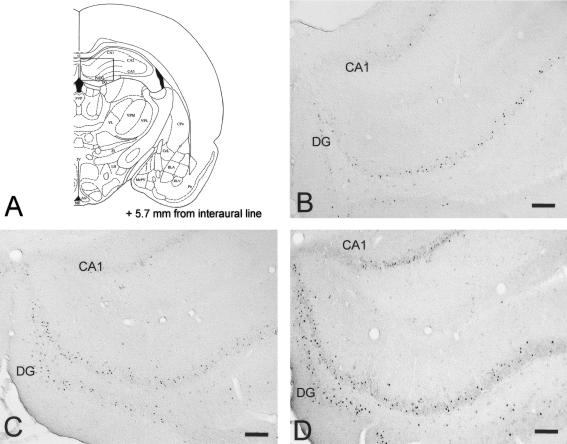
(A) Schematic drawing (Paxinos and Watson 1986) of a coronal section taken at +5.7 mm from the interaural line. The rectangle indicates the location of the hippocampal region illustrated by the photomicrographs. (B-D) Fos immunoreactivity in the hippocampus in a T rat, a TR rat, and a PO rat, respectively. Scale bar, 100 μm.
Figure 5.
Figure 5.
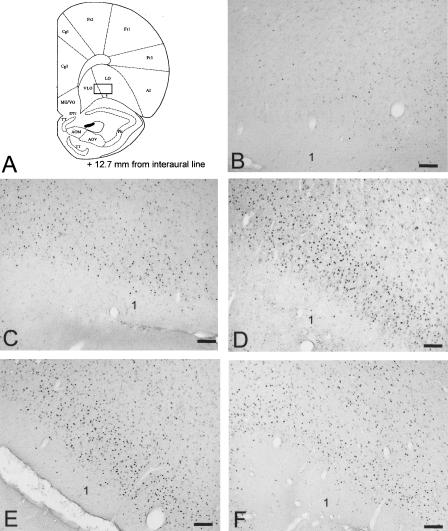
(A) Schematic (Paxinos and Watson 1986) of a coronal section taken +12.7 mm from the interaural line. The rectangle illustrates the location of the sample region in which labeled cells were counted in the VLO/LO. (B-F) Photomicrographs illustrating Fos labeling in the VLO/LO in C, T, PO, TR, and PWR rats, respectively. Scale bar, 100 μm; 1, neocortical layer 1.

References

    1. Abel, T. and Lattal, K.M. 2001. Molecular mechanisms of memory acquisition, consolidation and retrieval. Curr. Opin. Neurobiol. 11: 180-187. - PubMed
    1. Anagnostaras, S.G., Maren, S., and Fanselow, M.S. 1999. Temporally graded retrograde amnesia of contextual fear after hippocampal damage in rats: Within-subjects examination. J. Neurosci. 19: 1106-1114. - PMC - PubMed
    1. Anokhin, K.V. and Rose, S.P. 1991. Learning-induced increase of immediate early-gene messenger mRNA in the chick forebrain. Eur. J. Neurosci. 3: 162-167. - PubMed
    1. Berman, D.E. and Dudai, Y. 2001. Memory extinction, learning anew, and learning the new: Dissociations in the molecular machinery of learning in cortex. Science 291: 2417-2419. - PubMed
    1. Bertaina, V. and Destrade, C. 1995. Differential time courses of c-fos mRNA expression in hippocampal subfields following acquisition and recall testing in mice. Cog. Brain Res. 2: 269-275. - PubMed

Publication types

Substances

LinkOut - more resources