Comparative Study
. 2005;7(3):R458-67.
doi: 10.1186/ar1697. Epub 2005 Feb 21.

Citrullinated proteins have increased immunogenicity and arthritogenicity and their presence in arthritic joints correlates with disease severity

Affiliations
Comparative Study

Citrullinated proteins have increased immunogenicity and arthritogenicity and their presence in arthritic joints correlates with disease severity

Karin Lundberg et al. Arthritis Res Ther. 2005.

Abstract

Autoantibodies directed against citrulline-containing proteins have an impressive specificity of nearly 100% in patients with rheumatoid arthritis and have been suggested to be involved in the disease pathogenesis. The targeted epitopes are generated by a post-translational modification catalysed by the calcium-dependent enzyme peptidyl arginine deiminase (PAD), which converts positively charged arginine to polar but uncharged citrulline. The aim of this study was to explore the effects of citrullination on the immunogenicity of autoantigens as well as on potential arthritogenicity. Thus, immune responses to citrullinated rat serum albumin (Cit-RSA) and to unmodified rat serum albumin (RSA) were examined as well as arthritis development induced by immunisation with citrullinated rat collagen type II (Cit-CII) or unmodified CII. In addition, to correlate the presence of citrullinated proteins and the enzyme PAD4 with different stages of arthritis, synovial tissues obtained at different time points from rats with collagen-induced arthritis were examined immunohistochemically. Our results demonstrate that citrullination of the endogenous antigen RSA broke immunological tolerance, as was evident by the generation of antibodies directed against the modified protein and cross-reacting with the native protein. Furthermore we could demonstrate that Cit-CII induced arthritis with higher incidence and earlier onset than did the native counterpart. Finally, this study reveals that clinical signs of arthritis precede the presence of citrullinated proteins and the enzyme PAD4. As disease progressed into a more severe and chronic state, products of citrullination appeared specifically in the joints. Citrullinated proteins were detected mainly in extracellular deposits but could also be found in infiltrating cells and on the cartilage surface. PAD4 was detected in the cytoplasm of infiltrating mononuclear cells, from day 21 after immunisation and onwards. In conclusion, our data reveal the potency of citrullination to break tolerance against the self antigen RSA and to increase the arthritogenic properties of the cartilage antigen CII. We also show that citrullinated proteins and the enzyme PAD4 are not detectable in healthy joints, and that the appearance and amounts in arthritic joints of experimental animals are correlated with the severity of inflammation.


Figures
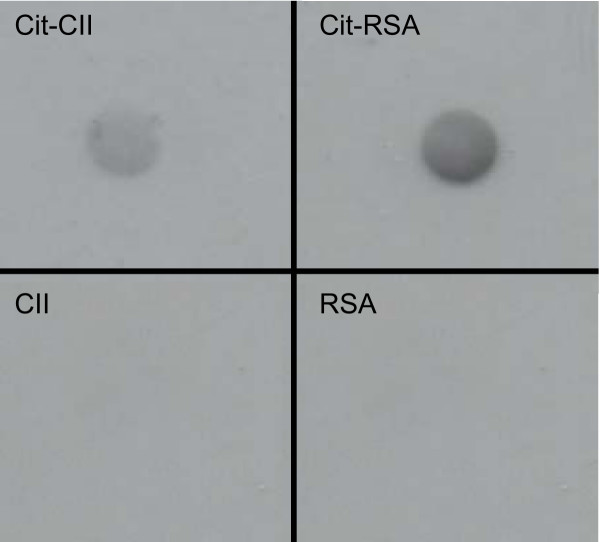
Figure 1
Figure 1
Verification of citrullination of collagen type II (CII) and rat serum albumin (RSA) by immunoblotting. Using the recombinant anti-citrullinated protein antibody RA3, citrulline was detected in the citrullinated CII (Cit-CII) sample (upper left) as well as in the citrullinated RSA (Cit-RSA) sample (upper right), while uncitrullinated CII (lower left) and uncitrullinated RSA (lower right) were negative for citrulline.
Figure 2
Figure 2
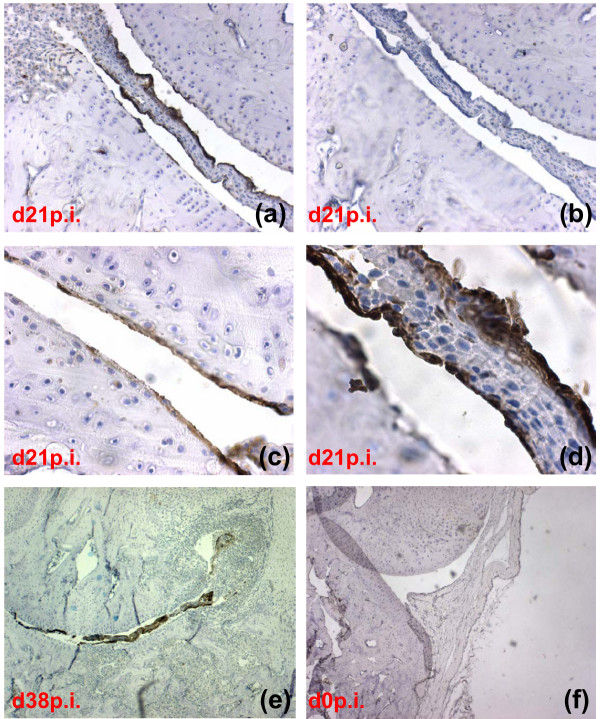
Citrullinated proteins are present in the arthritic joint. Positive citrulline staining was found in extracellular deposits (a,e), cartilage (c) and infiltrating cells (d). Unimmunised animals were negative for citrulline (f). Immunohistochemical staining was performed with RA3, a human recombinant anti-citrullinated protein antibody. Control staining was performed with an isotyped-matched recombinant human anti-U1-70K antibody (b). (Original magnifications: ×100 (a,b); ×250 (c); ×400 (d); ×40 (e,f)).
Figure 3
Figure 3
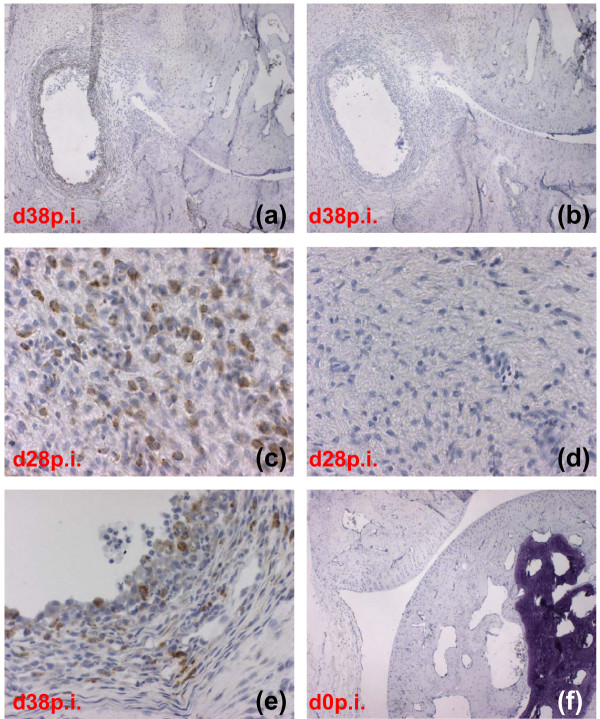
Peptidyl arginine deiminase 4 (PAD4) is present in the arthritic joint. PAD4 was detected in infiltrating cells (a), localised to the cytoplasm of mononuclear cells (c,e). Unimmunised animals were negative for PAD4 staining (f). Immunohistochemical stainings were performed with a rabbit anti-PAD4 antibody. Control staining was performed with preimmune rabbit sera (b,d) (Original magnifications: ×40 (a,b,f); ×200 (c-e)).
Figure 4
Figure 4
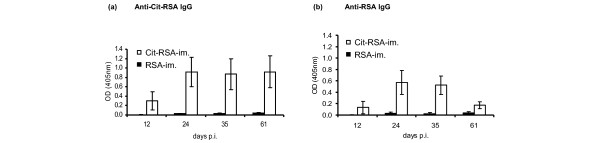
Immunisation with citrullinated rat serum albumin (Cit-RSA) breaks immunological tolerance on the B cell side. Immunisation with Cit-RSA (white bars) induced an antibody response against Cit-RSA (a), cross-reacting with unmodified rat serum albumin (RSA) (b) at all time points investigated, whereas immunisation with RSA (black bars) did not. Sera were collected 12, 24, 35 and 61 days after immunisation, and total IgG was measured by ELISA as OD at 405 nm. Results are means ± SD (n = 7 animals per group), representative of two replicate experiments. **P < 0.01 at all time points.
Figure 5
Figure 5
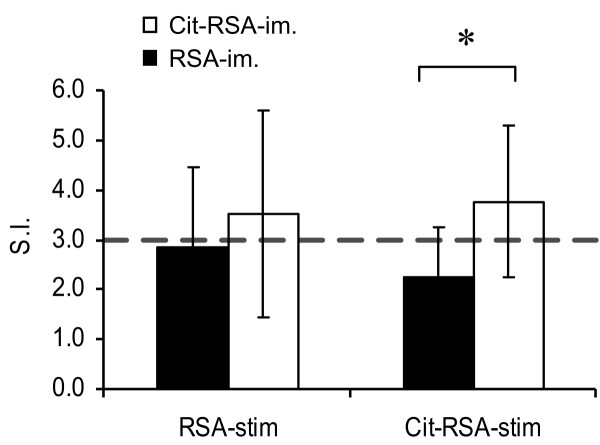
In vitro proliferative responses to rat serum albumin (RSA) and to citrullinated RSA (Cit-RSA). Stronger T cell responses to Cit-RSA (statistically significant) and to RSA (a trend) were observed in animals immunised with Cit-RSA (white bars) than in animals immunised with unmodified RSA (black bars). As previously shown (Fig. 4), the animals immunised with Cit-RSA developed a B cell response to RSA and to Cit-RSA, whereas the animals immunised with RSA did not. The dotted line suggests a hypothetical threshold that it is necessary to reach to induce B cell help and subsequent antibody production. Single cell suspensions were prepared from inguinal lymph nodes 10 days after immunisation, and stimulation index (S.I.) was calculated after 72 hours of culture in the presence of RSA or Cit-RSA (10 μg/ml). Results are means ± SD (n = 7 animals per group), representative of two replicate experiments. *P < 0.05.
Figure 6
Figure 6
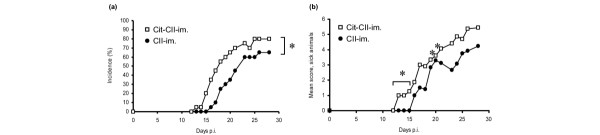
Citrullination of collagen type II (CII) increases its arthritogenic properties. Lew.1AV1 rats developed disease with higher incidence (a) and earlier onset as well as a trend towards higher mean arthritic score among the affected animals (b) when immunised with citrullinated CII (Cit-CII) (open squares) than when immunised with unmodified CII (filled circles). Rats were immunised with Cit-CII or unmodified CII and monitored for signs of arthritis for the next 30 days. Incidence (a) and mean score of sick animals (b) were calculated. Data include 20 animals per group from two pooled experiments. *P < 0.05.

References

    1. van Boekel MA, Vossenaar ER, van den Hoogen FH, van Venrooij WJ. Autoantibody systems in rheumatoid arthritis: specificity, sensitivity and diagnostic value. Arthritis Res. 2002;4:87–93. doi: 10.1186/ar395. - DOI - PMC - PubMed
    1. Steiner G, Smolen J. Autoantibodies in rheumatoid arthritis and their clinical significance. Arthritis Res. 2002;4(Suppl 2):S1–S5. doi: 10.1186/ar551. - DOI - PMC - PubMed
    1. Schellekens GA, de Jong BA, van den Hoogen FH, van de Putte LB, van Venrooij WJ. Citrulline is an essential constituent of antigenic determinants recognized by rheumatoid arthritis-specific autoantibodies. J Clin Invest. 1998;101:273–281. - PMC - PubMed
    1. Girbal-Neuhauser E, Durieux JJ, Arnaud M, Dalbon P, Sebbag M, Vincent C, Simon M, Senshu T, Masson-Bessiere C, Jolivet-Reynaud C, et al. The epitopes targeted by the rheumatoid arthritis-associated antifilaggrin autoantibodies are posttranslationally generated on various sites of (pro)filaggrin by deimination of arginine residues. J Immunol. 1999;162:585–594. - PubMed
    1. Senshu T, Akiyama K, Kan S, Asaga H, Ishigami A, Manabe M. Detection of deiminated proteins in rat skin: probing with a monospecific antibody after modification of citrulline residues. J Invest Dermatol. 1995;105:163–169. doi: 10.1111/1523-1747.ep12317070. - DOI - PubMed

Publication types