


Muscle strength, pain, and disease activity explain individual subdimensions of the Health Assessment Questionnaire disability index, especially in women with rheumatoid arthritis
- PMID: 15901635
- PMCID: PMC1797977
- DOI: 10.1136/ard.2004.034769
Muscle strength, pain, and disease activity explain individual subdimensions of the Health Assessment Questionnaire disability index, especially in women with rheumatoid arthritis
Abstract
Objective: To study the extent to which muscle strength and performance, pain, and disease activity are associated with the total Health Assessment Questionnaire (HAQ) disability index and its subdimensions in male and female patients with rheumatoid arthritis.
Methods: HAQ for functional capacity was completed by 135 patients with rheumatoid arthritis referred for orthopaedic surgery (74% women; mean (SD) age 62 (10) years; disease duration 19 (13) years, 70% positive for rheumatoid factor). Knee extension, trunk extension and flexion, grip strength, walking speed, and sit-to-stand test were measured to mirror physical function. Radiographs of hands and feet, pain, and the modified 28 joint disease activity score (DAS28) were also assessed.
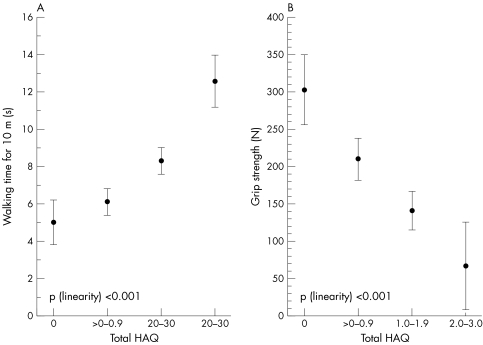
Results: Mean total HAQ was 1.08 (0.68) in women and 0.67 (0.70) in men (p = 0.0031). Women had greater disability than men in five of the eight subdimensions of the HAQ. Grip strength was 48%, knee extension strength 46%, trunk extension strength 54%, and trunk flexion strength 43% lower in women than in men. Knee extension strength was inversely correlated with walking time (r = -0.63 (95% confidence interval, -0.73 to -0.51)) and with sit-to-stand test (r = -0.47 (-0.60 to -0.31)). In an ordered logistic regression analysis in female rheumatoid patients, DAS28, pain, knee extension strength, and grip strength were associated with the total HAQ disability index.
Conclusions: Women reported greater disability than men both in the total HAQ and in the majority of its eight subdimensions. In addition to disease activity and pain, muscle strength has a major impact on disability especially in female rheumatoid patients.
References
-
- Janssen I, Heymsfield S B, Wang Z M, Ross R. Skeletal muscle mass and distribution in 468 men and women aged 18–88 yr. J Appl Physiol 20008981–88. - PubMed
-
- Kehayias J J, Fiatarone M A, Zhuang H, Roubenoff R. Total body potassium and body fat: relevance to aging. Am J Clin Nutr 199766904–910. - PubMed
-
- Lexell J, Downham D, Sjostrom M. Distribution of different fibre types in human skeletal muscles. Fibre type arrangement in m. vastus lateralis from three groups of healthy men between 15 and 83 years. J Neurol Sci 198672211–222. - PubMed
-
- Janssen I, Baumgartner R N, Ross R, Rosenberg I H, Roubenoff R. Skeletal muscle cutpoints associated with elevated physical disability risk in older men and women. Am J Epidemiol. 2004;15159413–421. - PubMed
-
- Frontera W R, Hughes V A, Lutz K J, Evans W J. A cross‐sectional study of muscle strength and mass in 45‐ to 78‐yr‐old men and women. J Appl Physiol 199171644–650. - PubMed
MeSH terms
LinkOut - more resources
Full Text Sources
Other Literature Sources
Medical
