. 2005 Jun 1;19(11):1365-75.
doi: 10.1101/gad.1305005. Epub 2005 May 18.

Histone deposition protein Asf1 maintains DNA replisome integrity and interacts with replication factor C

Affiliations

Histone deposition protein Asf1 maintains DNA replisome integrity and interacts with replication factor C

Alexa A Franco et al. Genes Dev. .

Abstract

Chromatin assembly and DNA replication are temporally coupled, and DNA replication in the absence of histone synthesis causes inviability. Here we demonstrate that chromatin assembly factor Asf1 also affects DNA replication. In budding yeast cells lacking Asf1, the amounts of several DNA replication proteins, including replication factor C (RFC), proliferating cell nuclear antigen (PCNA), and DNA polymerase epsilon (Pol epsilon), are reduced at stalled replication forks. In contrast, DNA polymerase alpha (Pol alpha) accumulates to higher than normal levels at stalled forks in asf1Delta cells. Using purified, recombinant proteins, we demonstrate that RFC directly binds Asf1 and can recruit Asf1 to DNA molecules in vitro. We conclude that histone chaperone protein Asf1 maintains a subset of replication elongation factors at stalled replication forks and directly interacts with the replication machinery.


Figures

Figure 1.
Figure 1.
Asf1 promotes chromosome replication when RFC function is altered. (A) Growth defects in asf1Δ rfc1-1 cells. Tenfold serial dilutions of exponentially growing yeast strains of the indicated genotypes were plated on rich media for 3 d at 30°C. (B) asf1Δ rfc1-1 cells accumulate with 2N DNA content. The indicated strains were grown to log phase at 30°C and DNA content was measured by flow cytometry. (C) asf1Δ rfc1-1 cells display bipolar spindles and chromosome segregation defects. Mitotic spindles were visualized in exponentially growing cells by immunostaining with anti-tubulin antibodies and nuclei were visualized by DAPI staining. Inset shows chromosome missegregation events visible in ∼1% of asf1Δ rfc1-1 cells. (D) asf1Δ rfc1-1 cells have an increased proportion of incompletely replicated chromosomes. Indicated yeast strains were grown to log phase at 30°C, and their isolated chromosomes were separated by pulse field gel electrophoresis. Total DNA was visualized by ethidium bromide (top), and Chromosome III was visualized by Southern blotting (bottom).
Figure 2.
Figure 2.
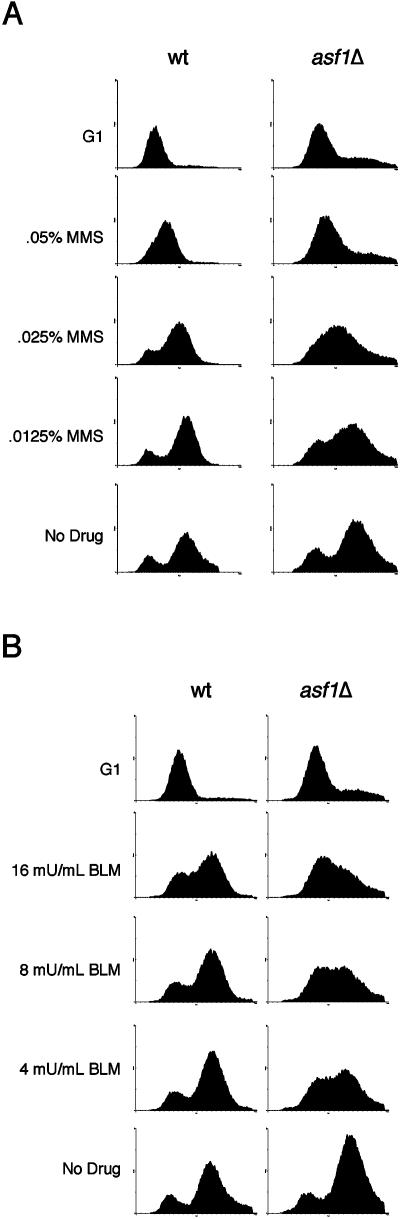
Asf1 is required for S-phase progression in the presence of DNA damaging agents. (A) Asf1 is required to complete DNA synthesis in the presence of low concentrations of MMS. Wild-type (WT) and asf1Δ mutant cells were arrested in G1 with α-factor and released into rich media containing the indicated concentration of MMS. Samples were harvested after 1 h and DNA content was measured by flow cytometry. (B) Asf1 promotes DNA synthesis in the presence of BLM. Cultures were treated as in A except that they were released into the indicated concentration of BLM.
Figure 3.
Figure 3.
Pol ε is displaced from stalled replication forks in asf1Δ mutant cells. (A) Pol ε-HA association with the origins in synchronized cells arrested with HU was assayed by ChIP followed by PCR analysis. Products were analyzed by native PAGE and ethidium bromide staining. (B) Quantitation of real-time PCR data. The amount of DNA recovered from wild-type (WT) and asf1Δ extracts is graphed relative to the untagged control for the early firing origins ARS607 and ARS305, as well as unreplicated regions 14 kb away from ARS607 (ARS607 + 14 kb) and 8 kb away from ARS305 (ARS305 + 8 kb). (C) asf1Δ mutant cells arrest in response to HU treatment. The strains used in the above ChIP experiment were synchronized in α-factor and released into HU. Samples were harvested every 30 min and DNA content measured by FACS. (D) Early origins replicate in asf1Δ cells. PCR products from an early (ARS305) and a late (ARS501) origin were quantified from cells arrested in α-factor (DNA α-factor) or HU (DNA HU) and expressed as a ratio (DNA HU/DNA α-factor). For all strains, twice as much ARS305 DNA was recovered from cells arrested in HU, indicating that early origin DNA duplicated. In contrast, the amount of ARS501 DNA did not double as expected because late origins do not fire in HU-arrested cells (Santocanale and Diffley 1998; Shirahige et al. 1998).
Figure 4.
Figure 4.
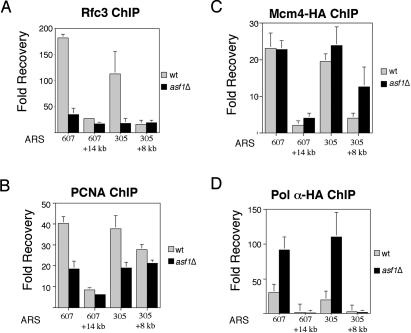
Differential replication fork protein stability at stalled forks in asf1Δ mutant cells. (A) Rfc3 localization to stalled replication forks requires Asf1. ChIP experiments were performed as described in Figure 3 except that the amount of Rfc3 associated with early origins was assayed using a polyclonal antibody. The amount of DNA recovered from wild-type (WT) and asf1Δ extracts is graphed relative to the amount recovered in the normal rabbit sera control for the early firing origins ARS607 and ARS305, as well as two unreplicated regions 14 kb away from ARS607 (ARS607 + 14 kb) and 8 kb away from ARS305 (ARS305 + 8). (B) PCNA localization to stalled replication forks is reduced in asf1Δ mutant cells. ChIP experiments were preformed and analyzed as described in A except that a polyclonal antibody raised against yeast PCNA was used. (C) Mcm4 localizes to stalled replication forks in the absence of Asf1. ChIP experiments were performed as described above and the amount of origin DNA that coprecipitated with HA-tagged Mcm4 (Mcm4-HA) is graphed relative to the untagged control. (D) Pol α association with stalled replication forks increases in the absence of Asf1. ChIP experiments were performed as described above and the amount of origin DNA that coprecipitated with HA-tagged Pol α (Pol α-HA) is graphed relative to the untagged control.
Figure 5.
Figure 5.
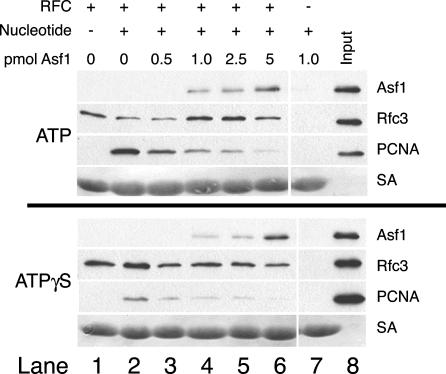
RFC recruits Asf1 to DNA. RFC (0.5 pmol) was incubated with 0.5-5.0 pmol of Asf1 or buffer as indicated and then combined with 1 pmol of primed, biotinylated DNA attached to streptavidin-agarose beads, 5 pmol PCNA, and the indicated nucleotide. Proteins associated with the DNA beads were separated by SDS-PAGE and visualized by immunoblotting. “SA” indicates streptavidin detected by Ponceau S staining, which serves as an internal control for protein recovery from the beads.
Figure 6.
Figure 6.
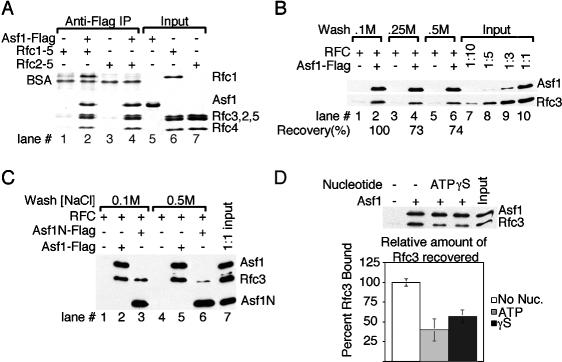
RFC interacts with Asf1 in solution. (A) RFC and Rfc2-5 coprecipitate with Asf1. Fifteen picomoles of Flag-tagged Asf1 were mixed with 15 pmol of either RFC or the Rfc2-5 subcomplex prior to precipitation with anti-Flag conjugated beads. After washing with buffer + 0.1 M NaCl, precipitated polypeptides were visualized by SDS-PAGE and Coomassie staining. (B) The interaction between Asf1 and RFC is resistant to 0.5 M NaCl. One picomole of Asf1-Flag and RFC were combined in buffer with 0.1 M NaCl and precipitated as above. Precipitates were washed with buffer containing either 0.1, 0.25 or 0.5 M NaCl as indicated and recovered proteins were detected by immunoblotting. The percentage of Rfc3 recovered in each lane relative to the amount in lane 2 is presented at the bottom. (C) Both full-length and the N terminus of Asf1 interact with RFC. Immunoprecipitates were washed with either 0.1 M NaCl (lanes 1-3) or 0.5 M NaCl (lanes 4-6) and detected by immunoblotting as above. (D) Nucleotide binding partially reverses the Asf1-RFC interaction. One picomole of RFC and 1 pmol of Asf1 were combined prior to the addition of the indicated nucleotides. The amount of Rfc3 that coprecipitated with Asf1-Flag was assayed by immunoblotting. Graphed are the averages of immunoprecipitations performed in triplicate.
Figure 7.
Figure 7.
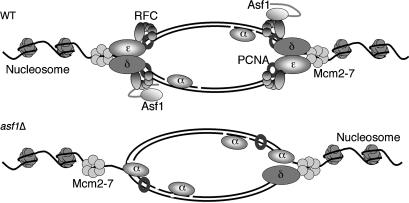
Asf1 interacts with RFC and maintains the replication elongation machinery at stalled forks. In wild-type cells, the integrity of the stalled replisome is maintained. In the absence of Asf1, components of the replication elongation machinery are lost from the replisome, including RFC, PCNA, and Pol ε. Note that the association of DNA Pol α with the stalled fork increases in the absence of Asf1. This may result from defects in the polymerase switch event or from uncoupling of the MCM complex from the replisome resulting in excess single-stranded DNA.

References

    1. Adams A.K. and Holm, C. 1996. Specific DNA replication mutations affect telomere length in Saccharomyces cerevisiae. Mol. Cell. Biol. 16: 4614-4620. - PMC - PubMed
    1. Aparicio O.M., Stout, A.M., and Bell, S.P. 1999. Differential assembly of Cdc45p and DNA polymerases at early and late origins of DNA replication. Proc. Natl. Acad. Sci. 96: 9130-9135. - PMC - PubMed
    1. Ayyagari R., Impellizzeri, K.J., Yoder, B.L., Gary, S.L., and Burgers, P.M. 1995. A mutational analysis of the yeast proliferating cell nuclear antigen indicates distinct roles in DNA replication and DNA repair. Mol. Cell. Biol. 15: 4420-4429. - PMC - PubMed
    1. Bastin-Shanower S.A. and Brill, S.J. 2001. Functional analysis of the four DNA binding domains of replication protein A. The role of RPA2 in ssDNA binding. J. Biol. Chem. 276: 36446-36453. - PMC - PubMed
    1. Bell S.P. and Dutta, A. 2002. DNA replication in eukaryotic cells. Annu. Rev. Biochem. 71: 333-374. - PubMed

Publication types