. 2005 Jun;187(11):3650-61.
doi: 10.1128/JB.187.11.3650-3661.2005.

Bordetella AlcS transporter functions in alcaligin siderophore export and is central to inducer sensing in positive regulation of alcaligin system gene expression

Affiliations

Bordetella AlcS transporter functions in alcaligin siderophore export and is central to inducer sensing in positive regulation of alcaligin system gene expression

Timothy J Brickman et al. J Bacteriol. 2005 Jun.

Abstract

Bordetella pertussis and Bordetella bronchiseptica, which are respiratory mucosal pathogens of mammals, produce and utilize the siderophore alcaligin to acquire iron in response to iron starvation. A predicted permease of the major facilitator superfamily class of membrane efflux pumps, AlcS (synonyms, OrfX and Bcr), was reported to be encoded within the alcaligin gene cluster. In this study, alcS null mutants were found to be defective in growth under iron starvation conditions, in iron source utilization, and in alcaligin export. trans complementation using cloned alcS genes of B. pertussis or B. bronchiseptica restored the wild-type phenotype to the alcS mutants. Although the levels of extracellular alcaligin measured in alcS strain culture fluids were severely reduced compared with the wild-type levels, alcS mutants had elevated levels of cell-associated alcaligin, implicating AlcS in alcaligin export. Interestingly, a deltaalcA mutation that eliminated alcaligin production suppressed the growth defects of alcS mutants. This suppression and the alcaligin production defect were reversed by trans complementation of the deltaalcA mutation in the double-mutant strain, confirming that the growth-defective phenotype of alcS mutants is associated with alcaligin production. In an alcA::mini-Tn5 lacZ1 operon fusion strain background, an alcS null mutation resulted in enhanced AlcR-dependent transcriptional responsiveness to alcaligin inducer; conversely, AlcS overproduction blunted the transcriptional response to alcaligin. These transcription studies indicate that the alcaligin exporter activity of AlcS is required to maintain appropriate intracellular alcaligin levels for normal inducer sensing and responsiveness necessary for positive regulation of alcaligin system gene expression.


Figures
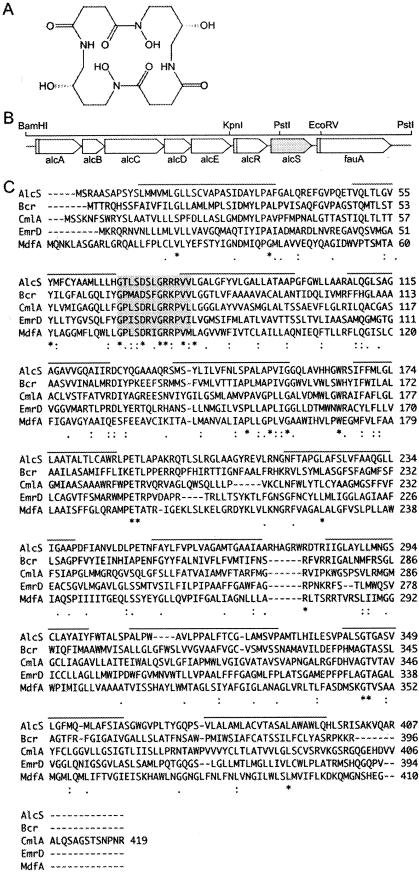
FIG. 1.
FIG. 1.
AlcS is a predicted MFS transporter encoded within the Bordetella alcaligin siderophore gene cluster. (A) Molecular structure of alcaligin siderophore [1,8(S),11,18(S)-tetrahydroxy-1,6,11,16-tetraazacycloeicosane-2,5,12,15-tetrone] produced by Bordetella species. (B) Spatial organization of the Bordetella alcaligin siderophore gene cluster. The linear genetic map represents an approximately 12-kb BamHI-PstI chromosomal DNA region of B. bronchiseptica and B. pertussis (41). The arrows indicate the transcriptional orientations of genes, and the open rectangles upstream from alcA, alcR, and fauA represent the locations of known Fur-regulated promoter-operator regions. The arrow representing the alcS gene is shaded. (C) Multiple-protein sequence alignment of AlcS with representative bacterial MFS transporters with known functions. The proteins and GenBank accession numbers are as follows: AlcS, the Bordetella alcaligin exporter protein (B. bronchiseptica accession no. NP_890434, B. pertussis accession no. NP_881089); E. coli Bcr bicyclomycin resistance protein (accession no. P28246); Pseudomonas aeruginosa chloramphenicol resistance protein CmlA (accession no. P32482); E. coli multidrug resistance protein EmrD (accession no. P31442); and E. coli multidrug resistance protein MdfA (accession no. CAA69997). In the ClustalW alignment consensussequence, asterisks indicate residues that are identical in all sequences, colons indicate conserved substitutions, and periods indicate semiconserved substitutions. Predicted transmembrane segments of AlcS are overlined, and motif A conserved among 12-transmembrane segment MFS proteins is shaded.
FIG. 2.
FIG. 2.
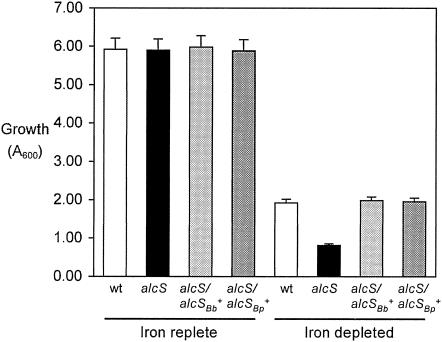
Growth yields of B. bronchiseptica strains. The bars indicate growth yields of B. bronchiseptica strains after 24 h of culture in iron-replete batch cultures (36 μM iron; iron-sufficient growth conditions that repress alcaligin production) and iron-depleted SS batch cultures, expressed as A600 (means ± standard deviations; n = 3). In iron-depleted SS batch cultures, growth of all strains was limited by the presence of only trace amounts of iron in the system. Cultures were initiated at a cell density of 0.05 ODU600l using washed cells from 24-h iron-replete SS seed cultures. Abbreviations for strains used are as follows: wt, B103N; alcS, BRM16; alcS/alcSBb+, BRM16 (pRK/alcSBb); alcS/alcSBp+, BRM16 (pRK/alcSBp)
FIG. 3.
FIG. 3.
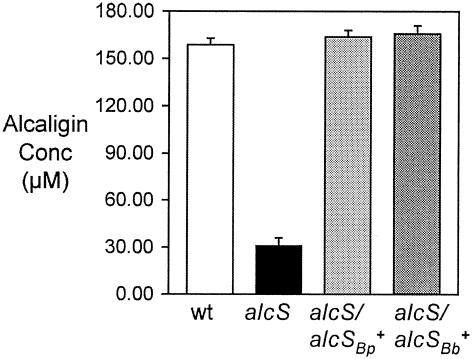
Alcaligin concentrations in cell-free culture supernatant fluids. Alcaligin concentrations in cell-free culture supernatant fluids after 24 h of growth in iron-depleted SS, expressed as alcaligin monomer concentrations (means ± standard deviations; n = 3), were measured by the quantitative CAS method. The concentrations shown were normalized to growth yields based on CFU/ml determinations. Abbreviations for strains used are as follows: wt, B013N; alcS, BRM16; alcS/alcSBb+, BRM16 (pRK/alcSBb); alcS/alcSBp+, BRM16 (pRK/alcSBp).
FIG. 4.
FIG. 4.
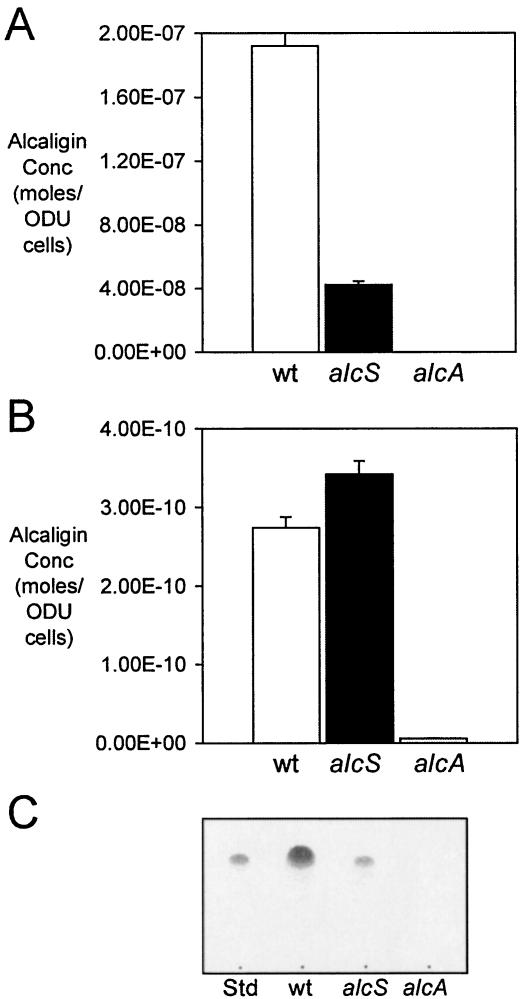
Extracellular and cell-associated alcaligin siderophore. Alcaligin production by B. bronchiseptica strains cultured for 24 h in iron-depleted SS, expressed as alcaligin monomer concentrations (means ± standard deviations; n = 3), was normalized to cell numbers (1 U of OD600 [ODU] = ∼2 × 10⁹ CFU). (A) Exported alcaligin as measured in cell-free culture supernatant fluids. (B) Cell-associated alcaligin production as measured in cell extracts. Abbreviations for strains used are as follows: wt, B013N; alcS, BRM16; alcA, BRM26. (C) Thin-layer chromatography of alcaligin extracted from cell-free culture supernatant fuids after 24 h growth in iron-depleted SS. Abbreviations for samples used; Std, 50 μg purified alcaligin; wt. B013N extract; alcS, BRM16 extract; alcA, BRM26 extract.
FIG. 5.
FIG. 5.
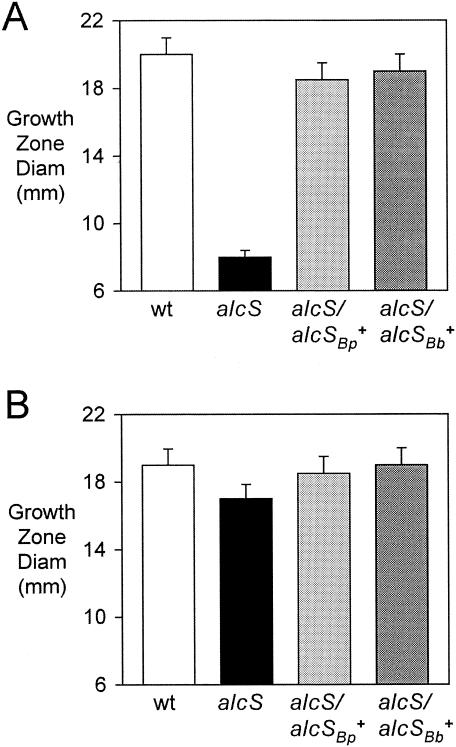
Feeding by nutritional iron sources. Feeding assays with B. bronchiseptica indicator strains were performed using iron-restricted EDDA agar plates as described in Materials and Methods. The bars indicate the mean diameters of growth stimulation zones, including the 6-mm diameter of the sample well, and the error bars indicate standard deviations (n =3). (A) Growth stimulation by 1.25 mM ferric chloride. (B) Growth stimulation by 300 μM alcaligin. Abbreviations for strains used are as follows: wt, B013N; alcS, BRM16; alcS/alcSBb+, BRM16 (pRK/alcSBp); alcS/alcSBp+, BRM16 (pRKalcSBp).
FIG. 6.
FIG. 6.
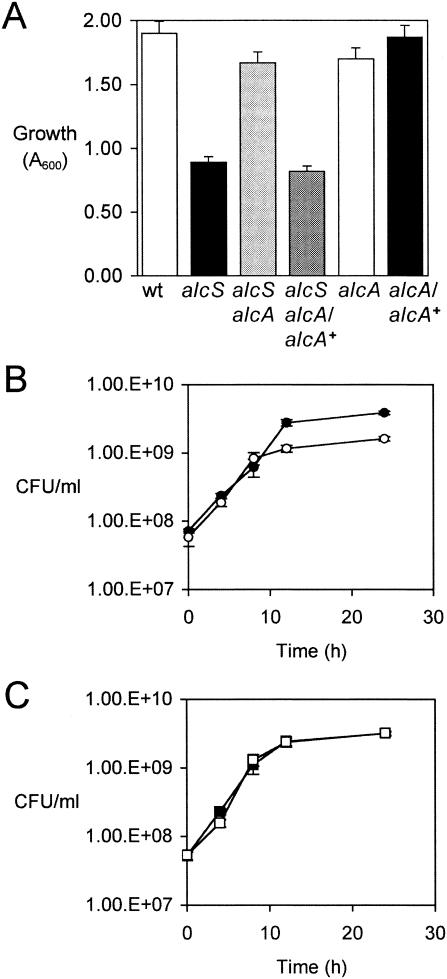
Iron starvation growth defect of alcS mutants is related to alcaligin production. (A) The bars indicate the mean growth yields of B. bronchiseptica strains, expressed as A600, and the error bars indicate standard deviations (n = 3) after 24 h of culture in iron-depleted SS batch cultures. Note that the growth of all strains was limited by the availability of only trace amounts of iron in this culture system, but alcaligin production by alcaligin-positive strains was maximized. Abbreviations for strains used are as follows: wt, B013N; alcS, BRM16; alcS alcA, BRM27; alcS alcA/alcA+, BRM27(pBB21); alcA, BRM26; alcA/alcA+, BRM26(pBB21). (B) Growth curves for B. bronchiseptica strains cultured in iron-depleted SS. Viable cell counts, expressed as CFU/ml (means ± standard deviations; n = 3), are shown. •, B013N (wild type); ○, BRM16 (alcS). (C) Growth curves for B. bronchiseptica strains cultured in iron-depleted SS. ▪, BRM26 (alcA); □, BRM27 (alcS alcA).
FIG. 7.
FIG. 7.
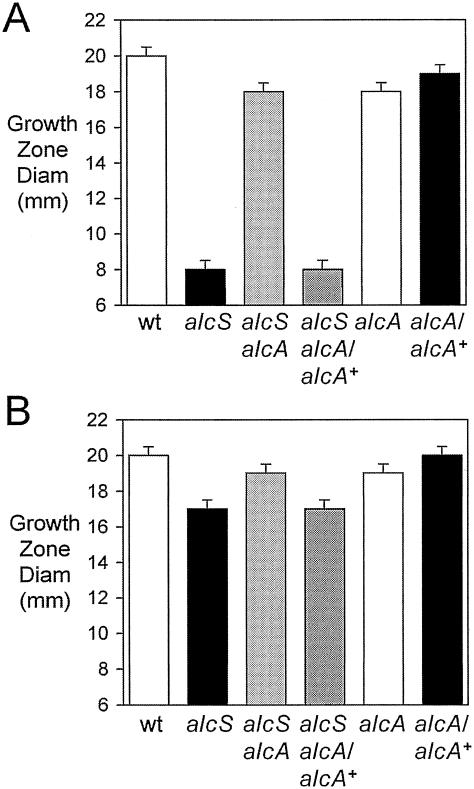
Feeding defects of alcS mutants are related to alcaligin production. The bars indicate the mean diameters of growth stimulation zones in iron-restricted EDDA agar plates, including the 6-mm diameter of the sample wells, and the error bars indicate standard deviations (n =3). Iron restriction by EDDA chelation resulted in alcaligin production by alcaligin-positive indicator bacteria seeded into the agar. (A) Growth stimulation by 1.25 mM ferric chloride. (B) Growth stimulation by 300 μM alcaligin. Abbreviations for strains used are as follows: wt, B013N; alcS, BRM16; alcS alcA, BRM27; alcS alcA/alcA+, BRM27(pBB21); alcA, BRM26; alcA/alcA+, BRM26(pBB21).
FIG. 8.
FIG. 8.
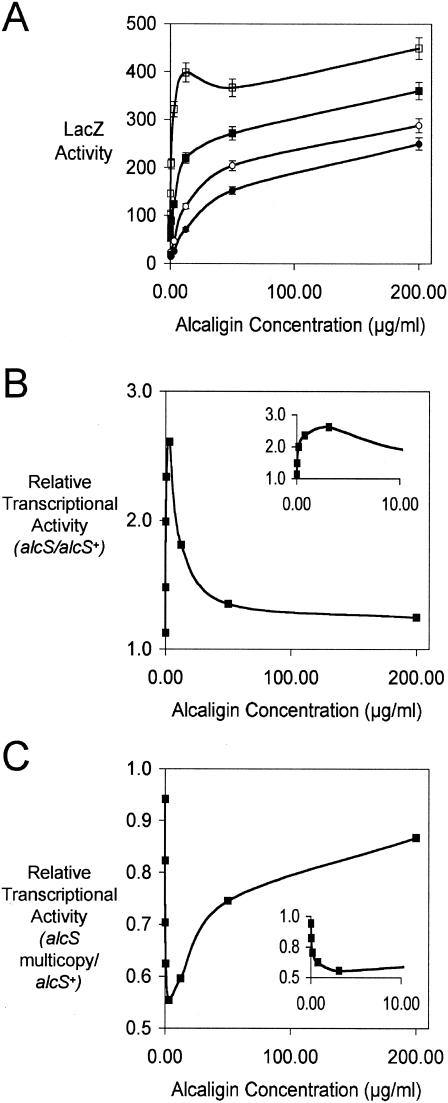
alcS expression affects inducer sensing and responsiveness in positive regulation of alcaligin gene transcription. (A) Transcriptional activity of alcA::mini-Tn5 lacZ1 fusion reporter strains, expressed in Miller units (means ± standard deviations; n = 3), after 24 h of culture in iron-depleted SS supplemented with alcaligin inducer at 0.00, 0.04, 0.20, 0.78, 3.13, 12.50, 50.00, and 200.00 μg/ml. The strains used were strains BRM1 (AlcS+) (▪), BRM30 (AlcS) (□), BRM1(pRK415) (AlcS+) (○), and BRM1(pRK/alcSBb+) (B. bronchiseptica AlcS overproducer) (•). (B) Relative transcriptional activity (mean LacZ activity of AlcS strain BRM30/mean LacZ activity of AlcS+ strain BRM1), plotted as a function of alcaligin inducer concentration. (Inset) Expanded portion of the graph, showing relative transcriptional activity as a function of inducer concentrations ranging from 0.00 to 10.00 μg/ml. (C) Relative transcriptional activity [mean LacZ activity of AlcS-overproducing strain BRM1(pRK/alcSBb+)/mean LacZ activity of AlcS+ strain BRM1(pRK415)], plotted as a function of alcaligin inducer concentration. (Inset) Expanded portion of the graph, showing relative transcriptional activity as a function of inducer concentrations ranging from 0.00 to 10.00 μg/ml.

References

    1. Alexeyev, M. F. 1995. Three kanamycin resistance gene cassettes with different polylinkers. BioTechniques 18:52, 54, 56. - PubMed
    1. Anderson, M. T., and S. K. Armstrong. 2004. The BfeR regulator mediates enterobactin-inducible expression of Bordetella enterobactin utilization genes. J. Bacteriol. 186:7302-7311. - PMC - PubMed
    1. Antoine, R., and C. Locht. 1992. Isolation and molecular characterization of a novel broad-host-range plasmid from Bordetella bronchiseptica with sequence similarities to plasmids from gram-positive organisms. Mol. Microbiol. 6:1785-1799. - PubMed
    1. Armstrong, S. K., and M. O. Clements. 1993. Isolation and characterization of Bordetella bronchiseptica mutants deficient in siderophore activity. J. Bacteriol. 175:1144-1152. - PMC - PubMed
    1. Bagg, A., and J. B. Neilands. 1987. Ferric uptake regulation protein acts as a repressor, employing iron(II) as a cofactor to bind the operator of an iron transport operon in Escherichia coli. Biochemistry 26:5471-5477. - PubMed

Publication types

MeSH terms

LinkOut - more resources