Comparative Study
. 2005 Aug;145(7):894-906.
doi: 10.1038/sj.bjp.0706251.

Benzodiazepine modulation of partial agonist efficacy and spontaneously active GABA(A) receptors supports an allosteric model of modulation

Affiliations
Comparative Study

Benzodiazepine modulation of partial agonist efficacy and spontaneously active GABA(A) receptors supports an allosteric model of modulation

Scott S Downing et al. Br J Pharmacol. 2005 Aug.

Abstract

Benzodiazepines (BZDs) have been used extensively for more than 40 years because of their high therapeutic index and low toxicity. Although BZDs are understood to act primarily as allosteric modulators of GABA(A) receptors, the mechanism of modulation is not well understood. The applicability of an allosteric model with two binding sites for gamma-aminobutyric acid (GABA) and one for a BZD-like modulator was investigated. This model predicts that BZDs should enhance the efficacy of partial agonists. Consistent with this prediction, diazepam increased the efficacy of the GABA(A) receptor partial agonist kojic amine in chick spinal cord neurons. To further test the validity of the model, the effects of diazepam, flurazepam, and zolpidem were examined using wild-type and spontaneously active mutant alpha1(L263S)beta3gamma2 GABA(A) receptors expressed in HEK-293 cells. In agreement with the predictions of the allosteric model, all three modulators acted as direct agonists for the spontaneously active receptors. The results indicate that BZD-like modulators enhance the amplitude of the GABA response by stabilizing the open channel active state relative to the inactive state by less than 1 kcal, which is similar to the energy of stabilization conferred by a single hydrogen bond.


Figures
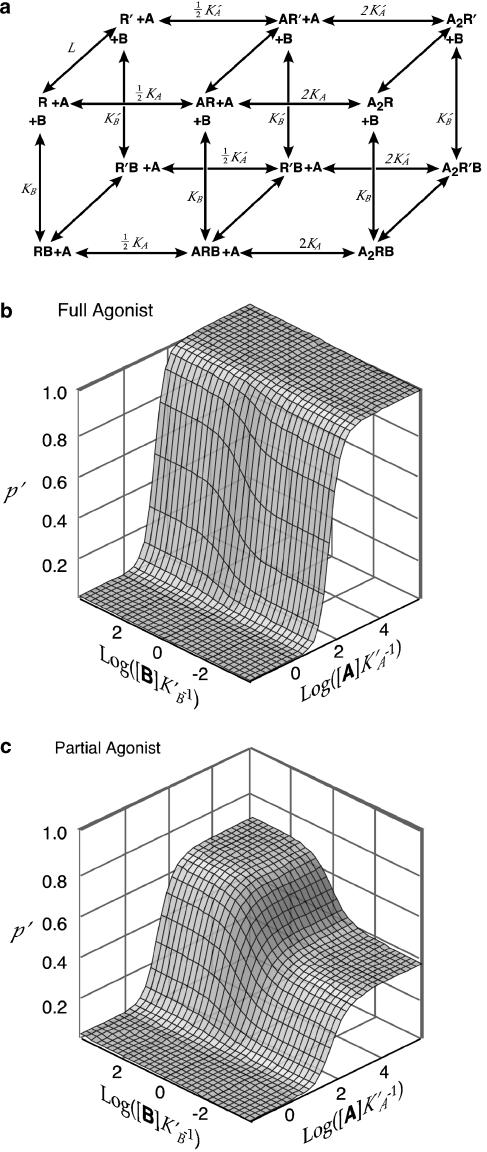
Figure 1
Figure 1
Two-state model of allosteric modulation. (a) Extended two site model with two identical sites for an agonist A and one site for a heterologous modulator B. R denotes the inactive conformation and R the active conformation. Binding sites for A are treated as identical; factors of 1/2 and 2 are stoichiometric. Desensitization is not modeled. (b) Simulated concentration–response–surface for interaction of a full agonist (A) with a positive modulator (B). Parameter values are L=3000, c=0.002, d=0.3. (c) Simulated concentration–response–surface for interaction of a partial agonist with a positive modulator. Parameter values are L=3000, c=0.025, d=0.3.
Figure 2
Figure 2
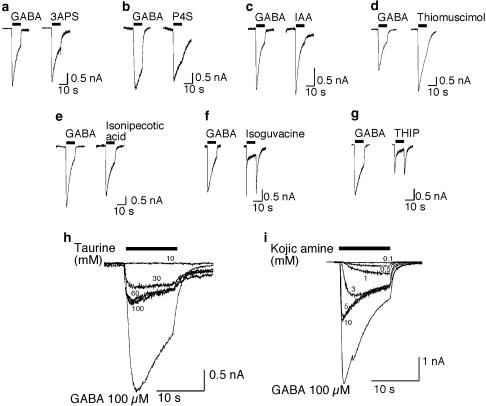
Identification of taurine and kojic amine as possible GABAA receptor partial agonists. Sample traces are shown illustrating responses of chick spinal cord neurons to (a) 100 μM 3APS; (b) 100 μM P4S; (c) 100 μM IAA; (d) 100 μM thiomuscimol; (e) 100 μM isonipecotic acid; (f) 100 μM isoguvacine; (g) 100 μM THIP; (h) 10–100 mM taurine; (i) 100 μM–10 mM kojic amine. Responses are compared to the response of the same neuron to 100 μM GABA, used as an internal standard. Bar indicates period of agonist exposure.
Figure 3
Figure 3
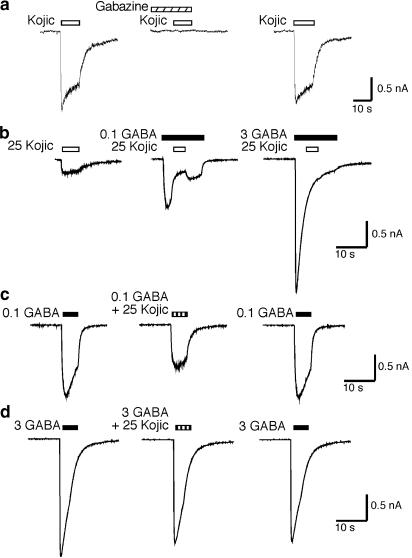
Surmountable antagonism of the GABA response by kojic amine. (a) Kojic amine-induced current is completely blocked by 100 μM gabazine. (b) Kojic amine (25 mM) reversibly inhibits the current induced by 100 μM GABA when applied midway during the GABA pulse. Inhibition by kojic amine is not observed when the concentration of GABA is increased to 3 mM. (c) Current induced by 100 μM GABA+25 mM kojic amine (middle trace) is less than that induced by 100 μM GABA alone (left trace). Trace on right shows recovery. (d) Simultaneous application of 3 mM GABA+25 mM kojic amine (middle) reveals little inhibition compared to 3 mM GABA alone (left and right traces).
Figure 4
Figure 4
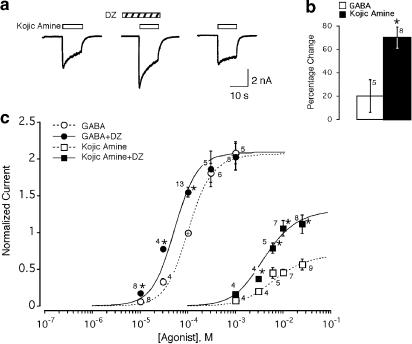
Modulation of GABA and kojic amine concentration–response curves by DZ. (a) DZ (1 μM) enhances the 10 mM kojic amine response. (b) Effect of DZ on maximal GABA and kojic amine responses. Bars show the percentage change in the 1 mM GABA response and 25 mM kojic amine response in the presence of 1 μM DZ. Number of cells tested is shown adjacent. *Indicates significant change (P⩽0.01, paired two-tail t-test). (c) Pooled concentration–response curves for GABA and kojic amine alone and in the presence of 1 μM DZ. Responses are normalized to the 100 μM GABA response of the same neuron (indicated by +). Smooth curves are calculated using Equation (1) with the parameters determined by simultaneous least-squares fitting of the entire data set to Equation (1). Fitted parameters are cGABA=0.002, cKojic=0.026, dDZ=0.29. As the experiments were carried out at a single saturating concentration of DZ, the results provide no information about KDZ, which was fixed at 50 nM. Since equally good fits were obtained over a large range of values of L, L was fixed and set equal to 3000. Error bars indicate s.e.m. Number of neurons tested is shown adjacent. *Indicates significant effect of DZ relative to paired GABA response of same neuron in the absence of DZ (P<0.03, paired t-test).
Figure 5
Figure 5
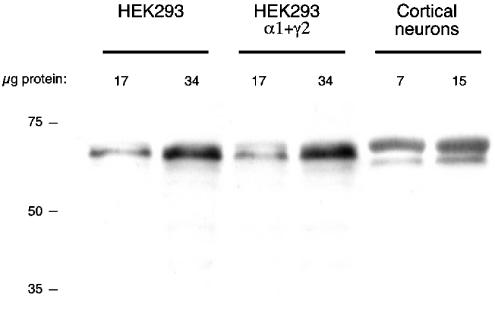
Untransfected HEK293 cells contain endogenous GABAA receptor β subunit protein. Results of a Western blot analysis of total protein from untransfected HEK293 cells, HEK293 cells transfected with GABAA receptor α1 and γ2 subunits, and rat cerebral cortical cultured neurons.
Figure 6
Figure 6
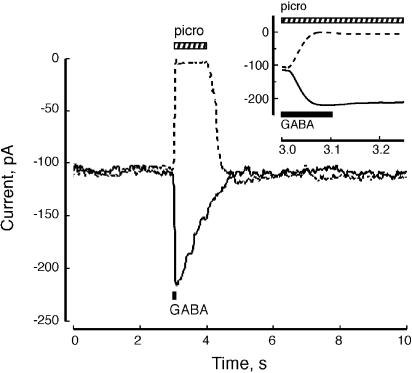
Mutant receptors exhibit picrotoxin-sensitive holding current. Application of 1 mM picrotoxin reversibly inhibited the holding current of HEK293 cells expressing α1L263Sβ3γ2 subunits. Response to 100 μM GABA is of similar magnitude but opposite direction, indicating that about half of the GABAA receptor channels are spontaneously active. Inset: Same data shown with an expanded time base.
Figure 7
Figure 7
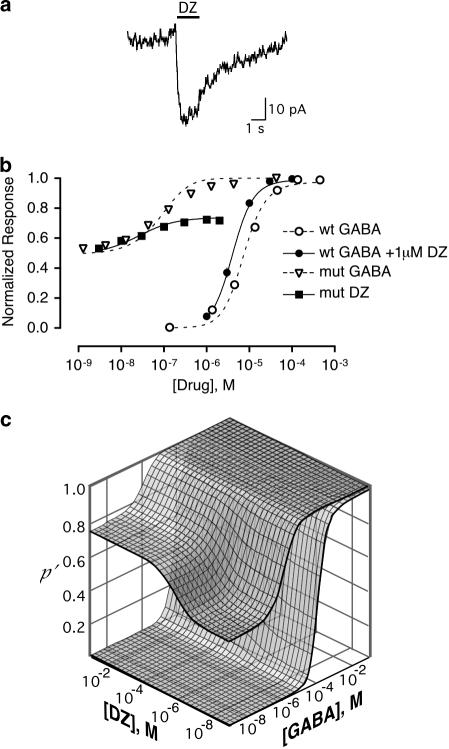
Diazepam modulation of GABA-induced current of wild-type receptor and spontaneous current of mutant receptor is consistent with an allosteric model. (a) Response of α1L263S receptor to 1 μM DZ alone. (b) Concentration–response dependence of activation of the wild-type and α1L263S mutant receptors by GABA and diazepam. Response of wild-type receptor to GABA alone and to GABA in the presence of 1 μM DZ is shown, along with the response of α1L263S mutant GABAA receptors to DZ alone and GABA alone. Error bars indicate standard error (n⩾5). Smooth curves are calculated from Equation (1) based upon simultaneous fits of the entire data set to Equation (1). Parameters are given in Table 1. (c) Dose–response surfaces for GABA and DZ acting at wild-type or α1L263S mutant GABAA receptors. Surfaces were calculated from Equation (1) using the parameters in Table 1.
Figure 8
Figure 8
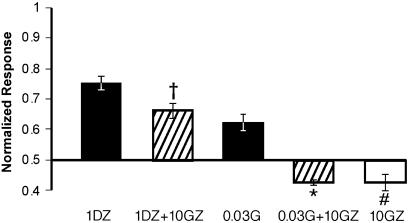
DZ-induced current is resistant to gabazine. Gabazine (GZ; 10 μM) completely blocked the response of HEK293 cells expressing αL263Sβ3γ2 subunits to 0.03 μM GABA (G), but failed to block the response to 1 μM DZ alone. Gabazine alone slightly inhibited the spontaneous current of the mutant receptor. Responses are scaled to full range of activation (i.e. the sum of the picrotoxin-sensitive current and the maximal GABA current), with the abscissa set at the level of the spontaneous (picrotoxin-sensitive) current. Bars show mean normalized current±s.e.m (n=6). *Significantly different from GABA alone (P<0.03, unpaired two-tail t-test). Significantly different from DZ alone (P<0.03, unpaired two-tail t-test). #Significant decrease in holding current (P<0.001 one sample two-tail t-test).
Figure 9
Figure 9
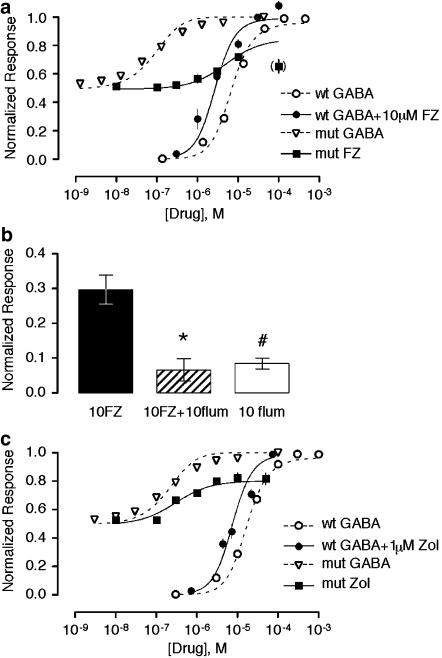
Modulation by FZ and zolpidem of GABA-induced current of wild-type receptor and spontaneous current of mutant receptor and is consistent with an allosteric model. (a) Response of wild-type receptor to GABA alone and to GABA in the presence of 1 μM FZ is shown, along with the response of α1L263S mutant GABAA receptors to FZ alone and GABA alone. Error bars indicate standard error (n⩾4). Smooth curves are calculated based upon simultaneous fits of the entire dataset (except for the highest concentration of FZ alone, data point in parentheses) to Equation (1). Parameters are given in Table 1. (b) FZ-induced activation is inhibited by the BZD antagonist flumazenil (flum). *Significantly less than FZ alone (P=0.0006); #Significantly greater than 0 (P<0.003). (c) Response of wild-type receptor to GABA alone and to GABA in the presence of 1 μM zolpidem (Zol) is shown, along with the response of α1L263S mutant GABAA receptors to zolpidem alone and GABA alone. Smooth curves are calculated based upon simultaneous fits of the entire dataset to Equation (1). Parameters are given in Table 1. Error bars indicate standard error (n⩾5). Results for GABA alone are the same as in Figure 7, and are repeated for comparison.
Figure 10
Figure 10
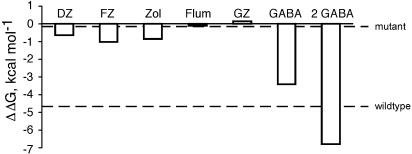
Energetics of GABAA receptor modulation. Difference in energy of binding to the active and inactive states was calculated as ΔΔGbinding=RT ln(d), using the values in Table 1. Dashed line indicates the ΔΔGbinding required to activate 50% of wild-type or α1L263S mutant receptors.

References

    1. BIANCHI M.T., MACDONALD R.L. Agonist trapping by GABAA receptor channels. J. Neurosci. 2001;21:9083–9091. - PMC - PubMed
    1. CELENTANO J.J., GIBBS T.T., FARB D.H. Negative modulation of the GABA response by extracellular zinc. Mol. Pharmacol. 1991;40:766–773. - PubMed
    1. CHAN C.Y., FARB D.H. Modulation of neurotransmitter action: control of the γ-aminobutyric acid response through the benzodiazepine receptor. J. Neurosci. 1985;5:2365–2373. - PMC - PubMed
    1. CHANG Y., WEISS D.S. Allosteric activation mechanism of the α1β2γ2 γ-aminobutyric acid type A receptor revealed by mutation of the conserved M2 leucine. Biophys. J. 1999;77:2542–2551. - PMC - PubMed
    1. CHOI D.W., FARB D.H., FISCHBACH G.D. Chlordiazepoxide selectively augments GABA action in spinal cord cell cultures. Nat. (London) 1977;269:342–344. - PubMed

Publication types