


High prevalence of glucose-6-phosphate dehydrogenase deficiency without gene mutation suggests a novel genetic mechanism predisposing to ketosis-prone diabetes
- PMID: 15914531
- PMCID: PMC6143174
- DOI: 10.1210/jc.2004-2545
High prevalence of glucose-6-phosphate dehydrogenase deficiency without gene mutation suggests a novel genetic mechanism predisposing to ketosis-prone diabetes
Abstract
Context: Ketosis-prone diabetes (KPD) is mostly observed in males of West African descent and is characterized by phasic or permanent insulin dependence without apparent autoimmune process.
Objective: KPD subjects display a propensity to hyperglycemia-induced acute insulin deficiency, suggesting that they exhibit a propensity to oxidative stress in beta-cells. The enzyme glucose-6-phosphate dehydrogenase (G6PD) is a defense mechanism against oxidative stress, and G6PD deficiency, an X-linked genetic disorder with male predominance, is frequent in West Africans. We hypothesized that mutations in the G6PD gene could predispose to KPD.
Design: We studied G6PD erythrocyte enzyme activity and the insulin secretory reserve (glucagon-stimulated C peptide) in a cohort of hospitalized West Africans with KPD (n = 59) or type 2 diabetes (T2DM; n = 59) and in normoglycemic controls (n = 55). We also studied the G6PD gene in an extended population of KPD patients (n = 100), T2DM patients (n = 59), and controls (n = 85).
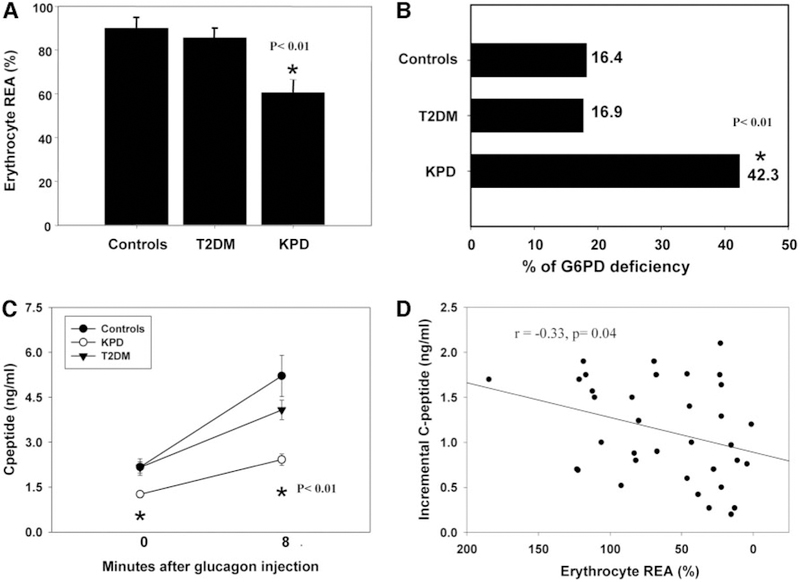
Results: The prevalence of G6PD deficiency was higher in KPD than in T2DM and controls (42.3%; 16.9%; 16.4%; P = 0.01). In KPD, but not in T2DM, insulin deficiency was proportional to the decreased G6PD activity (r = 0.33; P = 0.04). We found no increase in the prevalence of G6PD gene mutations in KPD compared with T2DM and controls. Rather, we found a 20.3% prevalence of G6PD deficiency in KPD without gene mutation.
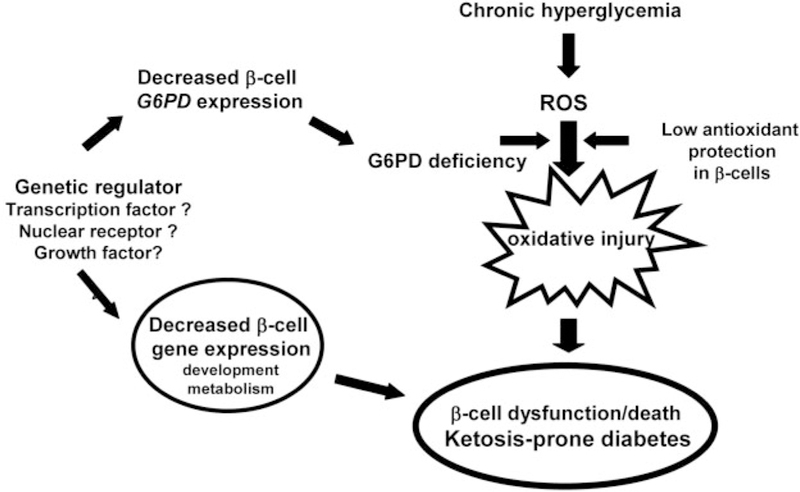
Conclusions: This study suggests that 1) G6PD deficiency alone is not causative of KPD; and 2) alterations in genes controlling both insulin secretion and G6PD-mediated antioxidant defenses may contribute to the predisposition to KPD in West Africans.
Figures
References
-
- Mauvais-Jarvis F, Sobngwi E, Porcher R, Riveline JP, Kevorkian JP, Vaisse C, Guillausseau PJ, Charpentier G, Vexiau P, Gautier JF 2004. Ketosis-prone type 2 diabetes in patients of sub-Saharan African origin: clinical pathophysiology and natural history of β-cell dysfunction and insulin resistance. Diabetes 53:645–653 - PubMed
-
- Umpierrez GE, Casals MM, Gebhart SP, Mixon PS, Clark WS, Phillips LS 1995. Diabetic ketoacidosis in obese African-Americans. Diabetes 44:790–795 - PubMed
-
- Poitout V, Robertson RP 2002. Minireview: secondary β-cell failure in type 2 diabetes: a convergence of glucotoxicity and lipotoxicity. Endocrinology 143: 339–342 - PubMed
-
- Prentki M, Joly E, El-Assaad W, Roduit R 2002. Malonyl-CoA signaling, lipid partitioning, and glucolipotoxicity: role in β-cell adaptation and failure in the etiology of diabetes. Diabetes 51(Suppl 3):S405–S413 - PubMed
Publication types
MeSH terms
Substances
Grants and funding
LinkOut - more resources
Full Text Sources
Medical
Miscellaneous
