National trends in statin use by coronary heart disease risk category
- PMID: 15916463
- PMCID: PMC1140942
- DOI: 10.1371/journal.pmed.0020123
National trends in statin use by coronary heart disease risk category
Abstract
Background: Only limited research tracks United States trends in the use of statins recorded during outpatient visits, particularly use by patients at moderate to high cardiovascular risk.
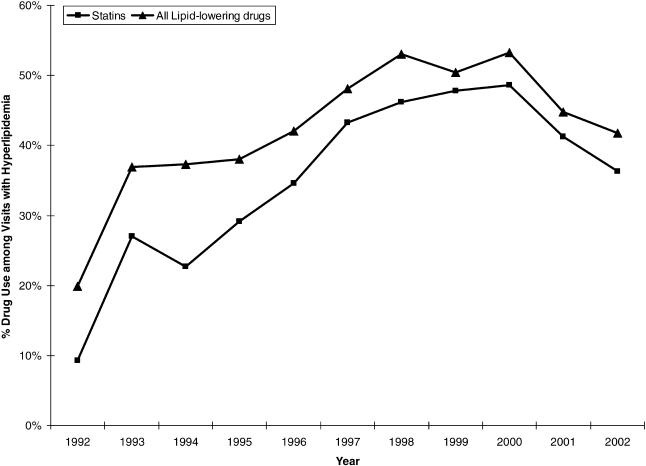
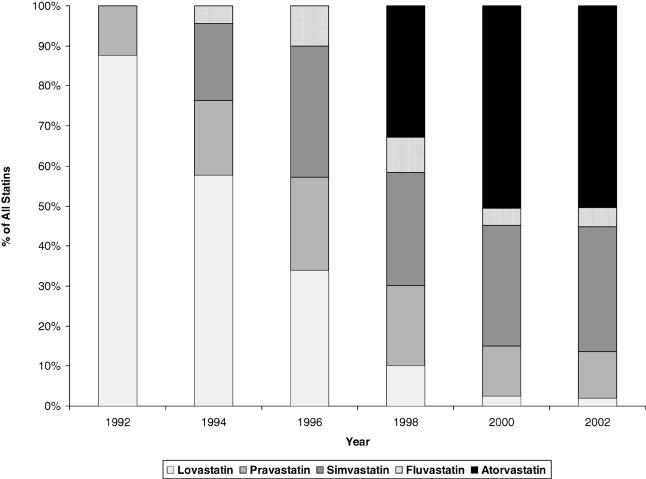
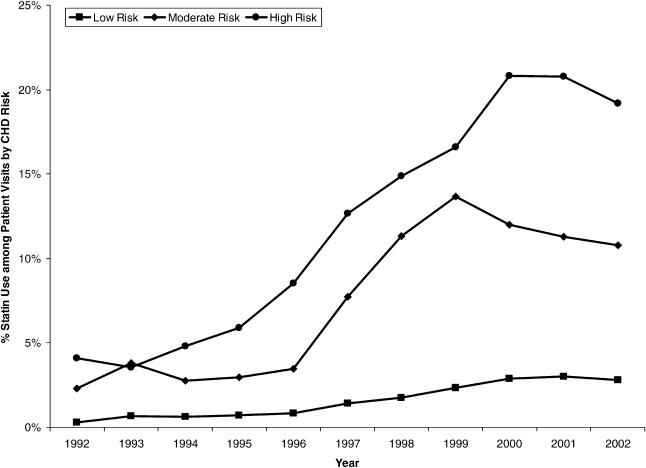
Methods and findings: Data collected between 1992 and 2002 in two federally administered surveys provided national estimates of statin use among ambulatory patients, stratified by coronary heart disease risk based on risk factor counting and clinical diagnoses. Statin use grew from 47% of all lipid-lowering medications in 1992 to 87% in 2002, with atorvastatin being the leading medication in 2002. Statin use by patients with hyperlipidemia, as recorded by the number of patient visits, increased significantly from 9% of patient visits in 1992 to 49% in 2000 but then declined to 36% in 2002. Absolute increases in the rate of statin use were greatest for high-risk patients, from 4% of patient visits in 1992 to 19% in 2002. Use among moderate-risk patients increased from 2% of patient visits in 1992 to 14% in 1999 but showed no continued growth subsequently. In 2002, 1 y after the release of the Adult Treatment Panel III recommendations, treatment gaps in statin use were detected for more than 50% of outpatient visits by moderate- and high-risk patients with reported hyperlipidemia. Lower statin use was independently associated with younger patient age, female gender, African American race (versus non-Hispanic white), and non-cardiologist care.
Conclusion: Despite notable improvements in the past decade, clinical practice fails to institute recommended statin therapy during many ambulatory visits of patients at moderate-to-high cardiovascular risk. Innovative approaches are needed to promote appropriate, more aggressive statin use for eligible patients.
Conflict of interest statement
Figures
References
-
- American Heart Association. Heart disease and stroke statistics—2003 Update. Dallas Texas: American Heart Association. Available: http://www.americanheart.org/downloadable/heart/10590179711482003HDSStat... . 2002 Accessed 23 March 2005.
-
- Siegel D, Lopez J, Meier J. Use of cholesterol-lowering medications in the United States from 1991 to 1997. Am J Med. 2000;108:496–499. - PubMed
-
- Expert Panel on Detection, Evaluation, and Treatment of High Blood Cholesterol in Adults. Executive Summary of The Third Report of The National Cholesterol Education Program (NCEP) Expert Panel on Detection, Evaluation, And Treatment of High Blood Cholesterol In Adults (Adult Treatment Panel III) JAMA. 2001;285:2486–2497. - PubMed
Publication types
MeSH terms
Substances
Grants and funding
LinkOut - more resources
Full Text Sources
Medical
Miscellaneous