Comparative Study
. 2005 May 25;25(21):5109-16.
doi: 10.1523/JNEUROSCI.0237-05.2005.

Extracellular cations sensitize and gate capsaicin receptor TRPV1 modulating pain signaling

Affiliations
Comparative Study

Extracellular cations sensitize and gate capsaicin receptor TRPV1 modulating pain signaling

Gerard P Ahern et al. J Neurosci. .

Abstract

Transient receptor potential (TRP) channels detect diverse sensory stimuli, including alterations in osmolarity. However, a molecular detector of noxious hypertonic stimuli has not yet been identified. We show here that acute pain-related behavior evoked by elevated ionic strength is abolished in TRP vanilloid subtype 1 (TRPV1)-null mice and inhibited by iodoresiniferatoxin, a potent TRPV1 antagonist. Electrophysiological recordings demonstrate a novel form of ion channel modulation by which extracellular Na+, Mg2+, and Ca2+ ions sensitize and activate the capsaicin receptor, TRPV1. At room temperature, increasing extracellular Mg2+ (from 1 to 5 mM) or Na+ (+50 mM) increased ligand-activated currents up to fourfold, and 10 mM Mg2+ reduced the EC50 for activation by capsaicin from 890 to 450 nM. Moreover, concentrations of divalent cations >10 mM directly gate the receptor. These effects occur via electrostatic interactions with two glutamates (E600 and E648) formerly identified as proton-binding residues. Furthermore, phospholipase C-mediated signaling enhances the effects of cations, and physiological concentrations of cations contribute to the bradykinin-evoked activation of TRPV1 and the sensitization of the receptor to heat. Thus, the modulation of TRPV1 by cationic strength may contribute to inflammatory pain signaling.


Figures
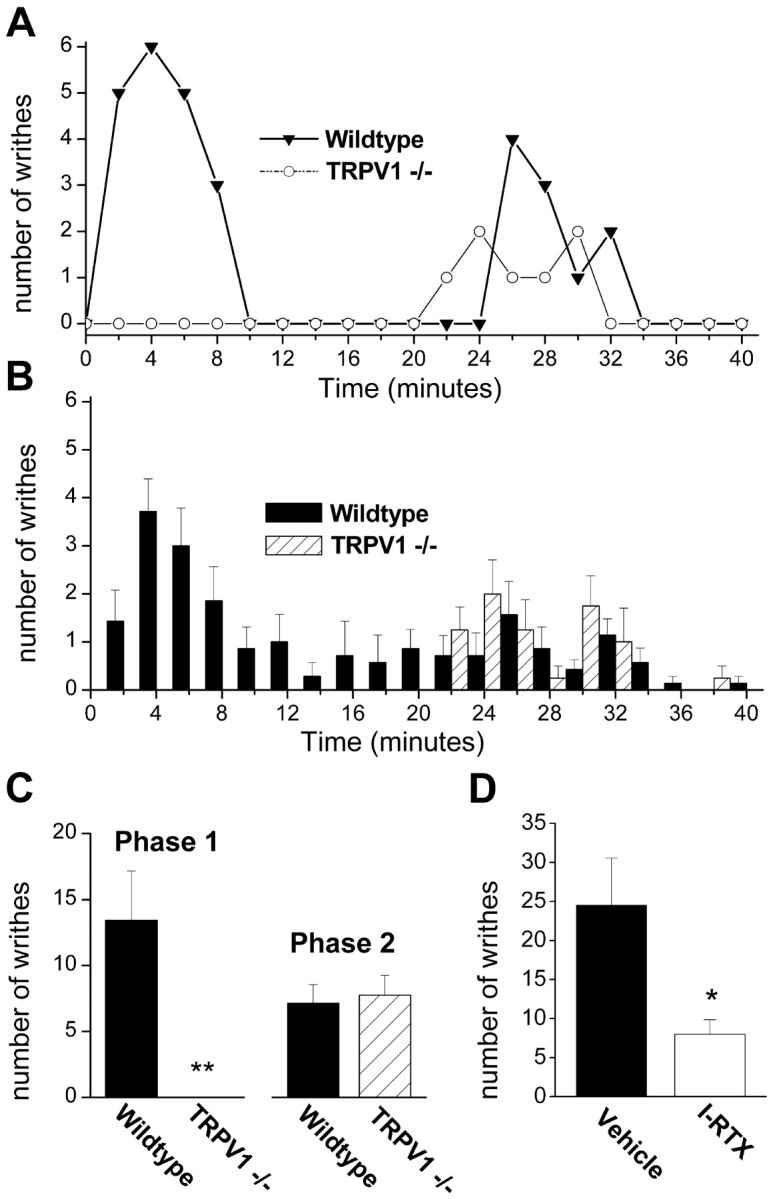
Figure 1.
Figure 1.
Mg2+ evokes visceral pain in mice via the activation of TRPV1. A, B, Time distribution of writhes (2 min bins) for 40 min after intraperitoneal injection of MgSO4 heptahydrate (12 mg/ml, 10 ml/kg). Responses of individual wild-type and TRPV1-/- mice (C57BL/6J) are shown in A, and mean responses of seven wild-type and four TRPV1-/- mice are shown in B. C, Mean number of writhes for wild-type and TRPV1-/- mice for the first phase (0-18 min) and second phase (18-40 min) of writhing; **p < 0.01. D, Mean number of writhes over 10 min for CBA mice after injection with anhydrous MgSO4 (12 mg/ml, 10 ml/kg; n = 3-4); *p < 0.05. Mice were preinjected (10 ml/kg, s.c.) with either 1 μmol/kg I-RTX or vehicle (1% EtOH in 0.9% saline) 1 h before MgSO4 injection. Error bars represent SEM.
Figure 2.
Figure 2.
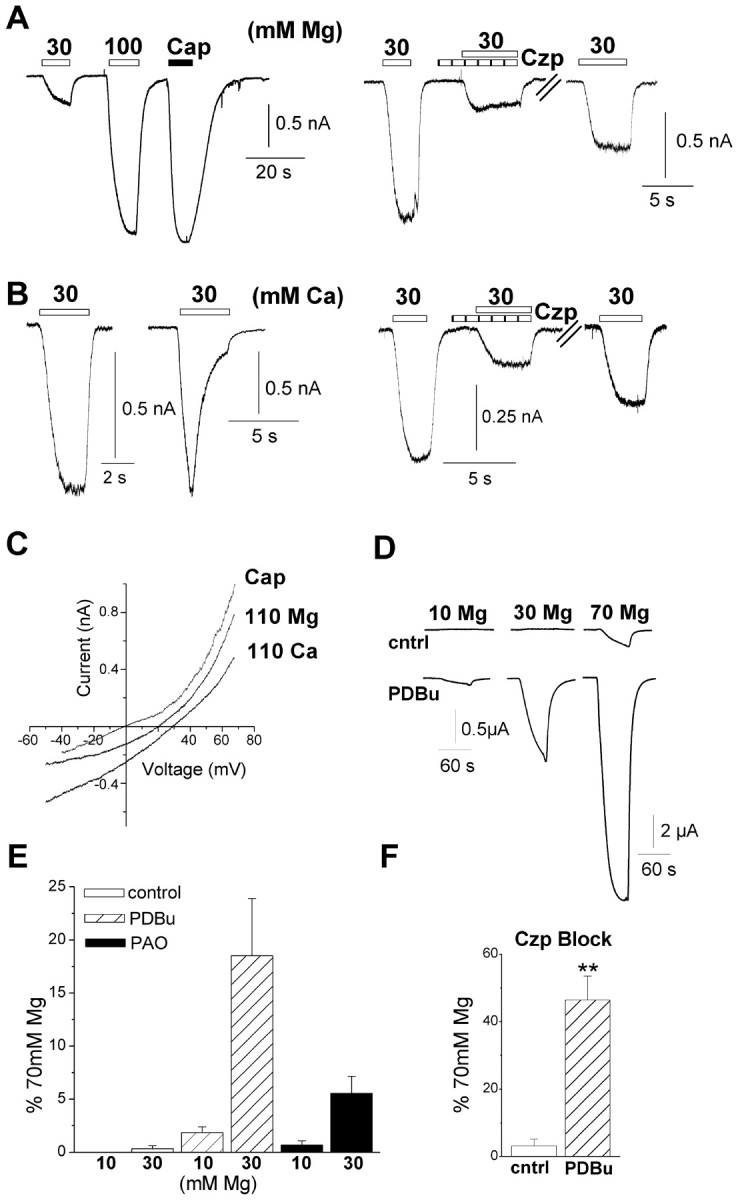
Extracellular cations activate TRPV1 currents in HEK293 cells and oocytes. A, HEK293 cells were voltage clamped at -50 mV in a nominally Ca2+-free medium with a CsCl pipette solution. Representative currents evoked by MgCl2 (30 and 100 mm) and capsaicin (Cap; 100 nm) in TRPV1-expressing HEK293 cells (left) and reversible inhibition with capsazepine (Czp; 5 μm; right). B, Representative currents evoked by 30 mm CaCl2 (left) that exhibit noninactivating (9 of 12 cells) and inactivating (3 of 12 cells) responses and reversible inhibition by capsazepine (5 μm; right). C, Current-voltage relationship for responses evoked by MgCl2 and CaCl2 (110 mm) in a single HEK293 cell compared with the response evoked by 100 nm capsaicin in control solution from a different cell (the baseline current under control conditions is subtracted from each trace). The mean reversal potentials for MgCl2 and CaCl2 from four cells were +18 ± 2 and +31 ± 2 mV, respectively. D, Currents in TRPV1-expressing oocytes evoked by 10, 30, and 70 mm MgCl2 before and after 3 min treatment with 100 nm PDBu. Note the different scale for the bottom right trace. E, Mean current evoked by 10 and 30 mm Mg2+ normalized to the current evoked by 70 mm concentrations, under control conditions (open bar) or after pretreatment with 100 nm PDBu (striped bar) and 30 μm PAO (filled bar). Data are mean of three to five oocytes. F, Currents evoked by 70 mm MgCl2 are inhibited by capsazepine (5 μm) under control conditions (cntrl, n = 4) and, to a lesser extent, after PDBu treatment (n = 5; **p < 0.001 PDBu compared with control). Error bars represent SEM.
Figure 3.
Figure 3.
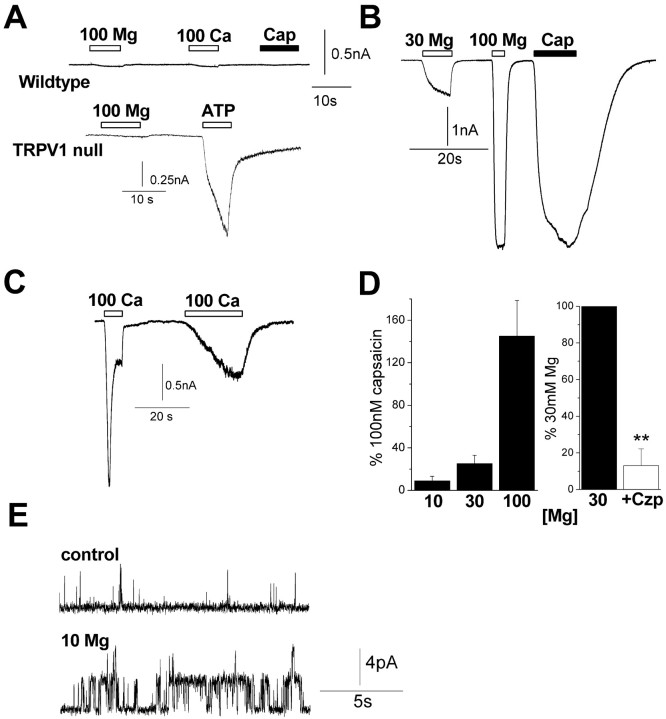
Mg2+ and Ca2+ directly activate TRPV1 in sensory neurons. Neurons were voltage clamped at -60 mV in a nominally Ca2+-free medium with a CsCl pipette solution. A, Response of a capsaicin (Cap)-insensitive neuron (top) to 100 mm Mg2+, 100 mm Ca2+, and 100 nm capsaicin and response of a neuron cultured from a TRPV1-null mouse (bottom) to 100 mm Mg2+ and 100 μm ATP. B, Mg2+ (30 and 100 mm)-evoked inward currents in a neuron that responded to capsaicin (100 nm). C, Ca2+ (100 mm)-evoked currents that exhibited desensitization. D, Dose-dependent activation of currents by 30-100 mm Mg2+ (n = 4-9 for each point) and comparison with 100 nm capsaicin (n = 14; left). Block of 30 mm Mg2+ with 5 μm capsazepine (Czp; n = 3; right); **p < 0.01. E, Mg2+ (10 mm)-activated TRPV1 channels in an outside-out patch (holding potential, +50 mV). Error bars represent SEM.
Figure 4.
Figure 4.
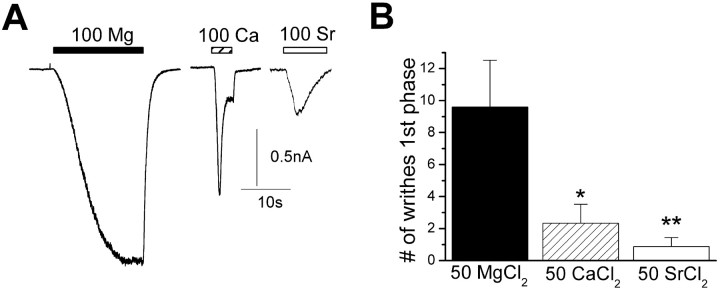
Cation-induced writhing behavior correlates with activation of TRPV1. A, Representative currents evoked by 100 mm MgCl2, CaCl2, and SrCl2. Mg2+ produces sustained inward currents; in contrast, both Ca2+ and Sr2+ elicit transient, desensitizing responses. B, Mean number of writhes within 16 min (first phase) after intraperitoneal injection (10 ml/kg) of 50 mm MgCl2, CaCl2, or SrCl2 (*p < 0.05 and **p < 0.001 compared with MgCl2). Error bars represent SEM.
Figure 5.
Figure 5.
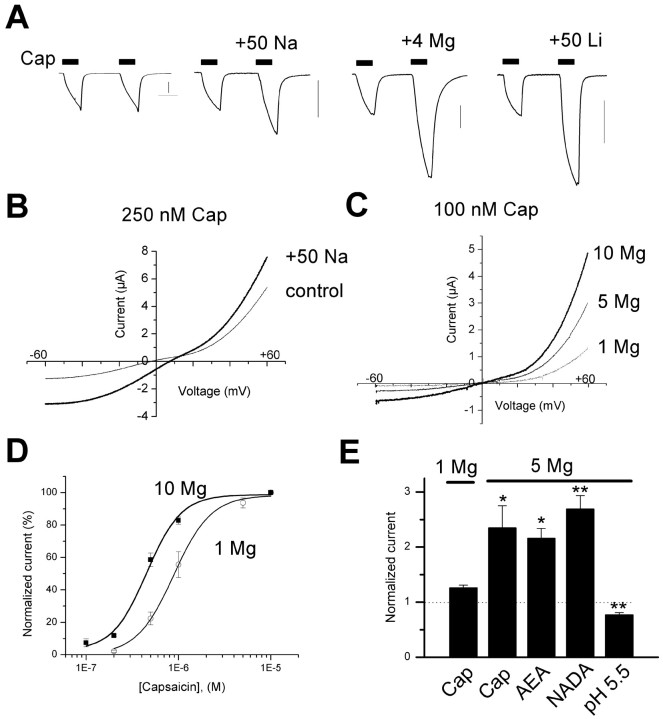
Extracellular cations enhance TRPV1 currents in oocytes. A, Currents evoked by successive 60 s applications of 500 nm capsaicin (Cap) in normal buffer (100 mm NaCl/1 mm MgCl2) or buffer supplemented with 50 mm NaCl, 4 mm MgCl2, or 50 mm LiCl. Traces shown are from four separate oocytes. Calibration, 2 μA. B, Current-voltage relationships for TRPV1 in oocytes activated by 250 nm capsaicin before and after the addition of 50 mm NaCl. C, Current-voltage relationship for TRPV1 activated by 100 nm capsaicin with 1, 5, and 10 mm Mg2+ in the extracellular solutions. D, Dose-response relationship for capsaicin-activated currents in 1 or 10 mm Mg2+. Each point is the mean of four to eight oocytes, and the smooth lines are best fits to a Hill function. EC50 values were 889 ± 45 and 454 ± 63 μm, respectively. E, Mean potentiation of TRPV1 currents by 5 mm Mg2+ in oocytes activated with capsaicin (100 nm; n = 4), anandamide (15 μm; n = 5), NADA (5 μm; n = 4), and pH 5.5 (n = 6; * p < 0.05 and ** p < 0.01 compared with control). Error bars represent SEM.
Figure 6.
Figure 6.
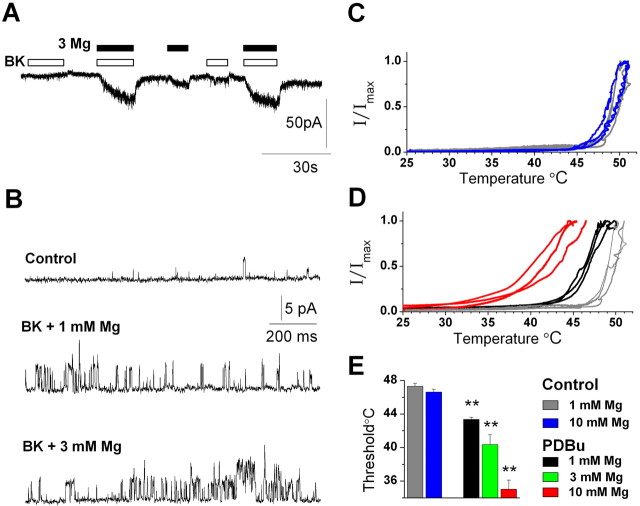
Physiological cation concentrations enhance TRPV1 activity during inflammatory conditions. A, B, MgCl2 (3 mm) enhances BK (100 nm)-evoked activation of TRPV1 in a whole-cell recording (-60 mV) and in an outside-out patch (+50 mV). C-E, Mg2+ lowers the TRPV1 temperature threshold in oocytes. Current versus temperature relationships are plotted for TRPV1-expressing oocytes in solutions containing 1-10 mm MgCl2 before (C) and after PDBu treatment (D). The mean temperature thresholds of three to seven oocytes are shown under stated conditions (**p < 0.001 compared with 1 mm Mg control).
Figure 7.
Figure 7.
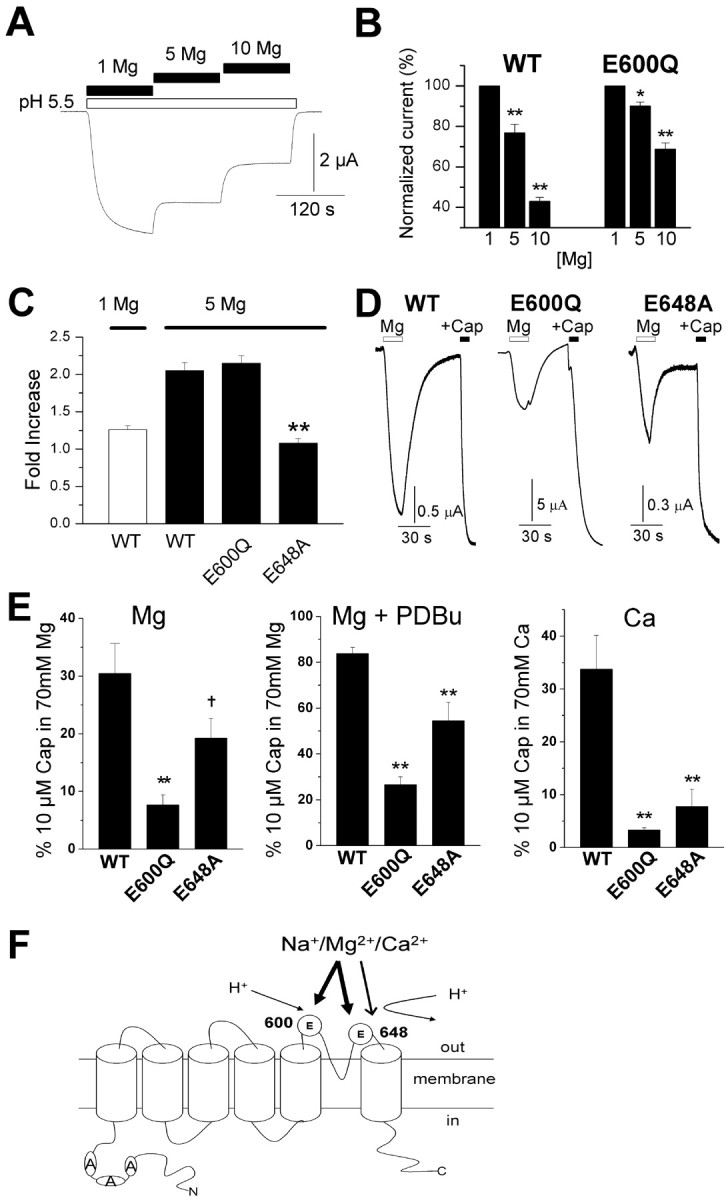
Cations regulate TRPV1 via extracellular proton-binding sites. A, B, Increasing [Mg2+]o from 1 to 10 mm dose-dependently inhibited the current evoked by protons (pH 5.5) in wild-type (WT) receptors (n = 6-7). A smaller reduction was observed in E600Q receptors (n = 3; *p < 0.05 and **p < 0.01 compared with 1 mm Mg control). E648A is very insensitive to proton activation and therefore was not tested. C, Mg2+ potentiation of currents evoked by capsaicin in oocytes expressing wild-type, E600Q, and E648A TRPV1. The capsaicin concentrations used were 500 nm for WT and E648 and 25 nm for E600Q and were selected based on the respective EC50 values of these receptors (Jordt et al., 2000). The mean fold potentiation is shown for three to four oocytes (**p < 0.01 compared with WT). D, Currents evoked by 70 mm MgCl2 and 10 μm capsaicin (Cap) in 70 mm MgCl2 solution in oocytes expressing wild-type, E600Q, and E648A receptors after phosphorylation of PKC with 100 nm PDBu. E, Currents from three to nine oocytes were normalized to the response evoked by 10 μm capsaicin in 70 mm Mg2+ or 70 mm Ca2+ solution (used to control for changes in Mg2+ or Ca2+ permeability; p < 0.06 and **p < 0.01 compared with WT). Oocytes in D and E were held at -20 mV (Cl- reversal potential found for these oocytes) and injected with 100 mm BAPTA 15-60 min before recording. F, Model of cation-mediated modulation of TRPV1 at glutamate (E) residues. Sensitization (arrow) occurs selectively via interactions at E648, whereas activation (thick arrow) requires interaction with both E600 and E648. This model also accounts for cation inhibition of H+ activation (thin arrow). Error bars represent SEM.

References

    1. Agarwal A, Dhiraj S, Raza M, Pandey R, Pandey CK, Singh PK, Singh U, Gupta D (2004) Vein pretreatment with magnesium sulfate to prevent pain on injection of propofol is not justified. Can J Anaesth 51: 130-133. - PubMed
    1. Ahern GP (2003) Activation of TRPV1 by the satiety factor oleoylethanolamide. J Biol Chem 278: 30429-30434. - PubMed
    1. Ahern GP, Premkumar LS (2002) Voltage-dependent priming of rat vanilloid receptor: effects of agonist and protein kinase C activation. J Physiol (Lond) 545: 441-451. - PMC - PubMed
    1. Alessandri-Haber N, Yeh JJ, Boyd AE, Parada CA, Chen X, Reichling DB, Levine JD (2003) Hypotonicity induces TRPV4-mediated nociception in rat. Neuron 39: 497-511. - PubMed
    1. Anderson SD (1984) Is there a unifying hypothesis for exercise-induced asthma? J Allergy Clin Immunol 73: 660-665. - PubMed

Publication types

MeSH terms