


doi: 10.1128/AAC.49.6.2454-2459.2005.
Mosaic structure of a multiple-drug-resistant, conjugative plasmid from Campylobacter jejuni
Affiliations
- PMID: 15917546
- PMCID: PMC1140535
- DOI: 10.1128/AAC.49.6.2454-2459.2005
Item in Clipboard
Mosaic structure of a multiple-drug-resistant, conjugative plasmid from Campylobacter jejuni
Antimicrob Agents Chemother.
2005 Jun.
Abstract
Partial sequence analysis of a tet(O) plasmid from a multiple-drug-resistant clinical isolate of Campylobacter jejuni revealed 10 genes or pseudogenes encoding different aminoglycoside inactivating enzymes, transposase-like genes, and multiple unknown genes from a variety of pathogenic and commensal bacteria. The plasmid could be mobilized by a P incompatibility group plasmid into Escherichia coli, where it apparently integrated into the chromosome and expressed high-level resistance to multiple aminoglycoside antibiotics. This work provides new information about both the nature of drug resistance in C. jejuni and the ability of C. jejuni to exchange genes with other bacterial species.
Figures
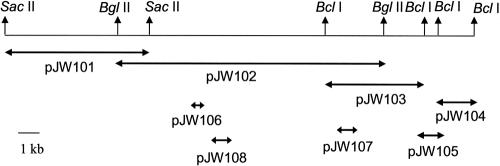
Schematic of the 25.7-kb region of pCG8245 that was sequenced. DNA sequencing was done on the overlapping regions of DNA either cloned into pBluescript (pJW101, pJW102, pJW103, and pJW104) or PCR amplified and cloned into pPCR-Script (pJW105, pJW106, pJW107, and pJW108). Plasmids pJW106, pJW107, and pJW108 are PCR clones of three different kanamycin resistance genes that were generated for mutational analyses as described in the text.
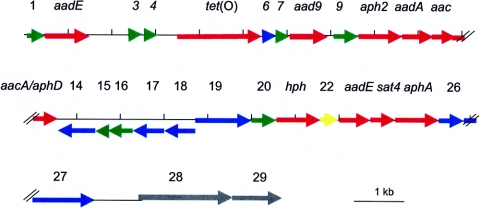
Schematic of the coding regions within the sequenced 25.7-kb region of pCG8245. The ORFs are color coded based on the putative function of the predicted encoded proteins. Red, antibiotic resistance genes; blue, transposases and transposon associated; green, unknown proteins; gray, similar to genes from the plasticity zones of H. pylori; yellow, known but not associated with antibiotic resistance. Vertical hash marks, below the linear plasmid, are located every 1 kb.
References
-
- Alm, R. A., L. S. Ling, D. T. Moir, B. L. King, E. D. Brown, P. C. Doig, D. R. Smith, B. Noonan, B. C. Guild, B. L. deJonge, G. Carmel, P. J. Tummino, A. Caruso, M. Uria-Nickelsen, D. M. Mills, C. Ives, R. Gibson, D. Merberg, S. D. Mills, Q. Jiang, D. E. Taylor, G. F. Vovis, and T. J. Trust. 1999. Genomic-sequence comparison of two unrelated isolates of the human gastric pathogen Helicobacter pylori. Nature 397:176-180. - PubMed
-
- Batchelor, R. A., B. M. Pearson, L. M. Friis, P. Guerry, and J. M. Wells. 2004. Nucleotide sequences and comparison of two large conjugative plasmids from different Campylobacter species. Microbiology 150:3507-3517. - PubMed
Publication types
MeSH terms
Substances
Associated data
- Actions
LinkOut - more resources
Full Text Sources
Other Literature Sources
Molecular Biology Databases
