. 2005 Jul;77(1):154-60.
doi: 10.1086/431653. Epub 2005 May 25.

3q29 microdeletion syndrome: clinical and molecular characterization of a new syndrome

Affiliations

3q29 microdeletion syndrome: clinical and molecular characterization of a new syndrome

Lionel Willatt et al. Am J Hum Genet. 2005 Jul.

Abstract

We report the identification of six patients with 3q29 microdeletion syndrome. The clinical phenotype is variable despite an almost identical deletion size. The phenotype includes mild-to-moderate mental retardation, with only slightly dysmorphic facial features that are similar in most patients: a long and narrow face, short philtrum, and high nasal bridge. Autism, gait ataxia, chest-wall deformity, and long and tapering fingers were noted in at least two of six patients. Additional features--including microcephaly, cleft lip and palate, horseshoe kidney and hypospadias, ligamentous laxity, recurrent middle ear infections, and abnormal pigmentation--were observed, but each feature was only found once, in a single patient. The microdeletion is approximately 1.5 Mb in length, with molecular boundaries mapping within the same or adjacent bacterial artificial chromosome (BAC) clones at either end of the deletion in all patients. The deletion encompasses 22 genes, including PAK2 and DLG1, which are autosomal homologues of two known X-linked mental retardation genes, PAK3 and DLG3. The presence of two nearly identical low-copy repeat sequences in BAC clones on each side of the deletion breakpoint suggests that nonallelic homologous recombination is the likely mechanism of disease causation in this syndrome.


Figures
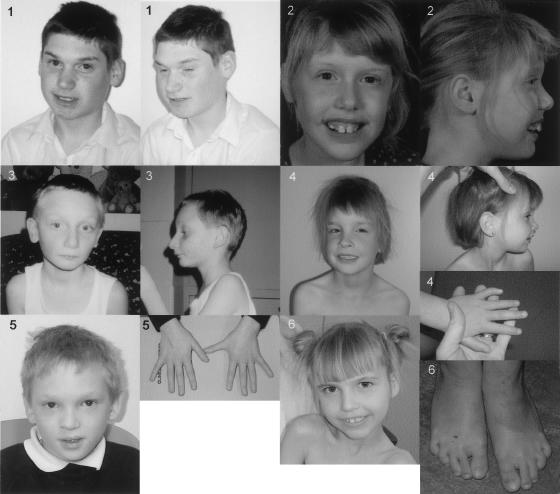
Figure  1
Figure 1
Photographs of patient 1, at age 9 years, 11 mo; patient 2, at age 14 years; patient 3, at age 6 years, 7 mo; patient 4, at age 6 years; patient 5, at age 7 years, 11 mo; and patient 6, at age 8 years, 10 mo. Written consent to publish these photographs was obtained from the parents of each child.
Figure  2
Figure 2
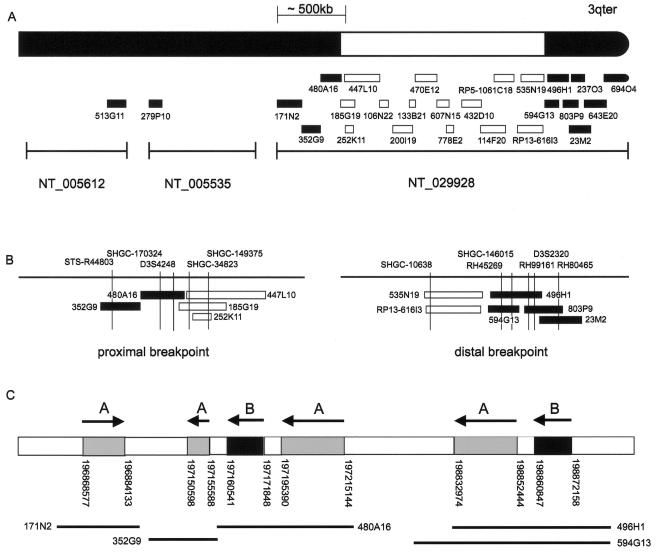
A, Genomic map of chromosome 3q, showing which clones are present (blackened) and which clones are deleted (unblackened). All six patients have deletions of BAC clones RP11-252K11–RP11-535N19 (see text). The MLPA probe, which can be used to detect the deletions in all six patients, is located within the BDH gene within BAC clones RP13-616I3 and RP11-535N19. The commercially available FISH probes—Vysis 3qter probe pVYS223B (D3S3560), Cytocell 3qtel106, and CTC-196F4—are all located within BAC clone RP5-1061C18. Unless otherwise stated, the BAC or PAC clones used were from the RP11 library. Contig NT_029928 and the size of the BAC clones within it are approximately to scale. The three contigs, GenBank NT_029928 (2.6 Mb), GenBank NT_005535 (1.2 Mb), and GenBank NT_005612 (100 Mb), are separated by gaps of unknown length in the sequence. B, The detailed positioning of BAC clones at the proximal and distal breakpoints. The relative position of each BAC clone was determined by identifying the presence or absence of known STS markers within the BAC clones and the genomic sequence around the deletion boundaries. C, LCR sequences in the deletion breakpoint genomic region. The region-specific LCRs designated “A” and “B” are shown (see text). The arrows above the bar show the orientation of the repeats; the position of the repeats on chromosome 3 are given below the bar. From left to right on the diagram, the repeat sizes are 15 kb, 5 kb, 11 kb, 19 kb, 19 kb, and 11 kb. The BAC clones that contain the LCRs are marked below the genomic location. The diagram is not to scale.

References

Web Resources

    1. BACPAC Resources Center, http://bacpac.chori.org/home.htm (for human genomic clones from the RPCI-5, -11, and -13 BAC and PAC libraries)
    1. GenBank, http://www.ncbi.nlm.nih.gov/Genbank/ (for all accession numbers of BAC and PAC clones and genomic contigs listed in )
    1. HGMP-RC Nix Session, http://www.hgmp.mrc.ac.uk/Registered/Webapp/nix/ (for homology searching within BAC clone sequences)
    1. Human BLAT Search, http://www.genome.ucsc.edu/cgi-bin/hgBlat (for homology searching within the chromosome 3 sequence)
    1. NCBI Map Viewer, http://www.ncbi.nlm.nih.gov/mapview/ (for BLAST sequence homology search and for transcripts and genes within the 3q29 deleted region)

References

    1. Aldred MA, Sanford RO, Thomas NS, Barrow MA, Wilson LC, Brueton LA, Bonaglia MC, Hennekam RC, Eng C, Dennis NR, Trembath RC (2004) Molecular analysis of 20 patients with 2q37.3 monosomy: definition of minimum deletion intervals for key phenotypes. J Med Genet 41:433–439 10.1136/jmg.2003.017202 - DOI - PMC - PubMed
    1. Allen KM, Gleeson JG, Bagrodia S, Partington MW, MacMillan JC, Cerione RA, Mulley JC, Walsh CA (1998) PAK3 mutation in nonsyndromic X-linked mental retardation. Nat Genet 20:25–30 10.1038/1675 - DOI - PubMed
    1. De Vries BB, Winter R, Schinzel A, van Ravenswaaij-Arts C (2003) Telomeres: a diagnosis at the end of the chromosomes. J Med Genet 40:385–398 10.1136/jmg.40.6.385 - DOI - PMC - PubMed
    1. Ewart AK, Morris CA, Atkinson D, Jin W, Sternes K, Spallone P, Stock AD, Leppert M, Keating MT (1993) Hemizygosity at the elastin locus in a developmental disorder, Williams syndrome. Nat Genet 5:11–16 10.1038/ng0993-11 - DOI - PubMed
    1. Flint J, Knight S (2003) The use of telomere probes to investigate submicroscopic rearrangements associated with mental retardation. Curr Opin Genet Dev 13:310–316 10.1016/S0959-437X(03)00049-2 - DOI - PubMed

Publication types