


Climate change threats to plant diversity in Europe
- PMID: 15919825
- PMCID: PMC1140480
- DOI: 10.1073/pnas.0409902102
Climate change threats to plant diversity in Europe
Abstract
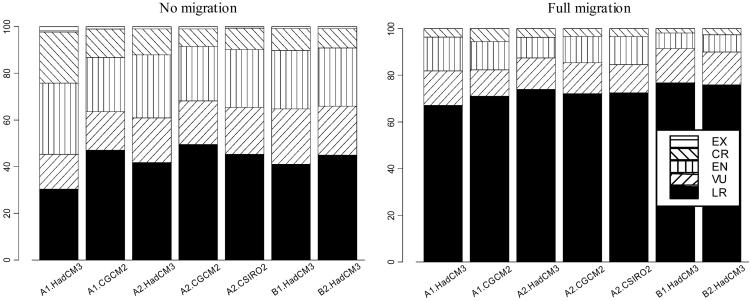
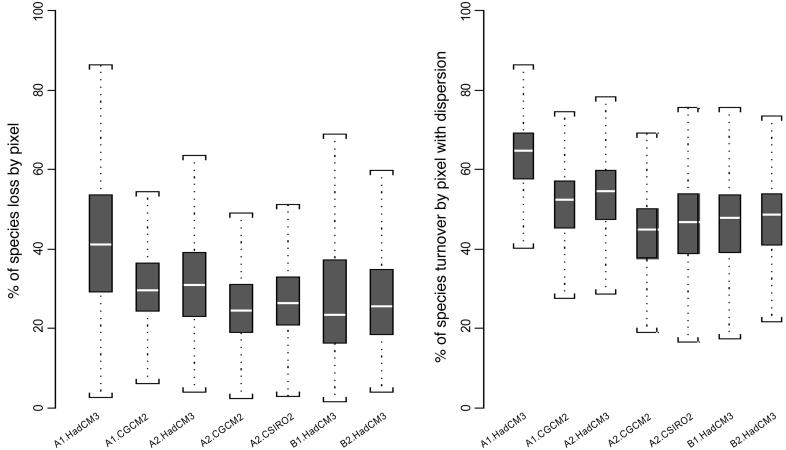
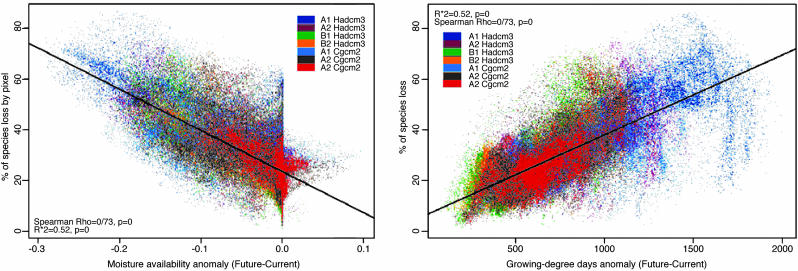
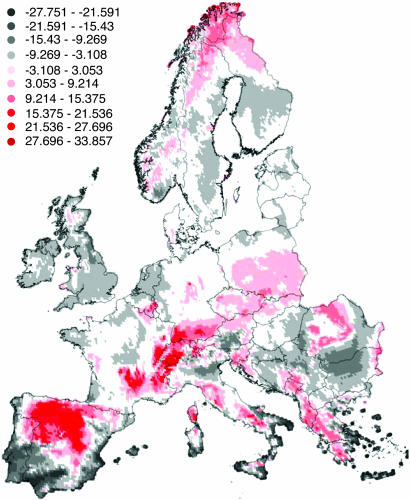
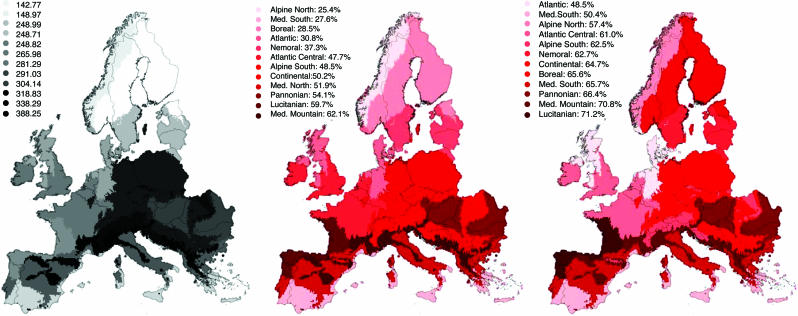
Climate change has already triggered species distribution shifts in many parts of the world. Increasing impacts are expected for the future, yet few studies have aimed for a general understanding of the regional basis for species vulnerability. We projected late 21st century distributions for 1,350 European plants species under seven climate change scenarios. Application of the International Union for Conservation of Nature and Natural Resources Red List criteria to our projections shows that many European plant species could become severely threatened. More than half of the species we studied could be vulnerable or threatened by 2080. Expected species loss and turnover per pixel proved to be highly variable across scenarios (27-42% and 45-63% respectively, averaged over Europe) and across regions (2.5-86% and 17-86%, averaged over scenarios). Modeled species loss and turnover were found to depend strongly on the degree of change in just two climate variables describing temperature and moisture conditions. Despite the coarse scale of the analysis, species from mountains could be seen to be disproportionably sensitive to climate change (approximately 60% species loss). The boreal region was projected to lose few species, although gaining many others from immigration. The greatest changes are expected in the transition between the Mediterranean and Euro-Siberian regions. We found that risks of extinction for European plants may be large, even in moderate scenarios of climate change and despite inter-model variability.
Figures
References
-
- Edwards, M. & Richardson, A. J. (2004) Nature 430, 881-884. - PubMed
-
- Parmesan, C. (1996) Nature 382, 765-766.
-
- Hughes, L. (2000) Trends Ecol. Evol. 15, 56-61. - PubMed
-
- Parmesan, C. & Yohe, G. (2003) Nature 421, 37-42. - PubMed
-
- Erasmus, B. F. N., Van Jaarsweld, A. S., Chown, S. L., Kshatriya, M. & Wessels, K. J. (2002) Glob. Change Biol. 8, 679-693.
Publication types
MeSH terms
LinkOut - more resources
Full Text Sources
