


Induction of Kaposi's sarcoma-associated herpesvirus latency-associated nuclear antigen by the lytic transactivator RTA: a novel mechanism for establishment of latency
- PMID: 15919901
- PMCID: PMC1143691
- DOI: 10.1128/JVI.79.12.7453-7465.2005
Induction of Kaposi's sarcoma-associated herpesvirus latency-associated nuclear antigen by the lytic transactivator RTA: a novel mechanism for establishment of latency
Abstract
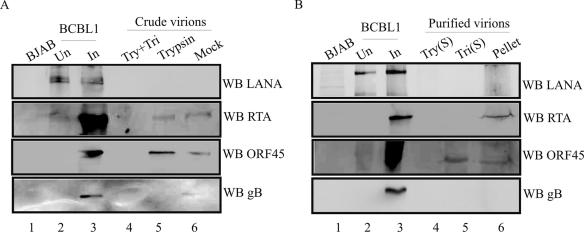
Kaposi's sarcoma-associated herpesvirus (KSHV) is the etiological agent contributing to development of Kaposi's sarcoma, primary effusion lymphoma, and multicentric Castleman desease. Following primary infection, latency is typically established. However, the mechanism by which KSHV establishes latency is not understood. We have reported that the latency-associated nuclear antigen (LANA) can repress RTA (for replication and transcription activator) expression by down-regulating its promoter. In this study, we show that RTA is associated with the virion particle. We also show that RTA can activate the LANA promoter and induce LANA expression in transient reporter assays. Additionally, the transcription of RTA correlates with LANA expression in the early stages of de novo infection of KSHV, and induction of LANA transcription is responsive to induction of RTA with an inducible system. This induction in LANA transcription was dependent on recombination signal sequence binding protein Jkappa (RBP-Jkappa), as a RBP-Jkappa-deficient cell line was significantly delayed and inefficient in LANA transcription with expression of RTA. These studies suggest that RTA contributes to establishment of KSHV latency by activating LANA expression in the early stages of infection by utilizing the major effector of the Notch signaling pathway RBP-Jkappa. This describes a feedback mechanism by which LANA and RTA can regulate each other and is likely to be a key event in the establishment of KSHV latency.
Figures



References
-
- Bais, C., B. Santomasso, O. Coso, L. Arvanitakis, E. G. Raaka, J. S. Gutkind, A. S. Asch, E. Cesarman, M. C. Gershengorn, E. A. Mesri, and M. C. Gerhengorn. 1998. G-protein-coupled receptor of Kaposi's sarcoma-associated herpesvirus is a viral oncogene and angiogenesis activator. Nature 391:86-89. - PubMed
-
- Bais, C., A. Van Geelen, P. Eroles, A. Mutlu, C. Chiozzini, S. Dias, R. L. Silverstein, S. Rafii, and E. A. Mesri. 2003. Kaposi's sarcoma associated herpesvirus G protein-coupled receptor immortalizes human endothelial cells by activation of the VEGF receptor-2/ KDR. Cancer Cell 3:131-143. - PubMed
-
- Ballestas, M. E., P. A. Chatis, and K. M. Kaye. 1999. Efficient persistence of extrachromosomal KSHV DNA mediated by latency-associated nuclear antigen. Science 284:641-644. - PubMed
Publication types
MeSH terms
Substances
Grants and funding
LinkOut - more resources
Full Text Sources
Other Literature Sources
