


doi: 10.1126/science.1108228.
Epub 2005 May 26.
Protection from experimental asthma by an endogenous bronchodilator
Affiliations
- PMID: 15919956
- PMCID: PMC2128762
- DOI: 10.1126/science.1108228
Item in Clipboard
Protection from experimental asthma by an endogenous bronchodilator
Science.
.
Abstract
Mechanisms that protect against asthma remain poorly understood. S-nitrosoglutathione (GSNO), an endogenous bronchodilator, is depleted from asthmatic airways, suggesting a protective role. We report that, following allergen challenge, wild-type mice exhibiting airway hyperresponsivity have increased airway levels of the enzyme GSNO reductase (GSNOR) and are depleted of lung S-nitrosothiols (SNOs). In contrast, mice with genetic deletion of GSNOR exhibit increases in lung SNOs and are protected from airway hyperresponsivity. Our results indicate that endogenous SNOs, governed by GSNOR, are critical regulators of airway responsivity and may provide new therapeutic approaches to asthma.
Figures
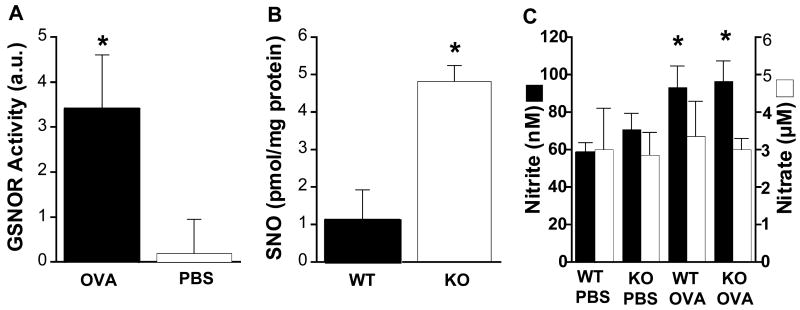
(A) GSNOR activity in bronchoalveolar ALF (cell-free) of WT mice is increased in response to OVA sensitization and challenge. Data represent the mean + SE of samples from at least seven OVA-treated and control (PBS) mice (*, P < 0.05; Student’s two-tailed t test). (B) Levels of S-nitrosylated proteins (SNO) in lung homogenates of GSNOR−/− mice [assayed as described in (12)] were significantly higher than in WT controls after OVA treatment. Data were normalized for protein content of total lysates and represent the mean + SE of at least three WT and GSNOR−/− (KO) mice (*, P < 0.02; Student’s two-tailed t test). (C) Levels of ALF nitrite (filled) and nitrate (open) were similar in WT and GSNOR−/− mice after either control (PBS) or allergen (OVA) treatment. An asterisk indicates significant pairwise differences between OVA-treated and control mice (P < 0.04, n = 12 to 20). Means + SE are shown.
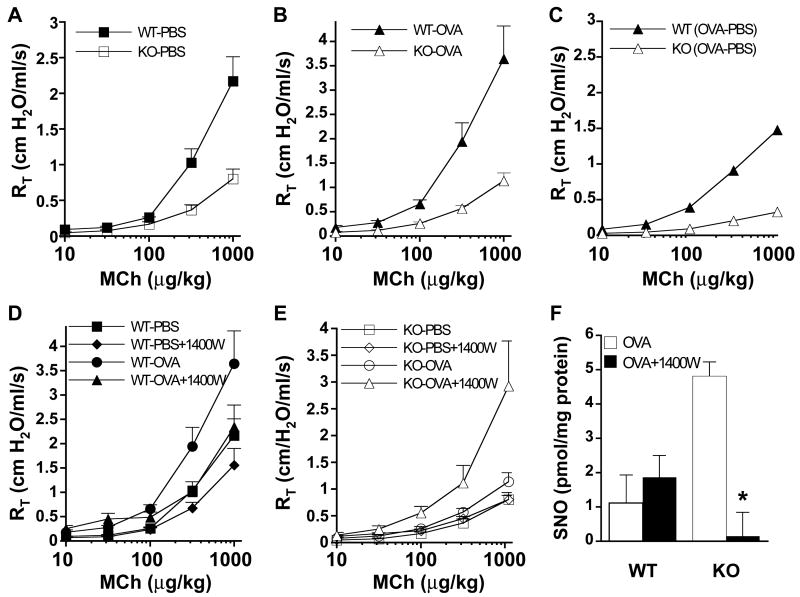
Airways of GSNOR−/− mice are hyporeactive to methacholine (MCh) and allergen challenge. Total pulmonary resistances (RT) of WT and GSNOR−/− (KO) mice after control (nonallergic; PBS) (A) and allergen (OVA) (B) treatment were determined in the absence or presence of various concentrations of MCh administered intravenously. RT values in PBS-treated and in OVA-treated GSNOR−/− mice were significantly lower than in WT controls [KO PBS versus WT PBS, P < 0.001; KO OVA versus WT OVA, P < 0.004; analysis of variance (ANOVA) and post-hoc analyses at 3- to 5-MCh doses]. Data represent the mean + SE of at least 7 to 10 mice per group. (C) The incremental effect of OVA (over PBS control) on WT and GSNOR−/− mice [OVA minus PBS (OVA-PBS)]. Whereas RT of WT mice increased significantly after OVA treatment (WT PBS versus WT OVA, P < 0.04; ANOVA), the RT of GSNOR −/− mice did not change significantly (KO PBS versus KO OVA, P = 0.1; ANOVA). (D) Effect of the iNOS inhibitor 1400W on airway responsiveness in PBS- and OVA-treated WT mice (WT PBS versus WT PBS + 1400W, P = 0.12, n = 5 to 9; WT OVA versus WT OVA + 1400W, P = 0.22, n = 7 to 9). (E) Effect of iNOS inhibition by 1400W on airway responsiveness in GSNOR−/− mice. Administration of 1400W to OVA-treated GSNOR−/− mice resulted in a significant increase in airway resistance (KO OVA versus KO OVA + 1400W, P < 0.02, n = 5 to 9; ANOVA). (F) Protein S-nitrosylation (SNO) in lung homogenates of OVA-treated mice. iNOS inhibition (1400W) reduces SNO levels in GSNOR−/− mice (*, P < 0.05, n = 3).
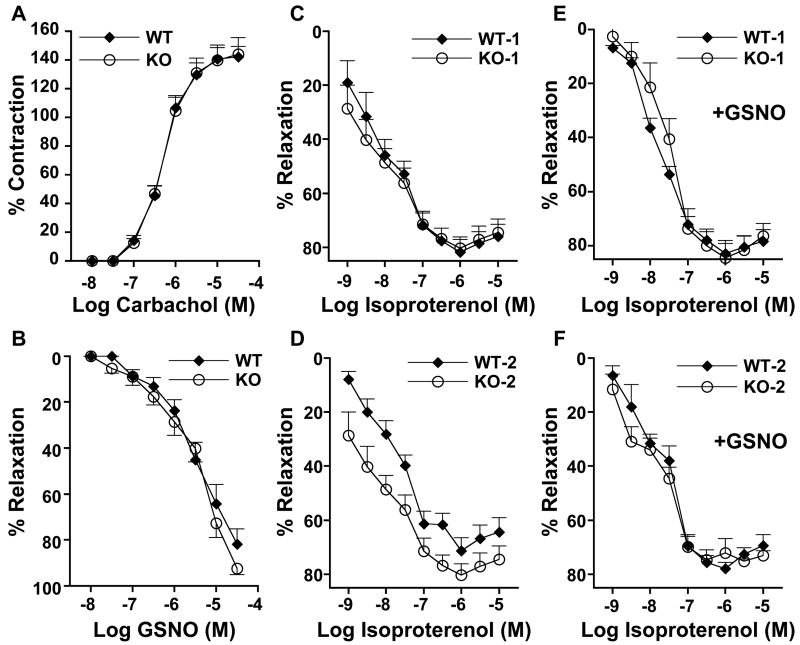
In vitro contractile and relaxant responses of tracheal rings from WT and GSNOR−/− (KO) mice. Rings were contracted by carbachol (A) and relaxed by GSNO (B) or isoproterenol (C to F). Data points are means + SE for n = 6 to 8 in all experiments. In (B) to (F), tracheal rings were precontracted with the EC50 concentration of carbachol [the concentration in (A) producing 50% of maximal contraction]. Relaxation of tracheal rings in response to the first (WT1 and KO1) (C) and second (WT2 and KO2) (D) exposures to isoproterenol. With repeated exposure to isoproterenol, WT rings (WT2) demonstrated a decremental response to β2-stimulation (P < 0.03, WT1 versus WT2; ANOVA), whereas GSNOR−/− rings (KO2) retained their responsivity (P = not significant, KO1 versus KO2). (E and F) Tracheal rings were incubated with 1 μM GSNO for 30 min before exposure to isoproterenol. GSNO-supplemented WT rings show a phenotype indistinguishable from KO (i.e., WT rings no longer desensitize) [(F) versus (D)].
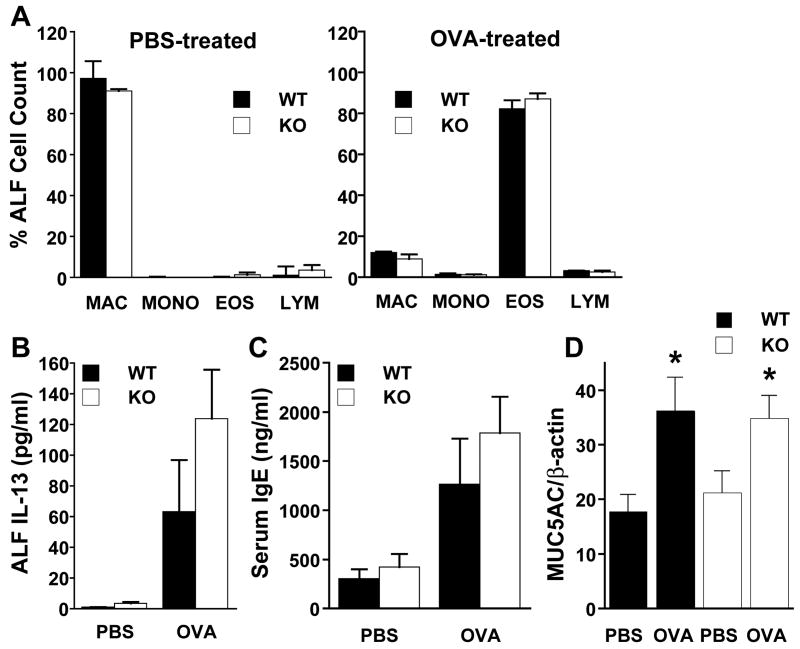
The inflammatory response to asthmatic challenge was not reduced in GSNOR−/− mice. (A) Leukocyte cell differentials (MAC, macrophage; MONO, monocyte; EOS eosinophil; LYM, lymphocyte), (B) IL-13 levels in ALF, and (C) total serum IgE level were determined for WT (filled) and GSNOR−/− (open) mice that had undergone either control (non-allergic; PBS) or allergic (OVA) exposure. Data are means + SE for n = 12 per group. (D) MUC5AC mRNA levels in whole lung (expressed as a ratio of β-actin mRNA levels) were determined for control (nonallergic; PBS) and allergic (OVA) WT and GSNOR−/− (KO) mice. MUC5AC mRNA expression increases comparably in both WT and GSNOR−/− mice after OVA challenge. Values are means + SE, n = 6 in each group. *, P < 0.05, WT PBS versus WT OVA and KO PBS versus KO OVA.
Comment in
-
Biomedicine. Asthmatics breathe easier when it's SNO-ing.Science. 2005 Jun 10;308(5728):1560-1. doi: 10.1126/science.1114163. Science. 2005. PMID: 15947161 No abstract available.
References
Publication types
MeSH terms
Substances
Grants and funding
LinkOut - more resources
Full Text Sources
Other Literature Sources
Medical
Molecular Biology Databases
