


The contribution of contractile pre-activation to loss of function after a single lengthening contraction
- PMID: 15922761
- PMCID: PMC4489540
- DOI: 10.1016/j.jbiomech.2004.07.008
The contribution of contractile pre-activation to loss of function after a single lengthening contraction
Abstract
Purpose: Some muscle injuries are the result of a single lengthening contraction. Our goal was to evaluate the contributions of angular velocity, arc of motion, and timing of contractile activation relative to the onset of joint motion in an animal model of muscle injury using a single lengthening contraction.
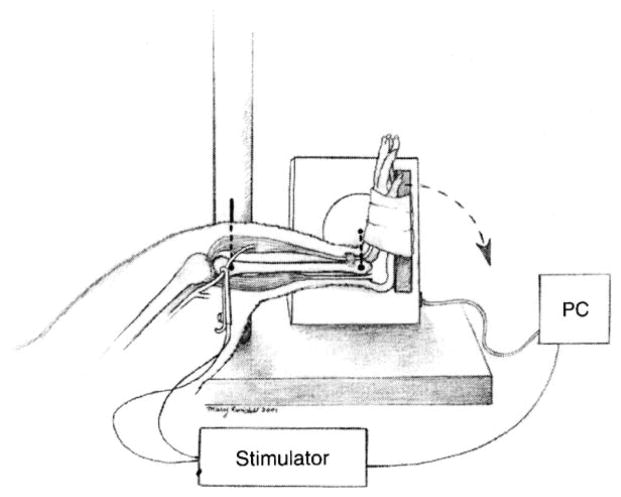
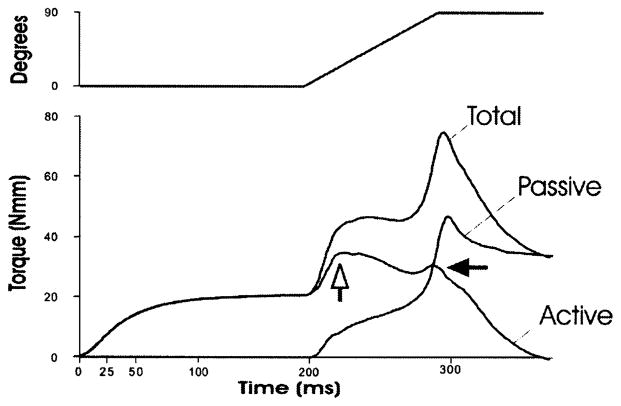
Methods: The intact tibialis anterior (TA) muscle of rats was activated while lengthened, preceded by a maximal isometric contraction of 0, 25, 50, 100, or 200 ms. The lengthening contraction was performed at two different angular velocities (300 or 900 degrees/s) and through two different arcs of motion (90 degrees or 45 degrees).
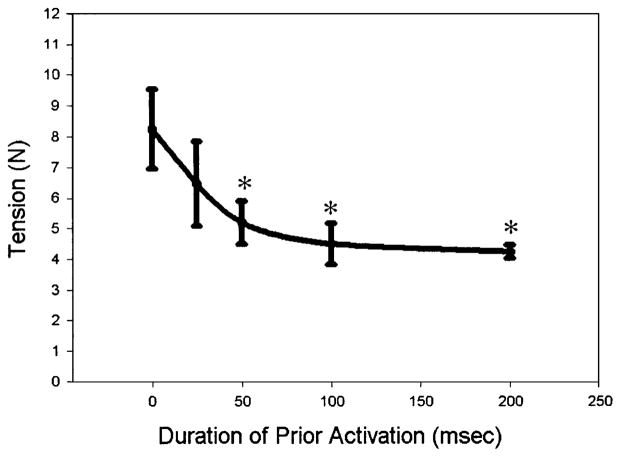
Results: Muscle contractile function, as measured by maximal isometric tetanic tension, was significantly decreased only when the TA was activated at least 50 ms prior to the motion, regardless of angular velocity or arc of motion.
Conclusion: The data indicated that the duration of an isometric contraction prior to a single lengthening contraction determined the extent of muscle injury irrespective of two different angular velocities.
Figures
References
-
- Ashton-Miller JA, He Y, Kadhiresan VA, McCubbrey DA, Faulkner JA. An apparatus to measure in vivo biomechanical behavior of dorsi- and plantarflexors of mouse ankle. Journal of Applied Physiology. 1992;72:1205–1211. - PubMed
-
- Benz RJ, Friden J, Lieber RL. Simultaneous stiffness and force measurements reveal subtle injury to rabbit soleus muscles. Molecular and Cellular Biochemistry. 1998;179:147–158. - PubMed
-
- Best TM. Soft-tissue injuries and muscle tears. Clinics in Sports Medicine. 1997;16:419–434. - PubMed
-
- Best TM, McElhaney JH, Garrett WE, Jr, Myers BS. Axial strain measurements in skeletal muscle at various strain rates. Journal of Biomechanical Engineering. 1995;117:262–265. - PubMed
Publication types
MeSH terms
Grants and funding
LinkOut - more resources
Full Text Sources
