. 2005 Jul;8(7):881-8.
doi: 10.1038/nn1478.

Nonclassical, distinct endocytic signals dictate constitutive and PKC-regulated neurotransmitter transporter internalization

Affiliations

Nonclassical, distinct endocytic signals dictate constitutive and PKC-regulated neurotransmitter transporter internalization

Katherine L Holton et al. Nat Neurosci. 2005 Jul.

Abstract

Neurotransmitter transporters are critical for synaptic neurotransmitter inactivation. Transporter inhibitors markedly increase the duration and magnitude of synaptic transmission, underscoring the importance of transporter activity in neurotransmission. Recent studies indicate that membrane trafficking dynamically governs neuronal transporter cell-surface presentation in a protein kinase C-regulated manner, suggesting that transporter trafficking profoundly affects synaptic signaling. However, the molecular architecture coupling neurotransmitter transporters to the endocytic machinery is not defined. Here, we identify nonclassical, distinct endocytic signals in the dopamine transporter (DAT) that are necessary and sufficient to drive constitutive and protein kinase C-regulated DAT internalization. The DAT internalization signal is conserved across SLC6 neurotransmitter carriers and is functional in the homologous norepinephrine transporter, suggesting that this region is likely to be the endocytic signal for all SLC6 neurotransmitter transporters. The DAT endocytic signal does not conform to classic internalization motifs, suggesting that SLC6 neurotransmitter transporters may have evolved unique endocytic mechanisms.


Figures

Figure 1
Figure 1
The DAT N terminus does not contain an autonomous endocytic signal. (a) Schematic representation of wild-type, Δ3-59 truncated (endocytic-deficient) and DAT-chimeric TfR. (b) Transferrin internalization assay. Tf-Alexa594 was applied to serum-starved, transfected TRVb cells for the times indicated, and cells were fixed, mounted and imaged by wide-field microscopy. Note loss of surface staining and appearance of intracellular puncta for wild-type TfR, indicative of internalization. Representative cells are shown, n = 2.
Figure 2
Figure 2
DAT C-terminal residues 587-596 are sufficient to drive Tac endocytosis. (a) Schematic representation of the interleukin-2α receptor (Tac) and chimeric Tac-DAT proteins. (b) Single-cell Tac internalization assay. Antibody to Tac (anti-Tac) was bound at 4 °C to cells transfected with the indicated Tac-DAT cDNAs, and cells were warmed to 37 °C for 20 min. Internalized anti-Tac was detected with fluorescently labeled secondary antibodies using wide-field microscopy and image deconvolution. Internalization was scored in cases where Tac surface staining was lost, with a parallel appearance of intracellular puncta. Representative cells are shown. See Table 1 for summary of results.
Figure 3
Figure 3
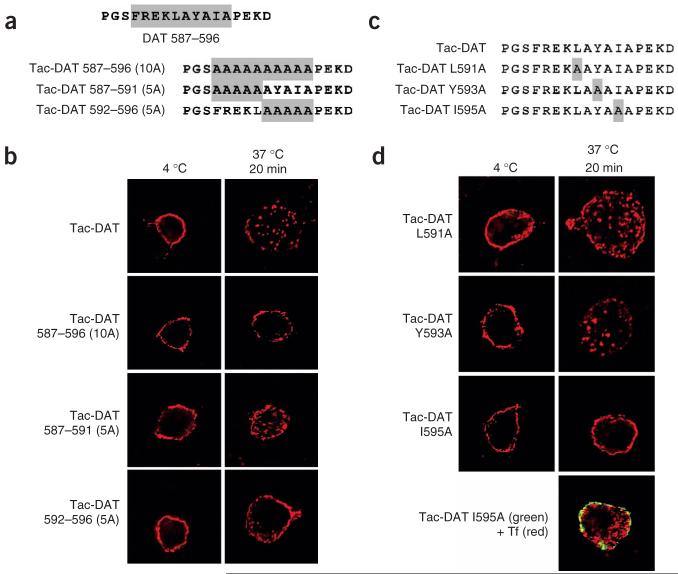
DAT Ile595 within the FREKLAYAIA sequence is necessary for Tac-DAT endocytosis. (a,c) DAT sequence illustrating the FREKLAYAIA sequence spanning DAT residues 587-596. Residues targeted for mutagenesis are shaded. (b,d) Single-cell Tac internalization assay. Internalization was scored in cases where Tac surface staining was lost, with a parallel appearance of intracellular puncta (see Methods). Global endocytosis in cells expressing Tac-DAT I595A (d, green) was validated by transferrin uptake with Tf-Alexa594 (red). Representative cells are shown for each condition. See Table 1 for summary of results.
Figure 4
Figure 4
Nonpolar residues within the FREKLAYAIA sequence are necessary for constitutive DAT internalization as shown by DAT internalization assay. Cells transfected with the indicated DAT cDNAs were surface biotinylated, and the percentage total DAT internalizing in 10 min was measured (see Methods). (a) Representative DAT immunoblots detecting total initial DAT surface pools (T), strip controls (S) and internalized DAT (I) for wild-type DAT (WT) and the indicated DAT mutants. (b) Average internalization data. Bars represent the percentage DAT internalized over 10 min at 37 °C, compared with total surface DAT at time zero, ±s.e.m. *P < 0.05, **P < 0.01, one-way ANOVA with Dunnett’s multiple comparison test; n = 2-5.
Figure 5
Figure 5
The FREKLAYAIA region is conserved in SLC6 neurotransmitter transporters and is both necessary and sufficient for NET endocytosis. (a) Amino acid sequence alignment of the DAT FREKLAYAIA region and the orthologous domain in rodent (mouse (m) and rat (r)) and primate (macaque (mac) and human (h)) SLC6 neurotransmitter transporters, with conserved residues shaded. The consensus sequence is indicated below the alignment. SERT, serotonin transporter. (b) Tac internalization assay. Tac and Tac-NET(580-617) were expressed in PC12 cells and their endocytic potential was assessed by antibody uptake with anti-Tac (see Methods). Representative cells are shown; n = 5. (c) NET internalization assay. Cells were transiently transfected with wild-type hNET or hNET584-593(10A) cDNAs, and internalization was measured as described in Methods.Bars represent the percentage NET internalized over 10 min at 37 °C compared with total surface NET at time zero, ±s.e.m; n values are indicated above the bars, *P < 0.002, Student’s t-test. Inset: representative immunoblot detecting total initial NET surface pools (T), strip controls (S) and internalized NET (I) for wild-type hNET and hNET584-593(10A).
Figure 6
Figure 6
Nonpolar residues within the FREKLAYAIA sequence are not required for PKC-stimulated DAT downregulation and internalization. (a) DA uptake assay of transfected PC12 cells preincubated with vehicle or 1 μM PMA, 30 min. Data are expressed as percentage uptake compared with vehicle-treated cells, ±s.e.m. (b) Cell-surface biotinylation of transfected PC12 cells following 30-min treatment with either vehicle or 1 μM PMA. Bar graph of averaged data expressed as percentage biotinylated DAT as compared with vehicle-treated cells, ±s.e.m. *P < 0.01, one-way ANOVA with Bonnferoni multiple comparison test; n values indicated above each bar.
Figure 7
Figure 7
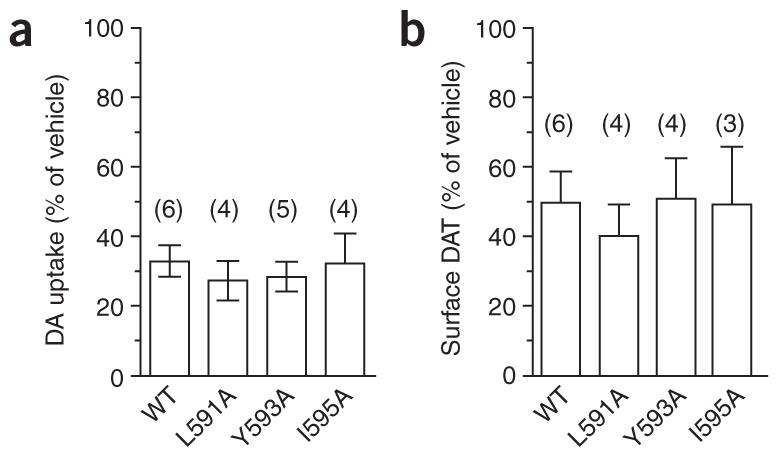
The DAT C terminus contains a PKC-sensitive endocytic signal. (a) Tac internalization assay. PC12 cells transfected with the indicated Tac proteins incubated with anti-Tac at either 4 °C or 37 °C in the presence of either vehicle or 1 μM PMA. Images are representative of 3-4 cells imaged per experiment; n = 4. (b) DA uptake assay. Cells transfected with wild-type DAT (WT) or the indicated DAT mutants were treated with either vehicle or 1 μM PMA for 30 min at 37 °C, and DA uptake was assessed as described in Methods. Bars indicate percentage DA uptake as compared with vehicle-treated cells ± s.e.m. Asterisks indicate values significantly different from wild type, *P < 0.001, **P < 0.01, one-way ANOVA with Bonferroni multiple comparisons test; n values are indicated above the bars.
Figure 8
Figure 8
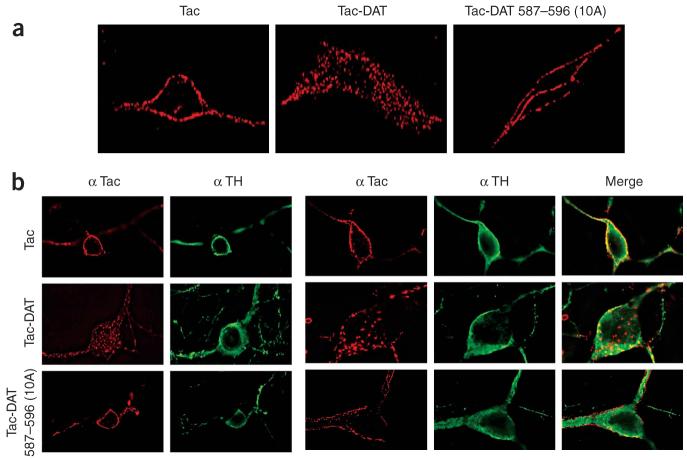
DAT C-terminal residues 587-596 are sufficient and necessary to drive endocytosis in dopaminergic cells. Immortalized mesencephalic AN27 cells (a) and primary ventral midbrain neurons (b) were transfected with the indicated Tac proteins and anti-Tac internalization was assessed. Representative images are shown. For AN27 cells, 7-10 cells were imaged per Tac construct, n = 2; for primary ventral midbrain neurons, 11-16 cells were imaged per Tac construct, n = 3-5.

References

    1. Chen NH, Reith ME, Quick MW. Synaptic uptake and beyond: the sodium- and chloride-dependent neurotransmitter transporter family SLC6. Pflugers Arch. 2004;447:519–531. - PubMed
    1. Torres GE, Gainetdinov RR, Caron MG. Plasma membrane monoamine transporters: structure, regulation and function. Nat. Rev. Neurosci. 2003;4:13–25. - PubMed
    1. Rothman RB, Baumann MH. Monoamine transporters and psychostimulant drugs. Eur. J. Pharmacol. 2003;479:23–40. - PubMed
    1. Schenk JO. The functioning neuronal transporter for dopamine: kinetic mechanisms and effects of amphetamines, cocaine and methylphenidate. Prog. Drug Res. 2002;59:111–131. - PubMed
    1. Gulley JM, Zahniser NR. Rapid regulation of dopamine transporter function by substrates blockers and presynaptic receptor ligands. Eur. J. Pharmacol. 2003;479:139–152. - PubMed

Publication types

MeSH terms

Substances