


The emergence of the unmarked: a new perspective on the language-specific function of Broca's area
- PMID: 15929098
- PMCID: PMC6871720
- DOI: 10.1002/hbm.20154
The emergence of the unmarked: a new perspective on the language-specific function of Broca's area
Abstract
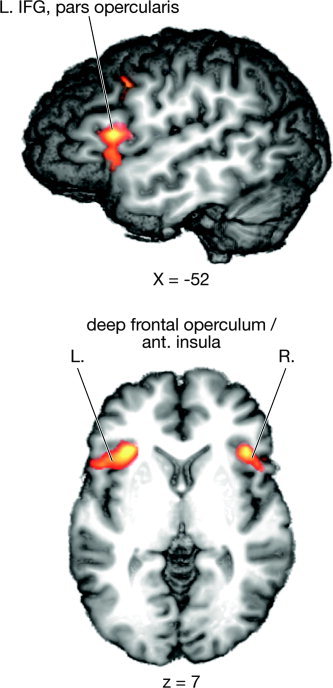
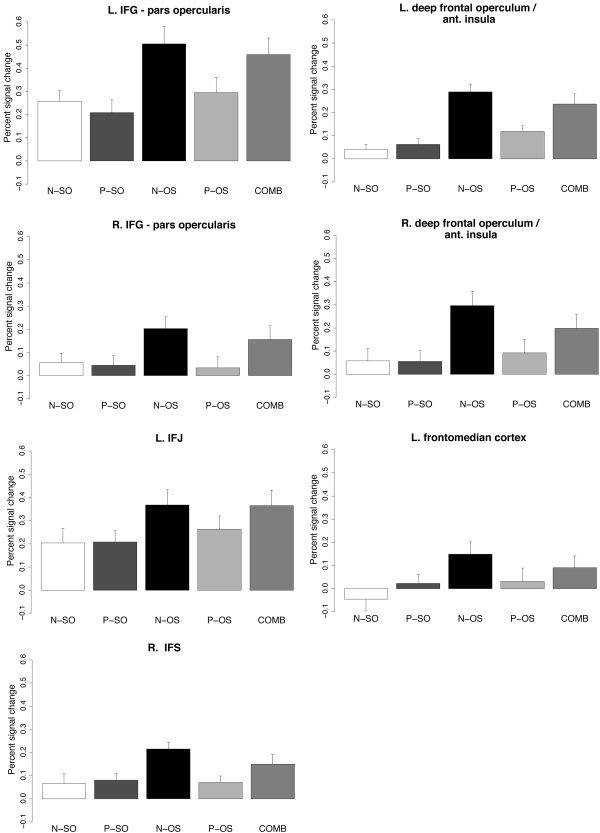
A number of neuroimaging studies have implicated an involvement of Broca's area, particularly of the pars opercularis of the left inferior frontal gyrus (IFG), in the processing of complex (permuted) sentences. However, functional interpretations of this region's role range from very general (e.g., in terms of working memory) to highly specific (e.g., as supporting particular types of syntactic operations). A dissociation of these competing accounts is often impossible because in most cases, the language internal complexity of permuted sentence structures is accompanied invariably by increasing costs of a more general cognitive nature (e.g., working memory, task difficulty, and acceptability). We used functional magnetic resonance imaging to explore the precise nature of the pars opercularis activation in the processing of permuted sentences by examining the permutation of pronouns in German. Although clearly involving a permutation operation, sentences with an initial object pronoun behave like simple, subject-initial sentences (e.g., in terms of acceptability) because of a rule stating that pronouns should generally precede non-pro-nominal arguments. The results of the experiment show that in contrast to non-pro-nominal permutations, sentences with a permuted pronoun do not engender enhanced pars opercularis activation. Our findings therefore speak against both language-related working memory and transformation-based accounts of this region's role in sentence comprehension. Rather, we argue that the pars opercularis of the left IFG supports the language-specific linearization of hierarchical linguistic dependencies.
Hum Brain Mapp, 2005. (c) 2005 Wiley-Liss, Inc.
Figures

References
-
- Aguirre GK, Zarrahn E, d'Esposito M (1997): Empirical analyses of BOLD fMRI statistics II. Spatially smoothed data collected under null‐hypothesis and experimental conditions. Neuroimage 5: 199–212. - PubMed
-
- Bader M, Meng M (1999): Subject‐object ambiguities in German embedded clauses: an across‐the‐board comparison. J Psycholinguist Res 28: 121–143.
-
- Baker M (1988): Incorporation: a theory of grammatical function changing. Chicago: University of Chicago Press.
-
- Ben‐Shachar M, Hendler T, Kahn I, Ben‐Bashat D, Grodzinsky Y (2003): The neural reality of syntactic transformations: evidence from fMRI. Psychol Sci 14: 433–440. - PubMed
-
- Ben‐Shachar M, Palti D, Grodzinsky Y (2004): Neural correlates of syntactic movement: converging evidence from two fMRI experiments. Neuroimage 21: 1320–1336. - PubMed
Publication types
MeSH terms
LinkOut - more resources
Full Text Sources
Miscellaneous
