Review
. 2003 Oct;1(4):291-300.
doi: 10.3121/cmr.1.4.291.

Mendelian forms of human hypertension and mechanisms of disease

Affiliations
Review

Mendelian forms of human hypertension and mechanisms of disease

Friedrich C Luft. Clin Med Res. 2003 Oct.

Abstract

Mendelian forms of hypertension have ushered in a revolution in our knowledge of blood pressure and volume regulation. If we include information on syndromes involving low blood pressure, this knowledge base is doubled. Glucocorticoid remediable aldosteronism, apparent mineralocorticoid excess, and mutations in the mineralocorticoid receptor gene have given us brilliant insights into mineralocorticoid-induced hypertension. The latter discovery has elucidated how mutations may modify the receptor sufficiently to allow erstwhile antagonists to have an agonistic action. The epithelial sodium channel (ENaC) has been elucidated. Gain-of-function mutations in the beta and gamma subunits of ENaC cause Liddle's syndrome. Loss-of-function mutations in all three subunits of ENaC cause hypotension (pseudohypoaldosteronism type I). Thus, all three subunits can be mutated, causing either hyper or hypotension. Three loci have been described for Gordon's syndrome, pseudohypoaldosteronism type II. Two members of the WNK serine-threonine kinase family have recently been found to be responsible. Their function has been largely elucidated. Autosomal dominant hypertension with brachydactyly features normal sodium and renin-angiotensin-aldosterone responses. The gene has been mapped to chromosome 12p. The condition is interesting because it may represent a novel neural form of hypertension. Finally, at least 5 different genes have been described that when mutated can cause pheochromocytoma. Thus, the elucidation of Mendelian blood pressure-regulatory disorders has been a resounding success.


Figures
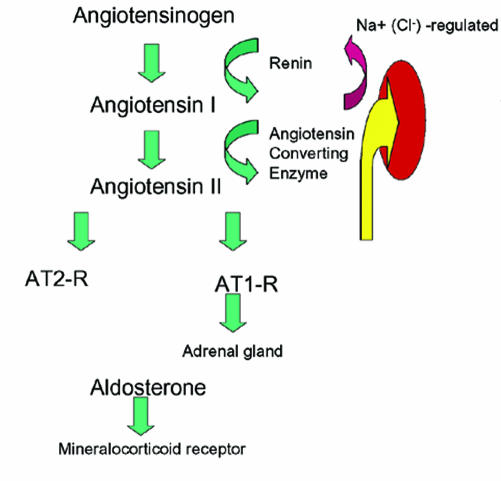
Figure 1
Figure 1
Renin-angiotensin-aldosterone system and its modification in Mendelian hypertension. Angiotensinogen from the liver is split by the enzyme rennin into angiotensin I (AT1), that is in turn split to angiotensin II via the angiotensin-converting enzyme. Angiotensin II acts on at least two receptors. For this discussion, we are interested only in the AT1 receptor. In the adrenal gland, this receptor leads to release of aldosterone. The second largest stimulus for aldosterone release is hyperkalemia.
Figure 2
Figure 2
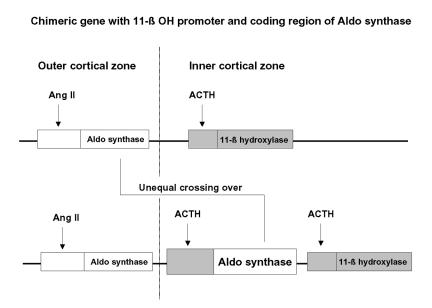
A chimeric gene is formed by miotic mismatch and unequal crossing over with the promoter region of the 11-β hydroxylase gene (dark box) and the coding region of the aldosterone synthase gene (white box). As a result, the aldosterone synthase gene is under control of ACTH in the inner cortical zone. (Aldo=Aldosterone, Ang II=Angiotensin II).
Figure 3
Figure 3
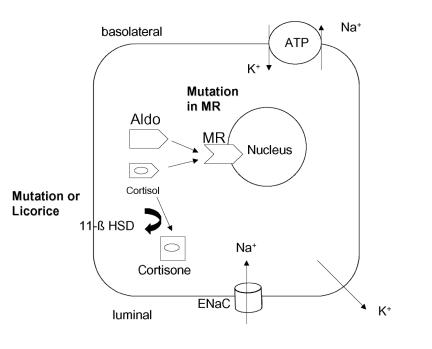
The diagram shows a cortical collecting duct cell. The mineralocorticoid receptor (MR) has the same affinity for cortisol as for aldosterone (Aldo). The enzyme 11-β hydroxysteroid dehydrogenase (11-β HSD) “protects” the MR by metabolizing cortisol to cortisone, which has no affinity. A mutated or an inhibited enzyme results in an increased intracellular concentration of cortisol and an increased activation of the MR. A mutated MR can result in an altered configuration so that the MR is activated by sterols not containing a 21-hydroxyl group. Increased MR activity causes enhanced Na+ reabsorption (ENaC, Na-K-ATPase) and K+ excretion.
Figure 4
Figure 4
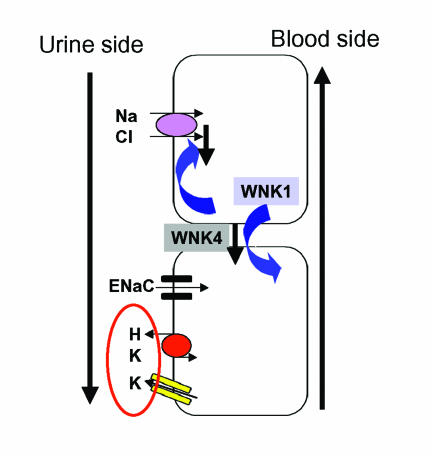
Shown is the distal nephron. The thiazide-sensitive Na, Cl cotransporter is over-active in pseudohypoaldosteronism type 2. As a result, less Na is available for the ENaC and less K and H ions are excreted in the cortical collecting duct. Therefore, the syndrome features volume expansion, hypertension, hyperkalemia and mild hyperchloremic metabolic acidosis. “With-no-lysine” (WNK) kinase 4 down-regulates the cotransporter. When the kinase is mutated, the cotransporter is hyperactive. WNK1 regulates WNK4 downward. Gain-of-function mutations in WNK1, would downregulate WNK4, causing cotransporter hyperactivity.
Figure 5
Figure 5
Hand roentgenogram of a 6 year-old Turkish boy with autosomal dominant hypertension (blood pressure 150/90 mm Hg) and brachydactyly type E is shown. The white arrow indicates the shortened metacarpal bones, which define this form of brachydactyly. The phalanges are also shortened. Additionally, cone shaped epiphyses are present (marked by white arrow).
Figure 5
Figure 5
Hand roentgenogram of a 6 year-old Turkish boy with autosomal dominant hypertension (blood pressure 150/90 mm Hg) and brachydactyly type E is shown. The white arrow indicates the shortened metacarpal bones, which define this form of brachydactyly. The phalanges are also shortened. Additionally, cone shaped epiphyses are present (marked by white arrow).
Figure 6
Figure 6
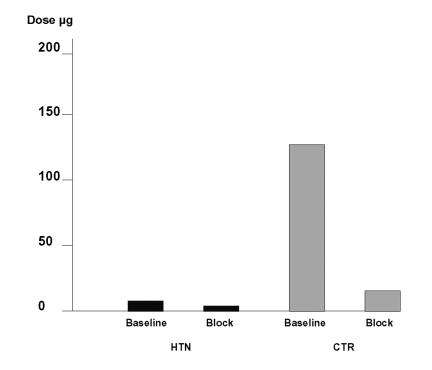
Doses of phenylephrine, which increase blood pressure 12.5 mm Hg before and during ganglion blockade with trimethaphan. The sensitivity to the alpha-agonist phenylephrine at baseline is in patients (HTN, black symbols) significantly higher compared to controls (CTR). After interruption of the baroreflex during ganglion blockade this difference is markedly diminished.

References

    1. Luft FC, Schuster H, Bilginturan N, Wienker T. “Treasure your exceptions”: what we can learn from autosomal-dominant inherited forms of hypertension. J Hypertens. 1995;13:1535–1538. - PubMed
    1. Lifton RP, Gharavi AG, Geller DS. Molecular mechanisms of human hypertension. Cell. 2001;104:545–556. - PubMed
    1. Lifton RP, Dluhy RG, Powers M, Rich GM, Cook S, Ulick S, Lalouel JM. A chimaeric 11β-hydroxylase/aldosterone synthase gene causes glucocorticoid-remediable aldosteronism and human hypertension. Nature. 1992;355:262–265. - PubMed
    1. Botero-Velez M, Curtis JJ, Warnock DG. Brief report: Liddle's syndrome revisited—a disorder of sodium reabsorption in the distal tubule. N Engl J Med. 1994;330:178–181. - PubMed
    1. Shimkets RA, Warnock DG, Bositis CM, Nelson-Williams C, Hansson JH, Schambelan M, Gill JR, Jr, Ulick S, Milora RV, Findling JW, Canessa CM, Rossier BC, Lifton RP. Liddle's syndrome: Heritable human hypertension caused by mutations in the β subunit of the epithelial sodium channel. Cell. 1994;79:407–414. - PubMed

Publication types

MeSH terms

Substances