


Complete nucleotide sequence of the LE1 prophage from the spirochete Leptospira biflexa and characterization of its replication and partition functions
- PMID: 15937155
- PMCID: PMC1151745
- DOI: 10.1128/JB.187.12.3931-3940.2005
Complete nucleotide sequence of the LE1 prophage from the spirochete Leptospira biflexa and characterization of its replication and partition functions
Abstract
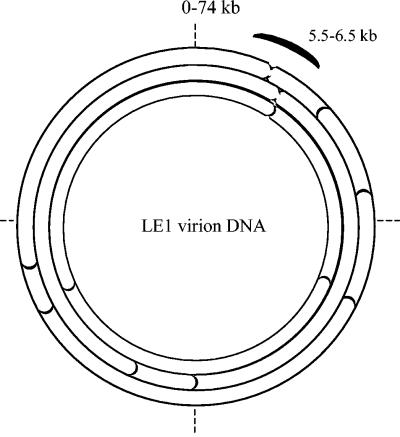
The first and, to date, only extrachromosomal circular replicon identified in the spirochete Leptospira is the LE1 prophage from Leptospira biflexa. The 74-kb LE1 genome has a GC content of 36%, which is similar to the GC content of Leptospira spp. Most of the 79 predicted open reading frames (ORFs) showed no similarities to known ORFs. However 21 ORFs appeared to be organized in clusters that could code for head and tail structural proteins and immunity repressor proteins. In addition, the pattern of gene expression showed that several LE1 genes are expressed specifically either in LE1 prophage or in L. biflexa late after infection. Since the LE1 prophage replicates autonomously as a circular replicon in L. biflexa, we were able to engineer an L. biflexa-Escherichia coli shuttle vector from a 5.3-kb DNA fragment of LE1 (Saint Girons et al., J. Bacteriol. 182:5700-5705, 2000), opening this genus to genetic manipulation. In this study, base compositional asymmetry confirms the location of the LE1 replication region and suggests that LE1 replicates via a bidirectional Theta-like replication mechanism from this unique origin. By subcloning experiments, the replication region can be narrowed down to a 1-kb region. This minimal replication region consists of a rep encoding a protein of 180 amino acids. Upstream from rep, putative partitioning genes, called parA and parB, were found to be similar to the par loci in Borrelia plasmids. A significant increase of plasmid stability in L. biflexa can be seen only when both parA and parB are present. These results enable the construction of new shuttle vectors for studying the genetics of Leptospira spp. This study will also contribute to a better knowledge of phages unrelated to lambdoid phages.
Figures



References
-
- Altschul, S. F., W. Gish, W. Miller, E. W. Myers, and D. J. Lipman. 1990. Basic local alignment search tool. J. Mol. Biol. 215:403-410. - PubMed
-
- Bauby, H., I. Saint Girons, and M. Picardeau. 2003. Construction and complementation of the first auxotrophic mutant in the spirochaete Leptospira meyeri. Microbiology 149:689-693. - PubMed
-
- Black, L. W. 1989. DNA packaging in dsDNA bacteriophages. Annu. Rev. Microbiol. 43:267-292. - PubMed
MeSH terms
Substances
Associated data
- Actions
LinkOut - more resources
Full Text Sources
Molecular Biology Databases
Miscellaneous
