. 2005 Jun;187(12):4207-13.
doi: 10.1128/JB.187.12.4207-4213.2005.

Defense against protein carbonylation by DnaK/DnaJ and proteases of the heat shock regulon

Affiliations

Defense against protein carbonylation by DnaK/DnaJ and proteases of the heat shock regulon

Asa Fredriksson et al. J Bacteriol. 2005 Jun.

Abstract

Protein carbonylation is an irreversible oxidative modification that increases during organism aging and bacterial growth arrest. We analyzed whether the heat shock regulon has a role in defending Escherichia coli cells against this deleterious modification upon entry into stationary phase. Providing the cell with ectopically elevated levels of the heat shock transcription factor, sigma32, effectively reduced stasis-induced carbonylation. Separate overproduction of the major chaperone systems, DnaK/DnaJ and GroEL/GroES, established that the former of these is more important in counteracting protein carbonylation. Deletion of the heat shock proteases Lon and HslVU enhanced carbonylation whereas a clpP deletion alone had no effect. However, ClpP appears to have a role in reducing protein carbonyls in cells lacking Lon and HslVU. Proteomic immunodetection of carbonylated proteins in the wild-type, lon, and hslVU strains demonstrated that the same spectrum of proteins displayed a higher load of carbonyl groups in the lon and hslVU mutants. These proteins included the beta-subunit of RNA polymerase, elongation factors Tu and G, the E1 subunit of the pyruvate dehydrogenase complex, isocitrate dehydrogenase, 6-phosphogluconate dehydrogenase, and serine hydroxymethyltranferase.


Figures

FIG. 1.
FIG. 1.
Protein carbonylation during growth and in stationary phase. Relative protein carbonylation levels (black squares) and the optical density of the wild-type culture (MG1655Δlac) (filled circles) are shown during growth and growth arrest caused by glucose depletion. Carbonyl levels were determined by one-dimensional Western blot immunoassays and quantified using Image Gauge software. Carbonyl levels were related to that obtained during exponential growth, which was assigned a value of 1.0. The arrow indicates the time at which samples were obtained for identification of carbonylated proteins (see Table 2). The experiment was repeated at least three times. Representative results are shown, and there was always less than 15% variation between experiments.
FIG. 2.
FIG. 2.
Effects of overproducing the Hsp regulon on protein oxidation. Severalfold change in the levels of DnaK, GroEL, and carbonylated proteins as a consequence of overproducing σ32 (ÅF41) (A), DnaK/DnaJ (ÅF38) (B), and GroEL/GroES (ÅF64) (C) in cells entering a growth arrested state (30 min after growth ceased) is shown. “1” on the y axis means no change compared to wild type, while “2” means a twofold increase and “−2” means a twofold decrease. The cells were grown with (100 μM) and without IPTG prior to starvation. Protein and carbonyl levels were determined by one-dimensional Western blot immunoassays and quantified using Image Gauge software. All levels were related to that obtained in the control culture without overproduction, which was assigned a value of 1.0.
FIG. 3.
FIG. 3.
Effects of overproducing DnaK/DnaJ (ÅF38) on EF-Tu carbonylation during glucose starvation (A). Open squares, no IPTG; gray squares; 100 μM IPTG; black squares, 250 μM IPTG. Carbonyl levels are normalized to EF-Tu levels. (B) General pattern and level of carbonylated proteins (equal amounts of total cellular proteins were loaded/well) in growth-arrested (2.5 h after cell division ceased) wild-type (ÅF38) cells harboring the PA1/lacO-1- dnaK dnaJ construct. Cells were grown with (250 μM) and without IPTG prior to starvation. Arrow indicates EF-Tu. Protein and carbonyl levels were determined by one-dimensional Western blot immunoassays and quantified using Image Gauge software. All experiments were repeated at least three times. Representative results are shown, and there was always less than 15% variation between experiments.
FIG. 4.
FIG. 4.
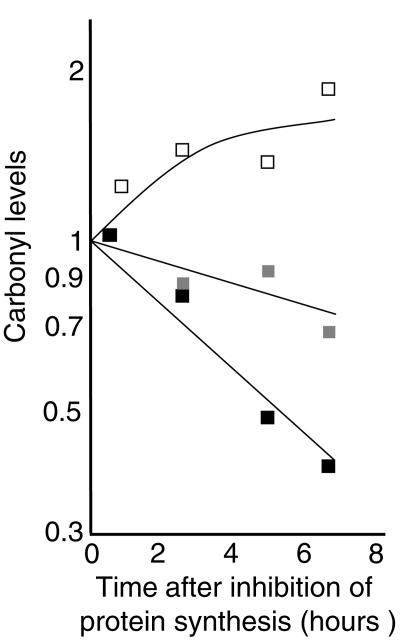
Relative stability of carbonylated proteins determined by one-dimensional Western blot immunoassays in cells with different levels of σ32. Protein synthesis was inhibited with spectinomycin during entry to stationary phase (30 min after growth ceased) in cells containing either the empty vector control (ÅF42; open squares) or the Ptrc- rpoH construct (ÅF41) grown in the presence (black squares) or absence (gray squares) of 100 μM IPTG.
FIG. 5.
FIG. 5.
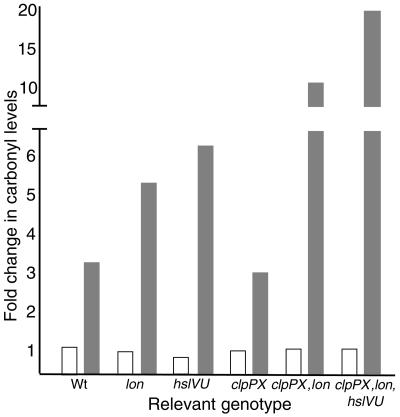
Severalfold change in the levels of carbonylated proteins in wild-type (MG1655Δlac) cells and in cells lacking the proteases Lon (ÅF66), HslVU (ÅF49), and ClpPX (PhB1907), ClpPX and Lon (PhB1465), and ClpPX, Lon, and HslVU (PhB1466). Protein extracts were from exponentially growing cells (open bars) and cells from an overnight stationary phase sample (grey bars). Carbonyl levels were determined by a slot-blot immunoassay and quantified using Image Gauge software. All levels were related to that obtained for the wild type during exponential growth, which was assigned a value of 1.0.
FIG. 6.
FIG. 6.
Proteomic immunodetection of carbonylated proteins in wild type (MG1655Δlac), Δlon (ÅF66), and ΔhslVU (ÅF49) cells entering a growth-arrested state due to glucose starvation. The major target proteins of carbonylation were identified by mass spectrometry and included the β-subunit of RNA polymerase (RpoB), elongation factors Tu and G (EF-Tu, EF-G), the E1 component (AceE) of the pyruvate dehydrogenase complex, isocitrate dehydrogenase (Icd), 6-phosphogluconate dehydrogenase (Gnd), and Serine hydroxymethyltranferase (GlyA). The boxed proteins are GroEL and DnaK. The experiment was repeated three times, and the patterns of carbonylated proteins were the same in each experiment. Representative results are shown.
FIG. 7.
FIG. 7.
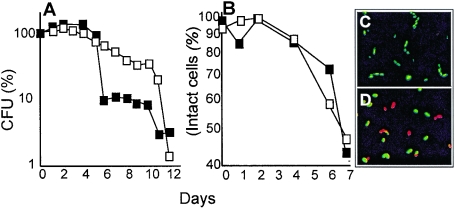
Stasis-survival of cells overproducing DnaK/DnaJ (ÅF38). Open squares, no IPTG; black squares, 250 μM IPTG. Plating efficiency (A) and membrane integrity (B) was monitored in cells growth arrested due to glucose starvation. Membrane integrity of cells was analyzed using the BacLight LIVE/DEAD methodology (12). Intact cells appear fluorescent green (C; 1 h starvation), whereas cells with a debilitated and leaky membrane appear red (D; 7 days of starvation). Representative results are shown, and there was always less than 15% variation between experiments.

References

    1. Agarwal, S., and R. S. Sohal. 1994. Aging and proteolysis of oxidized proteins. Arch. Biochem. Biophys. 309:24-28. - PubMed
    1. Amoros, M., and F. Estruch. 2001. Hsf1p and Msn2/4p cooperate in the expression of Saccharomyces cerevisiae genes HSP26 and HSP104 in a gene- and stress type-dependent manner. Mol. Microbiol. 39:1523-1532. - PubMed
    1. Ballesteros, M., A. Fredriksson, J. Henriksson, and T. Nyström. 2001. Bacterial senescence: protein oxidation in non-proliferating cells is dictated by the accuracy of the ribosomes. EMBO J. 20:5280-5289. - PMC - PubMed
    1. Bota, D. A., and K. J. Davies. 2002. Lon protease preferentially degrades oxidized mitochondrial aconitase by an ATP-stimulated mechanism. Nat Cell Biol. 4:674-680. - PubMed
    1. Bota, D. A., H. Van Remmen, and K. J. Davies. 2002. Modulation of Lon protease activity and aconitase turnover during aging and oxidative stress. FEBS Lett. 532:103-106. - PubMed

Publication types

MeSH terms

LinkOut - more resources