


Water balance, hydration status, and fat-free mass hydration in younger and older adults
- PMID: 15941885
- PMCID: PMC2495085
- DOI: 10.1093/ajcn/81.6.1342
Water balance, hydration status, and fat-free mass hydration in younger and older adults
Abstract
Background: Older adults are at increased risk of dehydration, yet water balance is understudied in this population.
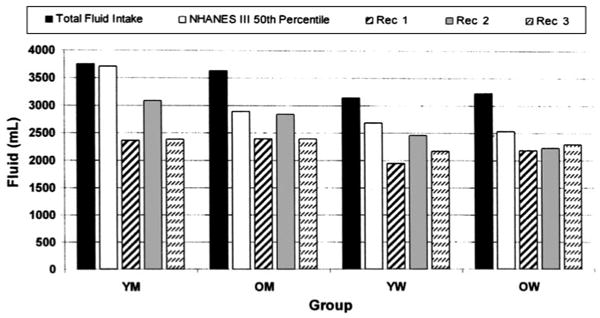
Objective: This controlled diet study assessed the effect of age on water input, output, and balance in healthy adults. Hydration status (plasma osmolality and urine specific gravity) and body composition were also measured.
Design: Eleven men and 14 women aged 23-46 y and 10 men and 11 women aged 63-81 y were subjects. Water balance was assessed during days 7-10 of three 18-d controlled feeding trials with protein intakes of 0.50, 0.75, and 1.00 g . kg(-1) . d(-1). Total water input included water from the provided foods and beverages, ad libitum intake, and metabolic production. Water output included the losses in urine and stool and the insensible losses from respiration and nonsweating perspiration.
Results: Ad libitum water consumption, total water intake, water output through urine, total water output, and net water balance were not different in the older subjects than in the younger subjects. Markers of hydration status were within the range of clinical normalcy for all groups. Total body water (TBW) was not significantly different, fat-free mass (FFM) was significantly lower (P < 0.05), and FFM hydration (TBW:FFM) was significantly higher (P < 0.05) in the older subjects than in the younger subjects. Dietary protein intake did not influence any of these results.
Conclusions: These results show that healthy older adults maintain water input, output, and balance comparable to those of younger adults and have no apparent changes in hydration status. The results support that the hydration of FFM is increased in older men and women.
Figures
References
-
- Adolph EF. Physiological regulations. Lancaster, PA: The Jacques Cattell Press; 1943.
-
- Food and Nutrition Board. Dietary reference intakes for water, potassium, sodium, chloride, and sulfate. Washington, DC: The National Academies Press; 2004. prepublication copy unedited proofs.
-
- National Center for Health Statistics. The third National Health and Nutrition Examination Survey (NHANES III, 1988-94) reference manuals and reports. Hyattsville, MD: US Department of Health and Human Services Centers for Disease Control and Prevention National Center for Health Statistics; 1996.
-
- Naitoh M, Burrell LM. Thirst in elderly subjects. J Nutr Health Aging. 1998;2:172–7. - PubMed
-
- Stout NR, Kenny RA, Baylis PH. A review of water balance in ageing in health and disease. Gerontology. 1999;45:61–6. - PubMed
Publication types
MeSH terms
Substances
Grants and funding
LinkOut - more resources
Full Text Sources
Other Literature Sources
Medical
