Comparative Study
. 2005 May 19:5:8.
doi: 10.1186/1471-2318-5-8.

Foot pressure distribution during walking in young and old adults

Affiliations
Comparative Study

Foot pressure distribution during walking in young and old adults

Mary Josephine Hessert et al. BMC Geriatr. .

Abstract

Background: Measurement of foot pressure distribution (FPD) is clinically useful for evaluation of foot and gait pathologies. The effects of healthy aging on FPD during walking are not well known. This study evaluated FPD during normal walking in healthy young and elderly subjects.

Methods: We studied 9 young (30 +/- 5.2 years), and 6 elderly subjects (68.7 +/- 4.8 years). FPD was measured during normal walking speed using shoe insoles with 99 capacitive sensors. Measured parameters included gait phase characteristics, mean and maximum pressure and force, and relative load.Time-series measurements of each variable for all sensors were grouped into 9 anatomical masks.

Results: Elderly subjects had lower normalized maximum pressure for the medial and lateral calcaneal masks, and for all medial masks combined. In the medial calcaneus mask, the elderly group also had a lower absolute maximum and lower mean and normalized mean pressures and forces, compared to young subjects. Elderly subjects had lower maximum force and normalized maximum force and lower mean force and normalized mean forces in the medial masks as well.

Conclusion: FPD differences between the young and elderly groups were confined to the calcaneus and hallux regions and to the medial side of the foot. In elderly subjects, weight bearing on the lateral side of the foot during heel touch and toe-off phases may affect stability during walking.


Figures
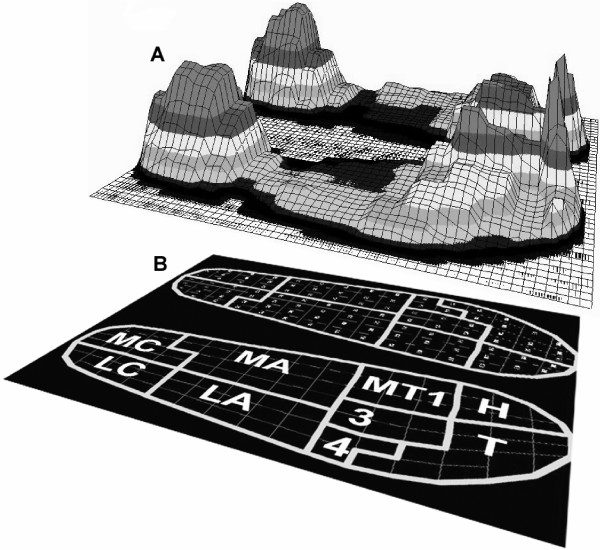
Figure 1
Figure 1
Foot pressure distribution. A. Maximum pressure distribution on all sensors during stance for one subject. B. The nine anatomical masks superimposed on the insole (MC = medial calcaneus, LC = lateral calcaneus, MA = medial arch, LA = lateral arch, MT1 = first metatarse, 3 = second and third metatarse, 4 = fourth and fifth metatarse, H = hallux, and T = toes).
Figure 2
Figure 2
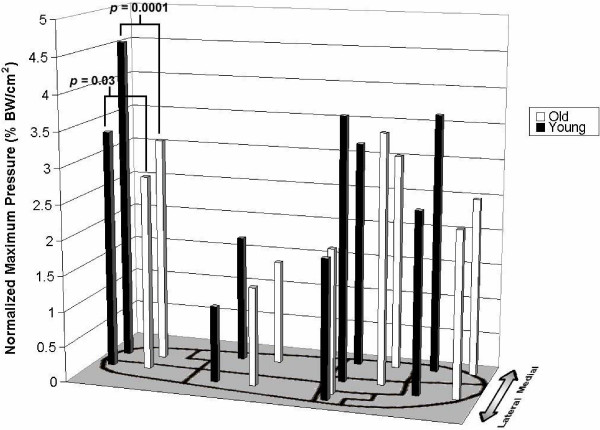
Pressure distribution by anatomical region. Normalized maximum pressure distribution for the young (white bar) and elderly (black bar) group for each anatomical region (medial calcalneus mask p = 0.0001, lateral calcaneus mask p = 0.03).
Figure 3
Figure 3
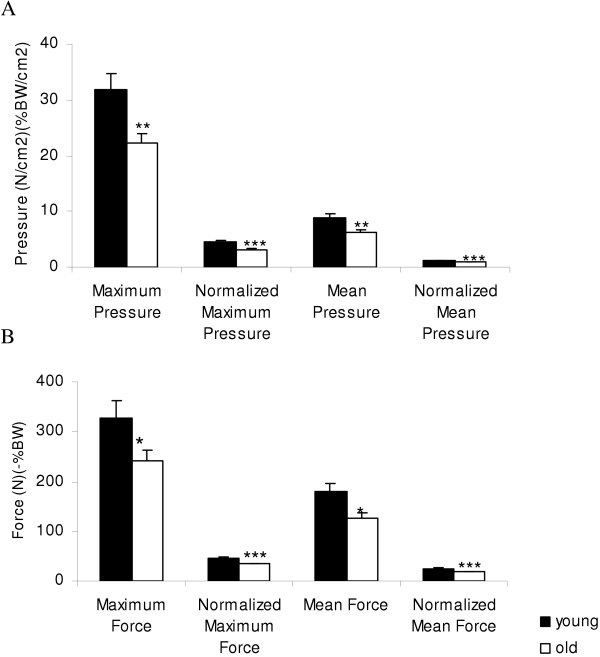
Medial calcaneus mask. A. The average maximum and mean pressures, and normalized mean and maximum pressures for medial calcaneus mask for young and old subjects (**p = 0.01, *** normalized maximum pressure p = 0.001, *** normalized mean pressure p = 0.0006). B. The average mean and maximum forces and normalized mean and maximum forces for medial calcaneus for the young and old groups (mean ± SD, maximum force * p = 0.05 *** normalized maximumn force p = 0.001, mean force * p = 0.02, *** normalized mean force p = 0.0006).

References

    1. Rodgers MM. Dynamic foot biomechanics. J Orthop Sports Phys Ther. 1995;21:306–316. - PubMed
    1. Hausdorff JM, Edelberg HK, Mitchell SL, Goldberger AL, Wei JY. Increased gait unsteadiness in community-dwelling elderly fallers. Arch Phys Med Rehabil. 1997;78:278–283. doi: 10.1016/S0003-9993(97)90034-4. - DOI - PubMed
    1. Morag E, Cavanagh PR. Structural and functional predictors of regional peak pressures under the foot during walking. J Biomech. 1999;32:359–370. doi: 10.1016/S0021-9290(98)00188-2. - DOI - PubMed
    1. Phillipson A, Dhar S, Linge K, McCabe C, Kleneman L. Foot Ankle Int. 1994;15:595–598. - PubMed
    1. Kimmeskamp S, Henning EM. Heel to toe motion characteristics in Parkinson patients during free walking. Clin Biomech. 2001;16:806–812. doi: 10.1016/S0268-0033(01)00069-9. - DOI - PubMed

Publication types