


The XPF-ERCC1 endonuclease and homologous recombination contribute to the repair of minor groove DNA interstrand crosslinks in mammalian cells produced by the pyrrolo[2,1-c][1,4]benzodiazepine dimer SJG-136
- PMID: 15944449
- PMCID: PMC1145189
- DOI: 10.1093/nar/gki639
The XPF-ERCC1 endonuclease and homologous recombination contribute to the repair of minor groove DNA interstrand crosslinks in mammalian cells produced by the pyrrolo[2,1-c][1,4]benzodiazepine dimer SJG-136
Abstract
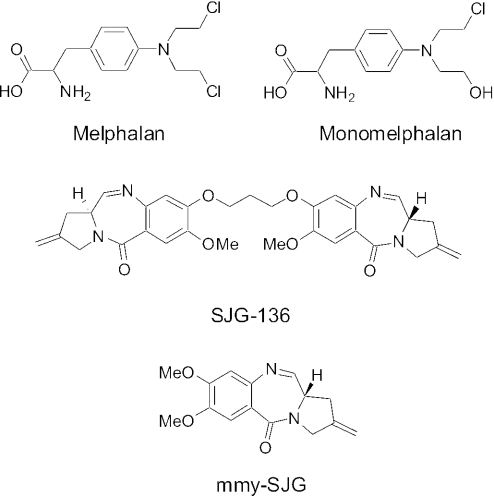
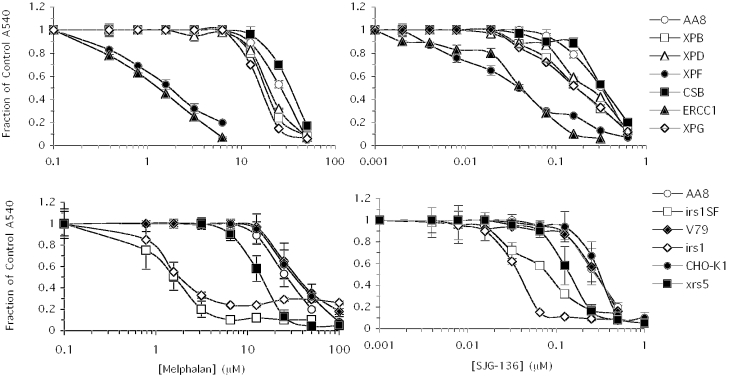
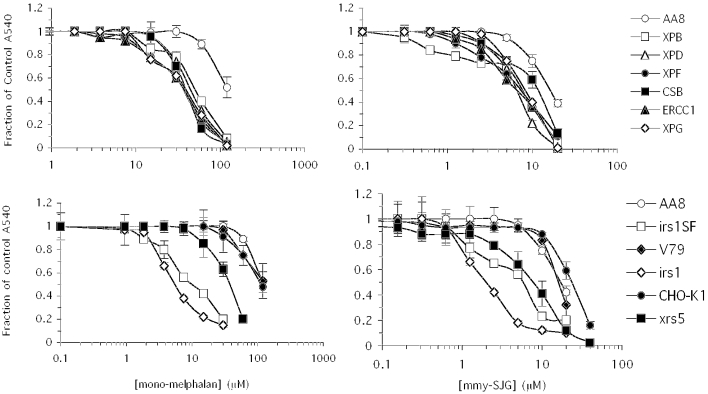
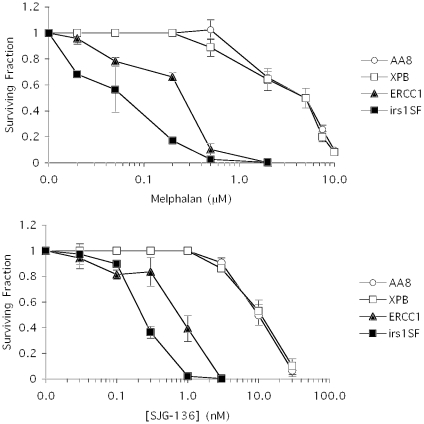
SJG-136, a pyrrolo[2,1-c][1,4]benzodiazepine (PBD) dimer, is a highly efficient interstrand crosslinking agent that reacts with guanine bases in a 5'-GATC-3' sequence in the DNA minor groove. SJG-136 crosslinks form rapidly and persist compared to those produced by conventional crosslinking agents such as nitrogen mustard, melphalan or cisplatin which bind in the DNA major groove. A panel of Chinese hamster ovary (CHO) cells with defined defects in specific DNA repair pathways were exposed to the bi-functional agents SJG-136 and melphalan, and to their mono-functional analogues mmy-SJG and mono-functional melphalan. SJG-136 was >100 times more cytotoxic than melphalan, and the bi-functional agents were much more cytotoxic than their respective mono-functional analogues. Cellular sensitivity of both SJG-136 and melphalan was dependent on the XPF-ERCC1 heterodimer, and homologous recombination repair factors XRCC2 and XRCC3. The relative level of sensitivity of these repair mutant cell lines to SJG-136 was, however, significantly less than with major groove crosslinking agents. In contrast to melphalan, there was no clear correlation between sensitivity to SJG-136 and crosslink unhooking capacity measured using a modified comet assay. Furthermore, repair of SJG-136 crosslinks did not involve the formation of DNA double-strand breaks. SJG-136 cytotoxicity is likely to result from the poor recognition of DNA damage by repair proteins resulting in the slow repair of both mono-adducts and more importantly crosslinks in the minor groove.
Figures

References
-
- Dronkert M.L., Kanaar R. Repair of DNA interstrand cross-links. Mutat. Res. 2001;486:217–247. - PubMed
-
- Lawley P.D., Phillips D.H. DNA adducts from chemotherapeutic agents. Mutat. Res. 1996;355:13–40. - PubMed
-
- Thurston D.E. Advances in the study of Pyrrolo[2,1 c][1,4]benzodiazepine (PBD) antitumour antibiotics. In: Neidle S., Waring M.J., editors. Topics in Molecular and Structural Biology: Molecular Aspects of Anticancer Drug–DNA Interactions. London: The Macmillan Press Ltd; 1993. pp. 54–88.
-
- Puvvada M.S., Forrow S.A., Hartley J.A., Stephenson P., Gibson I., Jenkins T.C., Thurston D.E. Inhibition of bacteriophage T7 RNA polymerase in vitro transcription by DNA-binding pyrrolo[2,1 c][1,4]benzodiazepines. Biochemistry. 1997;36:2478–2484. - PubMed
-
- Thurston D.E., Bose D.S., Thompson A.S., Howard P.W., Leoni A., Croker S.J., Jenkins T.C., Neidle S., Hartley J.A., Hurley L.H. Synthesis of sequence-selective C8-linked pyrrolo[2,1-c][1,4]benzodiazepine DNA interstrand crosslinking agents. J. Org. Chem. 1996;61:8141–8147. - PubMed
Publication types
MeSH terms
Substances
LinkOut - more resources
Full Text Sources
Other Literature Sources
