Review
. 2005 Jun;69(2):197-216.
doi: 10.1128/MMBR.69.2.197-216.2005.

Metabolic engineering in the -omics era: elucidating and modulating regulatory networks

Affiliations
Review

Metabolic engineering in the -omics era: elucidating and modulating regulatory networks

Goutham N Vemuri et al. Microbiol Mol Biol Rev. 2005 Jun.

Abstract

The importance of regulatory control in metabolic processes is widely acknowledged, and several enquiries (both local and global) are being made in understanding regulation at various levels of the metabolic hierarchy. The wealth of biological information has enabled identifying the individual components (genes, proteins, and metabolites) of a biological system, and we are now in a position to understand the interactions between these components. Since phenotype is the net result of these interactions, it is immensely important to elucidate them not only for an integrated understanding of physiology, but also for practical applications of using biological systems as cell factories. We present some of the recent "-omics" approaches that have expanded our understanding of regulation at the gene, protein, and metabolite level, followed by analysis of the impact of this progress on the advancement of metabolic engineering. Although this review is by no means exhaustive, we attempt to convey our ideology that combining global information from various levels of metabolic hierarchy is absolutely essential in understanding and subsequently predicting the relationship between changes in gene expression and the resulting phenotype. The ultimate aim of this review is to provide metabolic engineers with an overview of recent advances in complementary aspects of regulation at the gene, protein, and metabolite level and those involved in fundamental research with potential hurdles in the path to implementing their discoveries in practical applications.


Figures
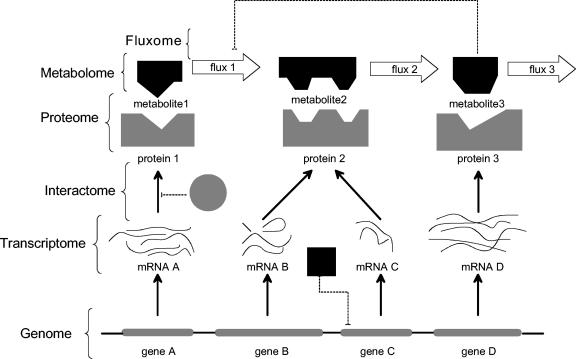
FIG. 1.
FIG. 1.
Organization of the various -omes in a hierarchical fashion. The comprehensive DNA sequence in a cell is the genome, which consists of coding regions, shown as gray bars. The coding process begins with the expression of DNA to the respective RNA species, which consists of the transcriptome. The transcription process is dictated by several factors, including the interaction of proteins and metabolites with DNA and the presence/absence of the required cellular machinery. The mRNA species are translated to form proteins (proteome). As shown in the figure, there may not exist a one-to-one correspondence between proteins and genes. The various interactions between proteins, DNA, and metabolites, called the interactome, is the key determinant of any cellular process. The solid arrows represent the flow of biological information, while the dashed lines show possible interactions between various cellular components. Proteins are the functional entities that carry out the actual metabolic process by interconverting metabolites (metabolome). Any observed phenotype such as growth and product formation is the net result of all these cellular events. Therefore, capturing information at just one stage of the process (transcription, translation, etc.) will not reveal the cause and effect relationships between cellular components. It is necessary for the metabolic engineer to understand these relationships in order to accurately design and control biological systems.
FIG. 2.
FIG. 2.
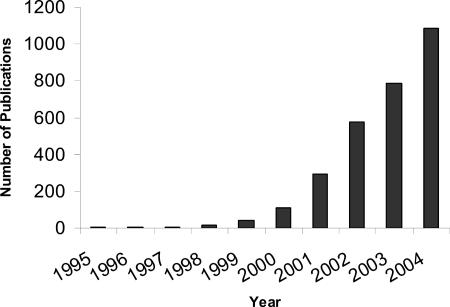
Exponential increase in the application of microarray technology in research. The statistics are taken from the papers in the Pubmed database. Only papers including the words microarray, oligonucleotide array, or global gene expression in the title or as key words were taken into account.
FIG. 3.
FIG. 3.
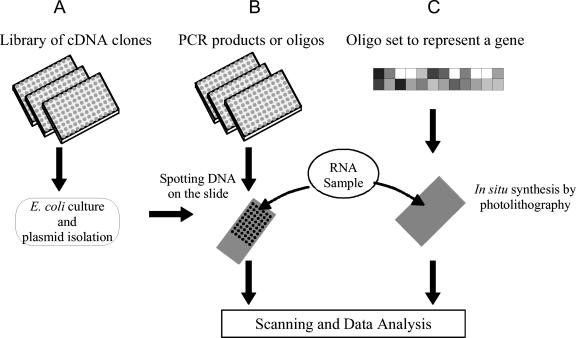
Three techniques of preparing microarrays. A) Early microarray platform involved obtaining a library of cDNA clones, which are inserted in a plasmid, expressed in E. coli. These inserts are then purified and spotted on a glass slide. B) In the postsequencing era, long oligonucleotides (about 60 bp) are designed for binding in the nonconserved region of the gene sequences, or commonly, the entire gene is PCR amplified and the purified product is spotted on the glass slide. In both A and B, the DNA bound to the glass slide will act as a template to which the target gene will uniquely hybridize. C) Several short oligonucleotides (about 20 to 25 bp long) are designed per gene along with one mismatch to serve as a negative control. These oligonucleotides are synthesized in situ using the photolithographic method. This platform offers very high quality data.
FIG. 4.
FIG. 4.
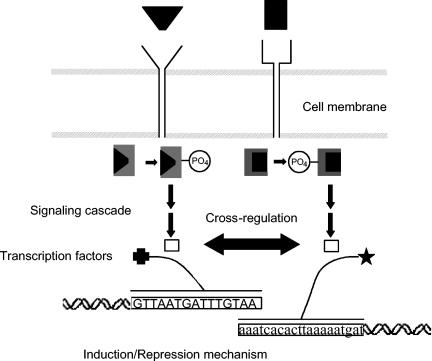
Representation of interaction between two signal transduction pathways. Upon external stimulation, the signaling molecule (usually the stimulus itself) binds to the outer membrane receptor proteins. The structural changes that these proteins undergo trigger the phosphorylation of kinases which are activated to trigger the transfer of signal to the transcription factors that bind to specific binding targets upstream of genes, thereby regulating their expression. Such two-component signal transduction systems have so far been studied in isolation, but recent -omic approaches have provided ample evidence for the existence of interactions between these systems.
FIG. 5.
FIG. 5.
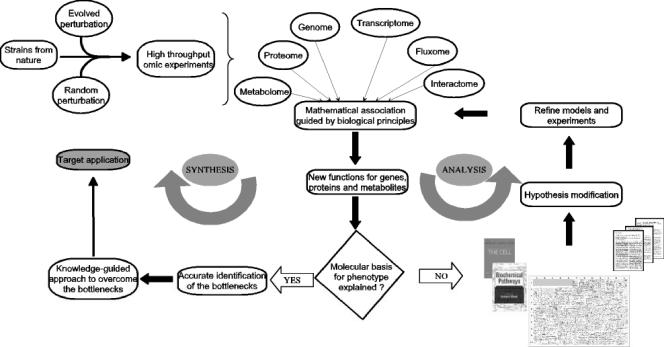
Analysis and synthesis in metabolic engineering as advocated by systems biology. Associating global information from strains with little-known physiology or from model organisms leads to new discoveries while refining existing knowledge. Experimental validation of these inferences will guide the fundamental understanding of microbial physiology as well as strain design for a purposeful end. However, often the model predictions and preliminary hypothesis do not agree with experimental observations. Referring to the available literature, prior knowledge about basic biochemistry and metabolic pathways leads to modifying the hypothesis, possibly requiring further experimentation. Performing the association again under the modified framework of knowledge should correct any disparities between predictions and experiments. Such iterative procedures are rapidly gaining prominence in systems biology.

References

    1. Aebersold, R., and M. Mann. 2003. Mass spectrometry-based proteomics. Nature 422:198-207. - PubMed
    1. Agarwal, A. K., P. D. Rogers, S. R. Baerson, M. R. Jacob, K. S. Barker, J. D. Cleary, L. A. Walker, D. G. Nagle, and A. M. Clark. 2003. Genome-wide expression profiling of the response to polyene, pyrimidine, azole, and echinocandin antifungal agents in Saccharomyces cerevisiae. J. Biol. Chem. 278:34998-35015. - PubMed
    1. Anderson, L., and J. Seilhamer. 1997. A comparison of selected mRNA and protein abundances in human liver. Electrophoresis 18:533-537. - PubMed
    1. Aravin, A. A., M. Lagos-Quintana, A. Yalcin, M. Zavolan, D. Marks, B. Snyder, T. Gaasterland, J. Meyer, and T. Tuschl. 2003. The small RNA profile during Drosophila melanogaster development. Dev. Cell 5:337-350. - PubMed
    1. Arfin, S. M., A. D. Long, E. T. Ito, L. Tolleri, M. M. Riehle, E. S. Paegle, and G. W. Hatfield. 2000. Global gene expression profiling in Escherichia coli K12. The effects of integration host factor. J. Biol. Chem. 275:29672-29684. - PubMed