. 2005 Jul;57(1):238-49.
doi: 10.1111/j.1365-2958.2005.04673.x.

The ClpX chaperone modulates assembly of the tubulin-like protein FtsZ

Affiliations

The ClpX chaperone modulates assembly of the tubulin-like protein FtsZ

Richard B Weart et al. Mol Microbiol. 2005 Jul.

Abstract

Summary Assembly of the tubulin-like cytoskeletal protein FtsZ into a ring structure establishes the location of the nascent division site in prokaryotes. Factors that modulate FtsZ assembly are essential for ensuring the precise spatial and temporal regulation of cytokinesis. We have identified ClpX, the substrate recognition subunit of the ClpXP protease, as an inhibitor of FtsZ assembly in Bacillus subtilis. Genetic data indicate that ClpX but not ClpP inhibits FtsZ-ring formation in vivo. In vitro, ClpX inhibits FtsZ assembly in a ClpP-independent manner through a mechanism that does not require ATP hydrolysis. Together our data support a model in which ClpX helps maintain the cytoplasmic pool of unassembled FtsZ that is required for the dynamic nature of the cytokinetic ring. ClpX is conserved throughout bacteria and has been shown to interact directly with FtsZ in Escherichia coli. Thus, we speculate that ClpX functions as a general regulator of FtsZ assembly and cell division in a wide variety of bacteria.


Figures
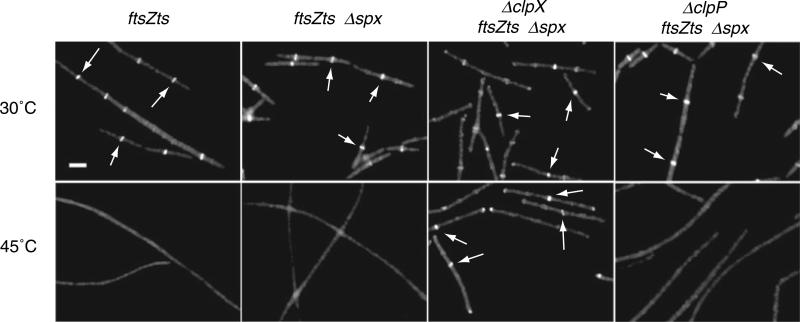
Fig. 1
Fig. 1. ClpX modulates FtsZts assembly in vivo
A. A clpX null mutation restores Z-ring formation to ftsZts cells at 45°C. PL642 (ftsZts), BW182 (ftsZts spx::neo), BW189 (ftsZts spx::neo clpX::spc) and BW206 (ftsZts spx::neo clpP::cat) cells were cultured in LB at 30°C to mid-exponential phase (OD600 ~0.400) and then back-diluted into LB at 30°C or 45°C and grown for ~2.5 h. FtsZts (FtsZ–GFP) was visualized in fixed cells using fluorescence microscopy. Arrows indicate examples of medial Z rings. Scale bar = 2.5 μm.
Fig. 2
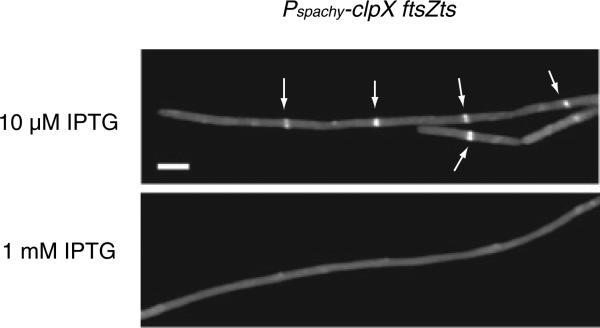
Fig. 2. ClpX overexpression blocks Z-ring assembly
A. ClpX overexpression increases cell length. Cells encoding both an IPTG-inducible clpX allele and an ftsZts allele (BW243) were grown in LB at 37°C with 10 μM IPTG to maintain basal levels of ClpX expression. At mid-exponential phase (OD600 ~0.400) cultures were back-diluted into LB containing either 10 μM IPTG (grey bars) or 1 mM IPTG (black bars) and grown for ~2.5 h prior. FtsZts (FtsZ– GFP) was visualized in live cells using fluorescence microscopy. Arrows indicate Z rings in cells grown in LB with 10 μM IPTG. Scale bar = 2.5 μm.
Fig. 3
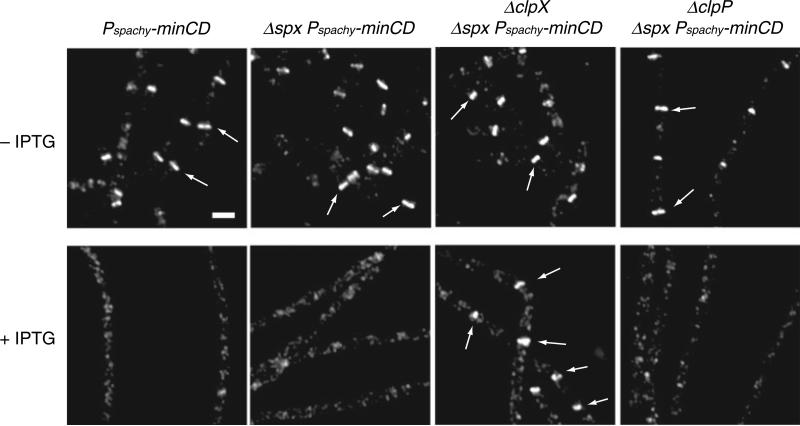
Fig. 3
A clpX null mutation restores Z-ring formation to cells overexpressing the FtsZ inhibitor MinCD. PL1145 (thrC::Pspachy-minCD), BW287 (thrC::Pspachy-minCD spx::neo), BW293 (thrC::Pspachy-minCD spx::neo clpX::spc) and BW220 (thrC::Pspachy-minCD spx::neo clpP::cat) cells were cultured in LB at 37°C to mid-exponential phase (OD600 ~0.400) and back-diluted into LB ± 1 mM IPTG and grown for ~2.5 h. FtsZ was visualized by immunofluorescence microscopy. Arrows indicate examples of FtsZ rings. Scale bar = 2.5 μm.
Fig. 4
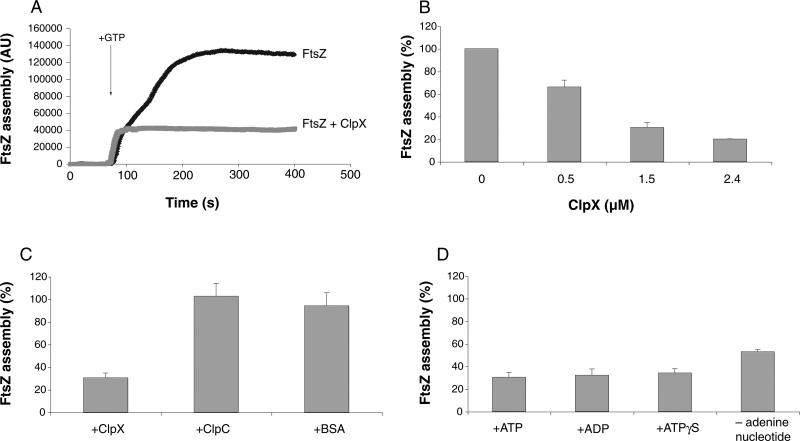
Fig. 4
ClpX inhibits FtsZ assembly in vitro in a 90° angle light scattering assay. Unless indicated otherwise, all reactions are performed in the presence of 1 mM ATP with an FtsZ concentration of 2.5 μM. Assembly values in (B), (C) and (D) represent maximal levels of FtsZ assembly in the presence of ClpX relative to FtsZ assembly in the absence of ClpX. Error bars represent standard deviation. A. Representative light scattering plot of FtsZ (black trace) and FtsZ + ClpX (grey trace). FtsZ assembly was initiated by the addition of 1 mM GTP. B. Dose-dependent inhibition of FtsZ assembly by ClpX. C. Inhibition of FtsZ assembly by ClpX is specific to ClpX. ClpX, ClpC and BSA were added to a final concentration of 1.5 μM. D. ATP hydrolysis is not required for inhibition of FtsZ assembly by ClpX. ATP, ADP and ATPγS were added to 1 mM where appropriate.
Fig. 5
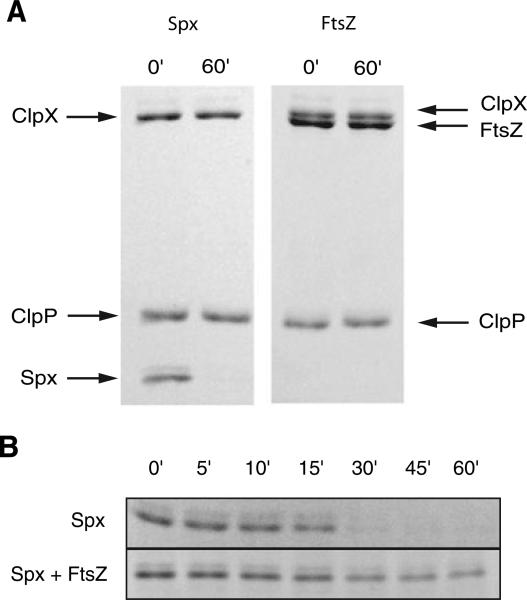
Fig. 5
FtsZ interacts with, but is not degraded by, ClpXP. A. ClpXP is able to degrade Spx but not FtsZ in vitro. Proteolysis reactions were performed at 37°C in the presence of 5 mM ATP and sampled at 0 and 60 min. B. The presence of 10-fold mass excess of FtsZ relative to Spx inhibits the degradation of Spx by ClpXP. Proteolysis reactions were performed at 30°C and sampled at 0, 5, 10, 15, 30, 45 and 60 min. Samples in (A) and (B) were analysed by SDS-PAGE and stained with coomassie Brilliant Blue and representative gels are shown.

References

    1. Burton BM, Williams TL, Baker TA. ClpX-mediated remodeling of mu transpososomes: selective unfolding of subunits destabilizes the entire complex. Mol Cell. 2001;8:449–454. - PubMed
    1. Cordell SC, Robinson EJ, Lowe J. Crystal structure of the SOS cell division inhibitor SulA and in complex with FtsZ. Proc Natl Acad Sci USA. 2003;100:7889–7894. - PMC - PubMed
    1. Desai A, Mitchison TJ. Microtubule polymerization dynamics. Annu Rev Cel Dev Biol. 1997;13:83–117. - PubMed
    1. Erickson HP. Atomic structures of tubulin and FtsZ. Trends Cell Biol. 1998;8:133–137. - PubMed
    1. Feucht A, Lucet I, Yudkin MD, Errington J. Cytological and biochemical characterization of the FtsA cell division protein of Bacillus subtilis. Mol Microbiol. 2001;40:115–125. - PubMed

Publication types

MeSH terms

LinkOut - more resources