Review
. 2005 Jun 21;102(25):8801-8.
doi: 10.1073/pnas.0500075102. Epub 2005 Jun 14.

Molecular electronics: some views on transport junctions and beyond

Affiliations
Review

Molecular electronics: some views on transport junctions and beyond

Christian Joachim et al. Proc Natl Acad Sci U S A. .

Abstract

The field of molecular electronics comprises a fundamental set of issues concerning the electronic response of molecules as parts of a mesoscopic structure and a technology-facing area of science. We will overview some important aspects of these subfields. The most advanced ideas in the field involve the use of molecules as individual logic or memory units and are broadly based on using the quantum state space of the molecule. Current work in molecular electronics usually addresses molecular junction transport, where the molecule acts as a barrier for incoming electrons: This is the fundamental Landauer idea of "conduction as scattering" generalized to molecular junction structures. Another point of view in terms of superexchange as a guiding mechanism for coherent electron transfer through the molecular bridge is discussed. Molecules generally exhibit relatively strong vibronic coupling. The last section of this overview focuses on vibronic effects, including inelastic electron tunneling spectroscopy, hysteresis in junction charge transport, and negative differential resistance in molecular transport junctions.


Figures
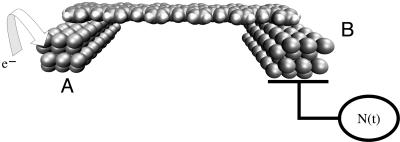
Fig. 1.
Fig. 1.
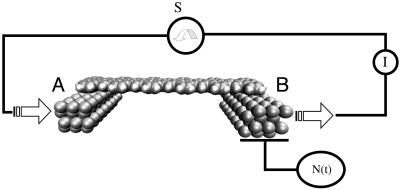
A molecular wire L adsorbed and providing electronic coupling between two metallic clusters A and B. Injecting one electron on A = (M1)n will trigger an ET process guided by L between the state A–L–B and A–L–B with B = (M2)n. This process can be followed in time by using the electron detector N(t) before it stops because of decoherence and relaxation effects at the interface, on the molecule, and in the A and B clusters.
Fig. 2.
Fig. 2.
A source S is added to Fig. 1, ideally synchronized with each ET event from A to B through L. An ideal S is supposed to provide an electron at cluster A each time the previous one had been pumped out of cluster B. A macroscopic amperometer is added to measure the tunnel current density in the circuit.
Fig. 3.
Fig. 3.
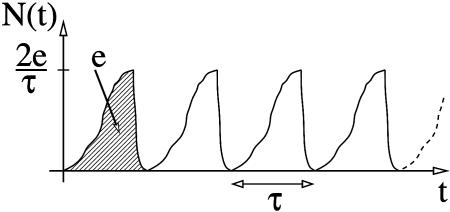
The ideal N(t) time-dependent electron population on cluster B when the source S in Fig. 2 is synchronized with each ET event. As indicated, each arc is supposed to be normalized to effectively one ET at a time. τ is the full duration of the event before its fast pumping out of cluster B, τ = h/4V12(n).
Fig. 4.
Fig. 4.
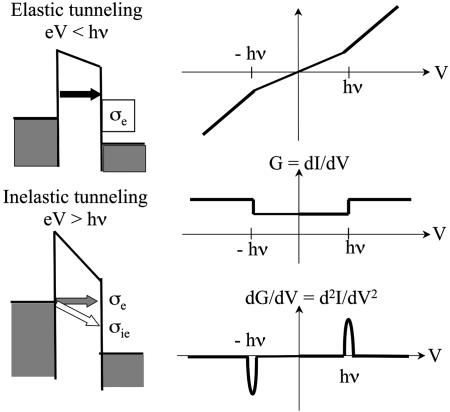
Schematic illustrations of the IETS measurement. The cross-sections for the elastic and inelastic tunneling are (to a first, rough approximation) additive, so that when the applied voltage exceeds a characteristic vibrational energy on the molecule, one expects to see changes of slope in the current, of value in the conductance, and peaks in the IETS (second derivative of the current) structure (M. A. Reed, personal communication).
Fig. 5.
Fig. 5.
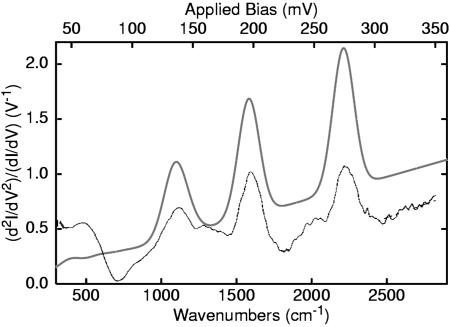
Calculated (upper line) (A. Troisi, personal communication) and measured (lower line) (71) IETS spectra of an ortho-phenylene ethynylene molecule with a nitro substituent and gold electrodes. The peaks correspond to specific normal coordinates of the molecule.
Fig. 6.
Fig. 6.
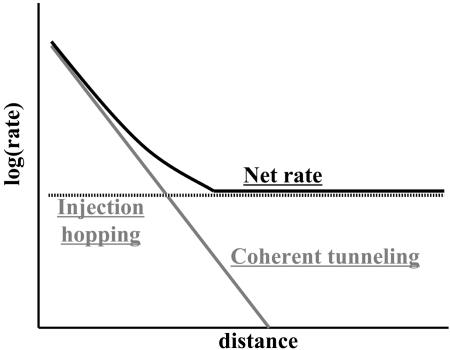
Schematic expected behavior for intramolecular ET reactions and for conductance as a function of the length of the molecular bridge. The total rate is the sum of injection hopping (incoherent motion), which is weakly distance-dependent, and coherent tunneling, which depends exponentially on distance.
Fig. 7.
Fig. 7.
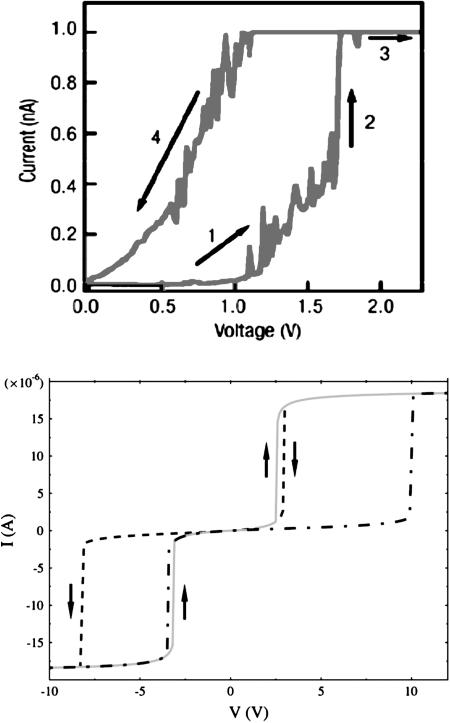
Computed (Lower) (89) and measured (Upper) (90) hysteretic behavior in the conductance spectrum of a conjugated molecular structure. Note that Right examines only the positive voltage sweep regime.
Fig. 8.
Fig. 8.
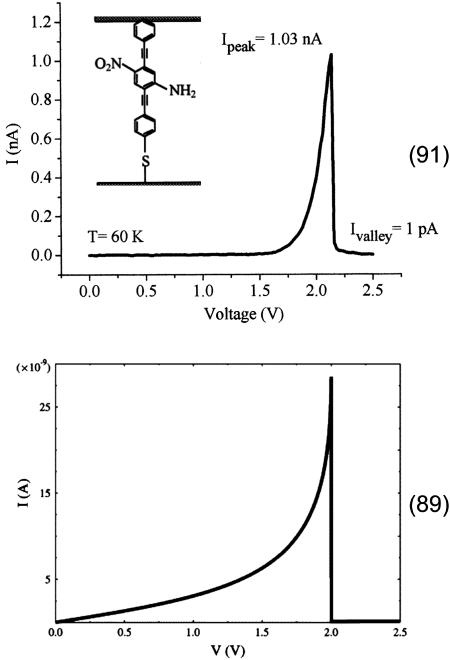
Measured (Upper) (91) and calculated (Lower) (89) negative differential resistance feature in the conductance measurement of the sketched molecule. The model explains the result based on charging of the molecular junction.

References

    1. Petty, M. C., Bryce, M. R. & Bloor, D. (1995) Introduction to Molecular Electronics (Oxford Univ. Press, Oxford).
    1. Aviram, A., ed. (1992) Molecular Electronics: Science and Technology (Am. Inst. Phys., College Park, MD)
    1. Aviram, A. & Ratner, M. A., eds. (1998) Ann. N.Y. Acad. Sci. 852, 1–370.
    1. Jortner, J. & Ratner, M. A., eds. (1997) Molecular Electronics (Blackwell Scientific, Oxford).
    1. Reed, M. A. & Lee, T., eds. (2003) Molecular Nanoelectronics (Am. Sci., Stevenson Ranch, CA).

Publication types

LinkOut - more resources