


doi: 10.1128/JVI.79.13.8651-8654.2005.
Growth of respiratory syncytial virus in primary epithelial cells from the human respiratory tract
Affiliations
- PMID: 15956607
- PMCID: PMC1143745
- DOI: 10.1128/JVI.79.13.8651-8654.2005
Item in Clipboard
Growth of respiratory syncytial virus in primary epithelial cells from the human respiratory tract
J Virol.
2005 Jul.
Abstract
Respiratory syncytial virus (RSV) is the most important cause of lower respiratory tract disease in infants and children. To study RSV replication, we have developed an in vitro model of human nasopharyngeal mucosa, human airway epithelium (HAE). RSV grows to moderate titers in HAE, though they are significantly lower than those in a continuous epithelial cell line, HEp-2. In HAE, RSV spreads over time to form focal collections of infected cells causing minimal cytopathic effect. Unlike HEp-2 cells, in which wild-type and live-attenuated vaccine candidate viruses grow equally well, the vaccine candidates exhibit growth in HAE that parallels their level of attenuation in children.
Figures
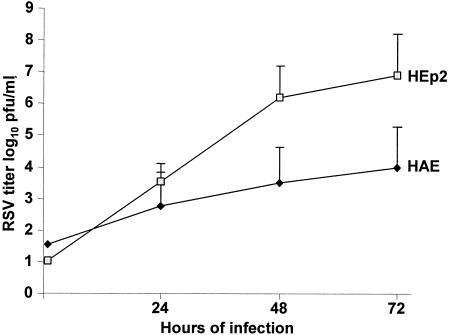
Growth of RSV in respiratory epithelial tissue culture systems. Titers of RSV strains were determined by plaque assay on HEp-2 cell monolayer cultures maintained under semisolid overlay at 37°C for wild-type RSV and at 32°C for live-attenuated mutants as previously described (13). Virus recovery was significantly greater from HEp-2 cells than from primary human epithelial cells (HAE) (P < 0.01 at 48 and 72 h).
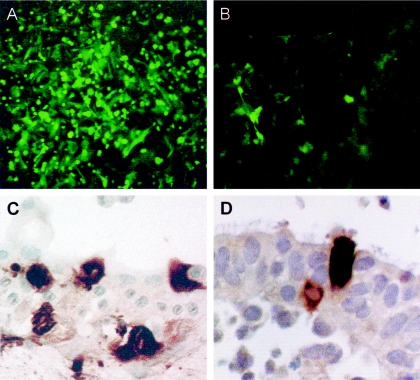
Demonstration of the limited growth and focal nature of the infection of RSV in HAE. Shown are expression of GFP by rgRSV in (A) HEp-2 cells and (B) HAE at 72 h after initiation of infection and results of immunoperoxidase staining with a goat biotin-conjugated antibody to RSV (Biodesign International, Saco, ME) in (C) HAE and (D) an adenoid organ culture.
References
-
- Bryson, D. G., M. S. McNulty, E. F. Logan, and P. F. Cush. 1983. Respiratory syncytial virus pneumonia in young calves: clinical and pathologic findings. Am. J. Vet. Res. 44:1648-1655. - PubMed
-
- Coyte, P. C., R. Croxford, W. McIsaac, W. Feldman, and J. Friedberg. 2001. The role of adjuvant adenoidectomy and tonsillectomy in the outcome of the insertion of tympanostomy tubes. N. Engl. J. Med. 344:1188-1195. - PubMed
-
- Crowe, J. E., Jr., P. T. Bui, A. R. Davis, R. M. Chanock, and B. R. Murphy. 1994. A further attenuated derivative of a cold-passaged temperature-sensitive mutant of human respiratory syncytial virus retains immunogenicity and protective efficacy against wild-type challenge in seronegative chimpanzees. Vaccine 12:783-790. - PubMed
-
- Crowe, J. E., Jr., P. T. Bui, G. R. Siber, W. R. Elkins, R. M. Chanock, and B. R. Murphy. 1995. Cold-passaged, temperature-sensitive mutants of human respiratory syncytial virus (RSV) are highly attenuated, immunogenic, and protective in seronegative chimpanzees, even when RSV antibodies are infused shortly before immunization. Vaccine 13:847-855. - PubMed
-
- Crowe, J. E., Jr. 2001. Respiratory syncytial virus vaccine development. Vaccine 20:S32-S37. - PubMed
Publication types
MeSH terms
Grants and funding
LinkOut - more resources
Full Text Sources
Other Literature Sources
