


Self-management strategies mediate self-efficacy and physical activity
- PMID: 15958246
- PMCID: PMC2435261
- DOI: 10.1016/j.amepre.2005.03.012
Self-management strategies mediate self-efficacy and physical activity
Abstract
Background: Self-efficacy theory proposes that girls who have confidence in their capability to be physically active will perceive fewer barriers to physical activity or be less influenced by them, be more likely to pursue perceived benefits of being physically active, and be more likely to enjoy physical activity. Self-efficacy is theorized also to influence physical activity through self-management strategies (e.g., thoughts, goals, plans, and acts) that support physical activity, but this idea has not been empirically tested.
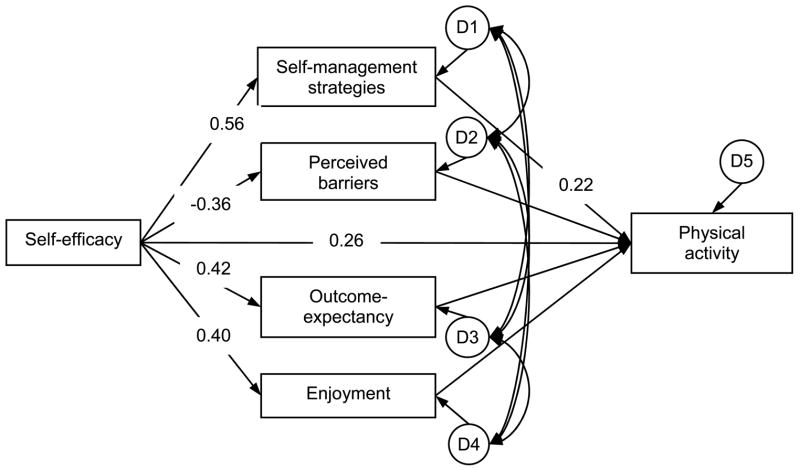
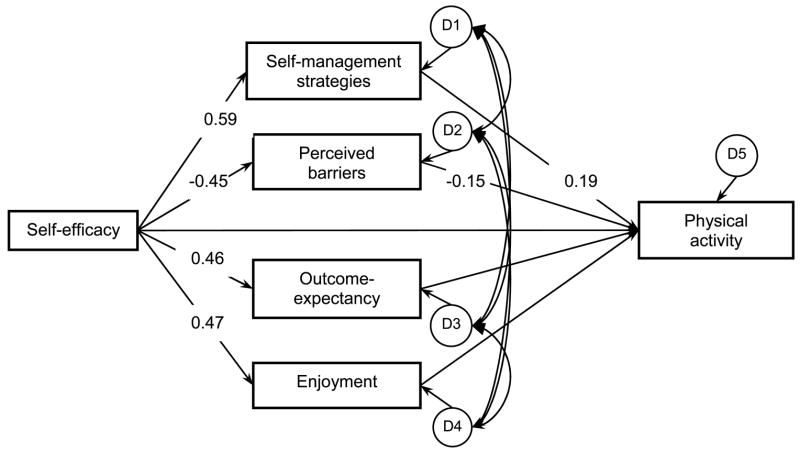
Methods: Confirmatory factor analysis was used to test the factorial validity of a measure of self-management strategies for physical activity. Next, the construct validity of the measure was tested by examining whether self-management strategies mediated the relationship between self-efficacy and self-reported physical activity, independently of several social-cognitive variables (i.e., perceived barriers, outcome expectancy value, and enjoyment), among cross-sectional samples of 6th grade (n=309) and 8th grade (n=296) girls tested between February 14 and March 17, 2002. Data were analyzed in 2004.
Results: Consistent with theory, self-efficacy had direct effects on the social-cognitive variables. The primary novel finding is that self-management strategies mediated the association of self-efficacy with physical activity in both samples.
Conclusions: The measure of self-management strategies for physical activity yields valid scores among adolescent girls and warrants experimental study as a mediator of the influence of efficacy beliefs on physical activity.
Conflict of interest statement
No financial conflict of interest was reported by the authors of this paper.
Figures
References
-
- Ogden CL, Flegal KM, Carroll MD, Johnson CL. Prevalence and trends in overweight among US children and adolescents, 1999–2000. JAMA. 2002;288:1728–32. - PubMed
-
- Wang G, Dietz WH. Economic burden of obesity in youths aged 6 to 17 years: 1979–1999. Pediatrics. 2002;109:E81, 1–6. - PubMed
-
- Duke J, Huhman M, Heitzler C. Physical activity levels among children aged 9–13 years – United States, 2002. Morb Mortal Wkly Rep. 2003;52:785–8. - PubMed
-
- Caspersen CJ, Pereira MA, Curran KM. Changes in physical activity patterns in the United States, by sex and cross-sectional age. Med Sci Sports Exerc. 2000;32:1601–9. - PubMed
-
- Centers for Disease Control and Prevention. Youth risk behavior surveillance—United States, 1997. MMWR Surveill Summ. 1998;47:1–89. - PubMed
Publication types
MeSH terms
Grants and funding
- U01HL66845/HL/NHLBI NIH HHS/United States
- U01HL66855/HL/NHLBI NIH HHS/United States
- U01HL66857/HL/NHLBI NIH HHS/United States
- U01 HL066855/HL/NHLBI NIH HHS/United States
- U01 HL066858/HL/NHLBI NIH HHS/United States
- U01 HL066856/HL/NHLBI NIH HHS/United States
- U01HL66858/HL/NHLBI NIH HHS/United States
- U01 HL066845/HL/NHLBI NIH HHS/United States
- U01HL66852/HL/NHLBI NIH HHS/United States
- U01HL66856/HL/NHLBI NIH HHS/United States
- U01 HL066852/HL/NHLBI NIH HHS/United States
- U01 HL066853/HL/NHLBI NIH HHS/United States
- U01 HL066857/HL/NHLBI NIH HHS/United States
- U01HL66853/HL/NHLBI NIH HHS/United States
