


Association between radiographic damage of the spine and spinal mobility for individual patients with ankylosing spondylitis: can assessment of spinal mobility be a proxy for radiographic evaluation?
- PMID: 15958757
- PMCID: PMC1755579
- DOI: 10.1136/ard.2004.029728
Association between radiographic damage of the spine and spinal mobility for individual patients with ankylosing spondylitis: can assessment of spinal mobility be a proxy for radiographic evaluation?
Abstract
Objective: To demonstrate the association between various measures of spinal mobility and radiographic damage of the spine in individual patients with ankylosing spondylitis, and to determine whether the assessment of spinal mobility can be a proxy for the assessment of radiographic damage.
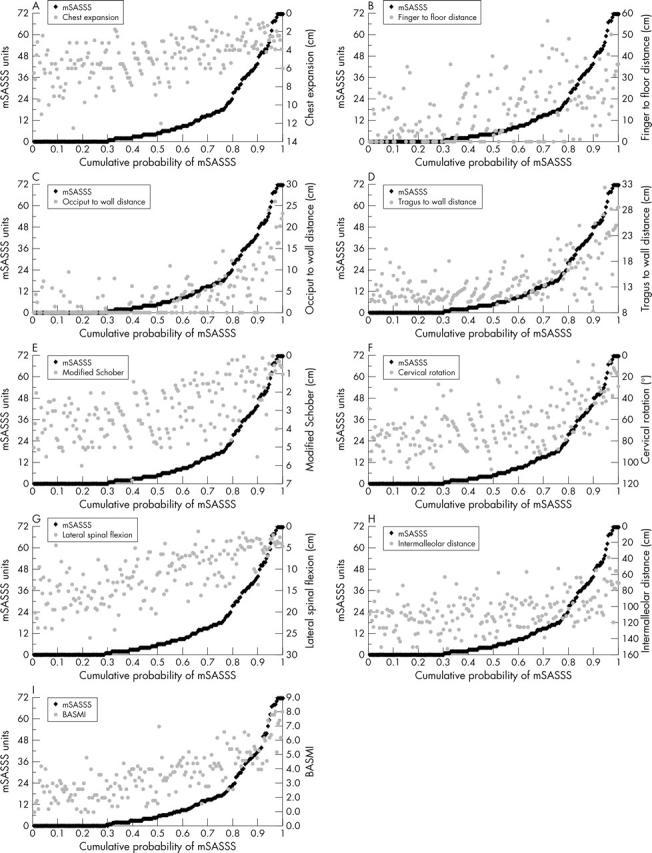
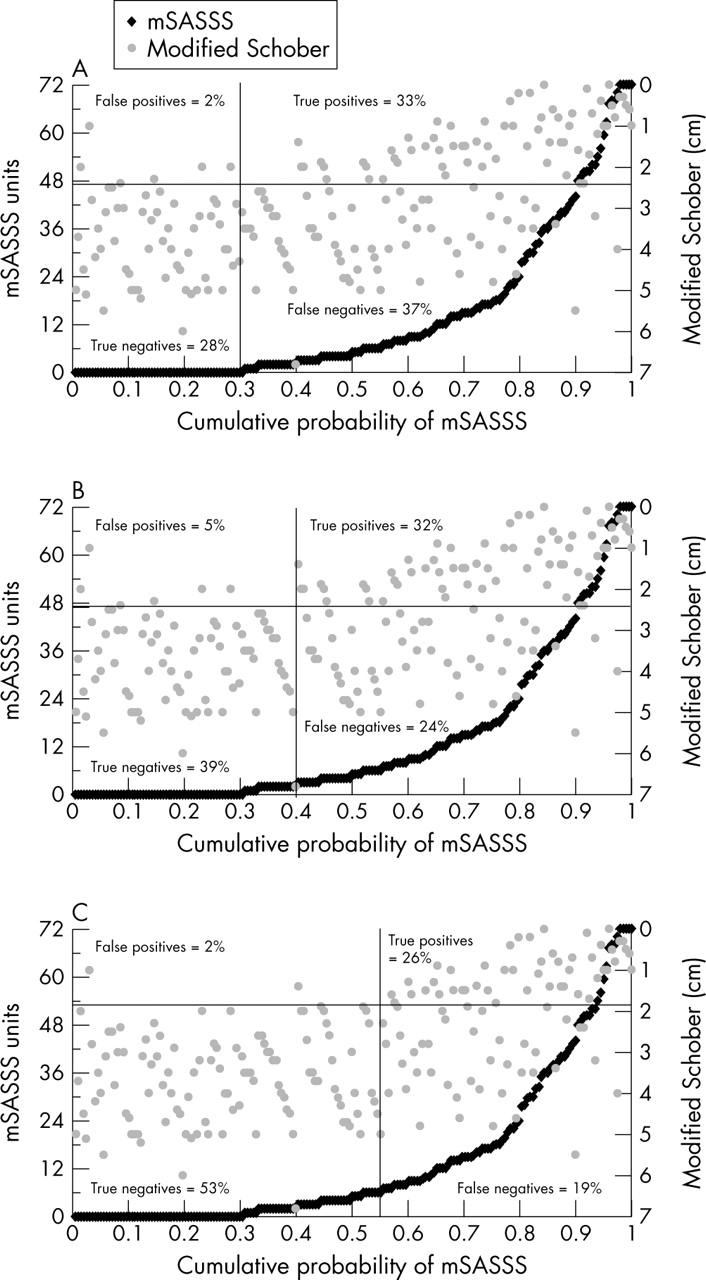
Methods: Radiographic damage was assessed by the mSASSS. Cumulative probability plots combined the radiographic damage score of an individual patient with the corresponding score for nine spinal mobility measures. Receiver operating characteristic analysis was performed to determine the cut off level of every spinal mobility measure that discriminates best between the presence and absence of radiographic damage. Three arbitrary cut off levels for radiographic damage were investigated. Likelihood ratios were calculated to explore further the diagnostic properties of the spinal mobility measures.
Results: Cumulative probability plots showed an association between spinal mobility measures and radiographic damage for the individual patient. Irrespective of the chosen cut off level for radiographic progression, lateral spinal flexion and BASMI discriminated best between patients with and those without structural damage. Even the best discriminatory spinal mobility assessments misclassified a considerable proportion of patients (up to 20%). Intermalleolar distance performed worst (up to 30% misclassifications). Lateral spinal flexion best predicted the absence of radiographic damage, and a modified Schober test best predicted the presence of radiographic damage.
Conclusion: This study unequivocally demonstrated a relationship between spinal mobility and radiographic damage. However, spinal mobility cannot be used as a proxy for radiographic evaluation in an individual patient.
Figures
References
Publication types
MeSH terms
LinkOut - more resources
Full Text Sources
Medical
Research Materials
