. 2005 Jul;25(13):5523-34.
doi: 10.1128/MCB.25.13.5523-5534.2005.

Esf2p, a U3-associated factor required for small-subunit processome assembly and compaction

Affiliations

Esf2p, a U3-associated factor required for small-subunit processome assembly and compaction

Tran Hoang et al. Mol Cell Biol. 2005 Jul.

Abstract

Esf2p is the Saccharomyces cerevisiae homolog of mouse ABT1, a protein previously identified as a putative partner of the TATA-element binding protein. However, large-scale studies have indicated that Esf2p is primarily localized to the nucleolus and that it physically associates with pre-rRNA processing factors. Here, we show that Esf2p-depleted cells are defective for pre-rRNA processing at the early nucleolar cleavage sites A0 through A2 and consequently are inhibited for 18S rRNA synthesis. Esf2p was stably associated with the 5' external transcribed spacer (ETS) and the box C+D snoRNA U3, as well as additional box C+D snoRNAs and proteins enriched within the small-subunit (SSU) processome/90S preribosomes. Esf2p colocalized on glycerol gradients with 90S preribosomes and slower migrating particles containing 5' ETS fragments. Strikingly, upon Esf2p depletion, chromatin spreads revealed that SSU processome assembly and compaction are inhibited and glycerol gradient analysis showed that U3 remains associated within 90S preribosomes. This suggests that in the absence of proper SSU processome assembly, early pre-rRNA processing is inhibited and U3 is not properly released from the 35S pre-rRNAs. The identification of ABT1 in a large-scale analysis of the human nucleolar proteome indicates that its role may also be conserved in mammals.


Figures
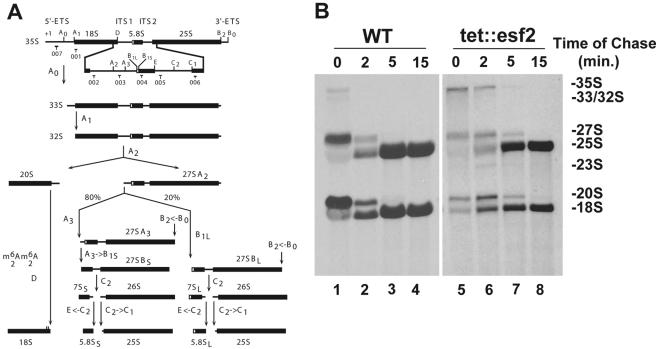
FIG. 1.
FIG. 1.
Esf2p is required for normal pre-rRNA processing. (A) Yeast pre-rRNA processing pathway. The 18S, 5.8S, and 25S rRNAs are encoded within a single large RNA Pol I transcript (35S). Mature sequences are interspersed with noncoding external (5′ and 3′) as well as internal (1 and 2) transcribed spacers. For a complete description of the pathway, see the text and reference . Cleavage sites (A0 to E) and the oligonucleotide probes used (001 through 007) are indicated. (B) Pulse-chase analysis. tet::esf2 and wild-type isogenic cells were grown in synthetic medium containing doxycycline for 24 h, pulsed with methyl-3H, and chased with an excess of cold methionine and samples collected at the times indicated. Total RNA was extracted and fractionated on denaturing agarose gels. Equal counts were loaded (20,000 cpm); the left exposure was for 3 days, the right for 18 days.
FIG. 2.
FIG. 2.
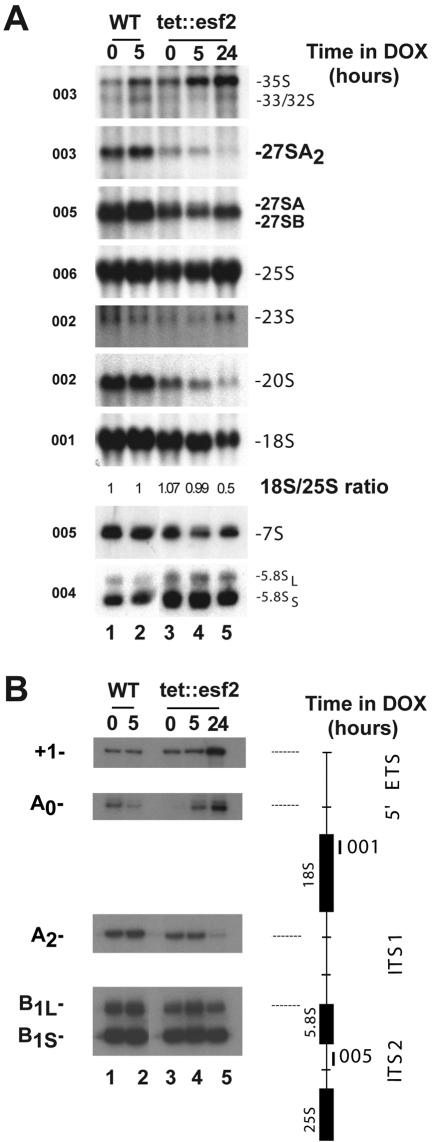
Esf2p is required for nucleolar pre-rRNA processing at cleavage sites A0 through A2. (A) Northern blot analysis. tet::esf2 and wild-type isogenic cells were grown in complete medium and maintained in exponential phase by dilution with fresh medium. Samples were collected in the absence of doxycycline (0-h time point) and following the addition of the antibiotic for 5 and 24 h. Total RNA was extracted, separated on agarose/formaldehyde gels, and processed for Northern blot hybridization. The oligonucleotide probes used (Fig. 1A) are indicated. The 18S-to-25S ratio was established by phosphorimager quantitation (Typhoon 9200/ImageQuantTL v2003.03; GE Healthcare). Note that for tet::esf2 strains, the pre-rRNA processing defect in the absence of doxycycline is already detected (0-h time point), suggesting that the level of ESF2 mRNA is already reduced by the Tet transcriptional fusion in the absence of doxycycline-mediated repression L, Long; S, short. (B) Primer extension analysis. Total RNA from Esf2p-depleted and isogenic control cells was also used as a template in primer extension experiments with oligonucleotides 001 and 005.
FIG. 3.
FIG. 3.
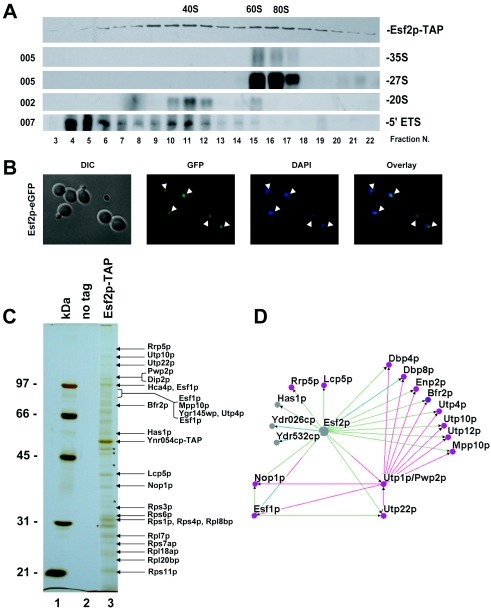
Esf2p, a component of 90S preribosomes and 5′ ETS-based RNPs. (A) Glycerol gradient. Total cellular extracts from a strain expressing a functional Esf2p-TAP construct were layered on 10 to 30% glycerol gradients and resolved by ultracentrifugation. Twenty-four fractions were collected manually and analyzed by Western and Northern blotting for protein and RNA compositions. The peroxidase antiperoxidase antibody (Sigma) that recognizes the protein A moiety of the tandem affinity purification tag and specific oligonucleotides (to the left) (Fig. 1A) were used in the hybridizations. (B) GFP fluorescence. Esf2p-eGFP-expressing cells were grown to mid-log phase in complete medium and the fusion wasdetected directly in live cells by use of a Zeiss Axioskop2 Plus microscope equipped with a Plan Neofluar 100×/1.30 objective. Acquisition was performed with an AxiocamHRm camera and the native Axiovision4 software from Zeiss (release 4.1). Cells were counterstained with DAPI that labels the bulk of the DNA; a differential interference contrast (DIC) is provided. The strain presented here is YDL892; the same result was obtained with strain YDL893. (C) MALDI-TOF mass spectrometry analysis. Total cellular extracts, as shown in panel A, were affinity purified according to the tandem affinity purification protocol. Pellet fractions were resolved by SDS-PAGE and analyzed by MALDI. Major copurifying bands are annotated. As a control, a wild-type isogenic strain (no tag) was used. Molecular weight markers (MW) are on the left. The asterisks represent degradation products of Esf2p. The cross corresponds to tobacco etch virus protease, which was used in the purification procedure. (D) Esf2p-centric view of preribosome assembly. This diagram was compiled with the Osprey software from several high-throughput data sets, as well as specific analysis (see Materials and Methods). Interactions are color coded as follows: light green, affinity purification (this work); turquoise, two-hybrid interaction (22); and pink, affinity purification (15, 23).
FIG. 4.
FIG. 4.
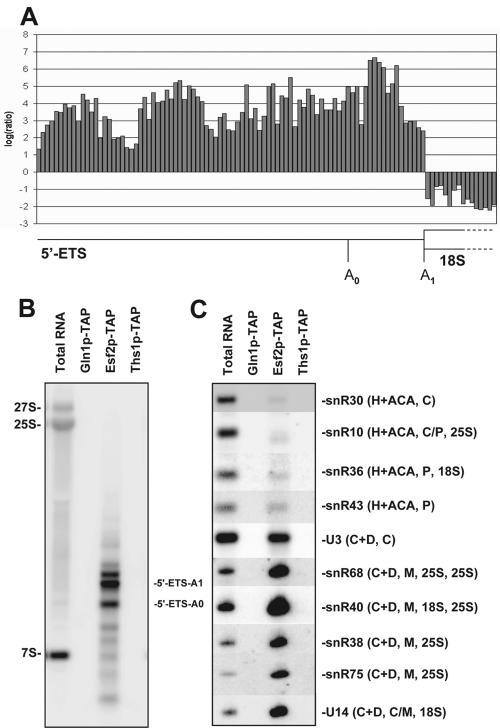
Esf2p is stably associated with 5′ ETS fragments, the box C+D snoRNA U3 and several other box C+D snoRNAs. (A) Ratios (Esf2p-TAP purification RNA versus total RNA) from oligonucleotide microarray probes spaced every five bases along the 5′ ETS fragments and the 5′ end of the 18S rRNA. Tandem affinity-purified fractions equivalent to 1.3 liters of cells were phenol extracted and subjected to microarray analysis or Northern blotting (see Materials and Methods). Microarray data are listed on our website (http://hugheslab.med.utoronto.ca/Hoang). The salt concentration used in washes was 150 mM. (B) Northern blot confirming that the Esf2p-TAP purification contains cleaved 5′ ETS. The bands detected are virtually identical to those detected in association with other UTPs (29, 36). Gln1p-TAP and Ths1p-TAP are included as negative controls for specificity; Gln1p is a metabolic enzyme, and Ths1p binds threonyl-tRNAs (25). The oligonucleotide probes used were EC2 and 5′ ETS-A0 (see Materials and Methods). (C) Northern blots confirming that the Esf2p-TAP purification contains U3 and a subset of other box C+D snoRNAs but not box H+ACA snoRNAs. The snoRNAs involved in cleavages (C) and/or modification (P, pseudouridylation; M, methylation), as well as known target substrates for modification (18S and/or 25S rRNA), are indicated. The snoRNA probes used are listed in Materials and Methods.
FIG. 5.
FIG. 5.
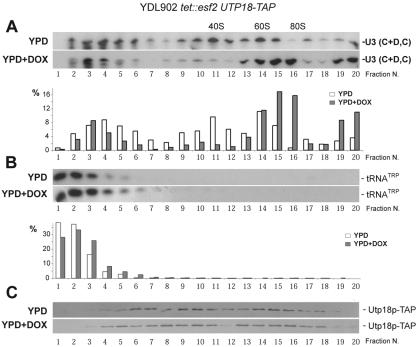
Esf2p is required for the efficient cycling of U3 and other snoRNAs. Total cellular extracts from a tet::esf2 UTP18-TAP strain grown to mid-log phase in complete medium in the absence of doxycycline (YPD) and following its addition for 24 h (YPD+DOX) were analyzed by a 10 to 30% glycerol gradient in 200 mM salt. Identical amounts of total proteins were loaded on each gradient. Total RNA was extracted from 20 fractions and processed for Northern blotting with a probe specific to U3 (A) and mature tRNATrp (B). The detected signal in each fraction was quantitated with a Typhoon 9200 and the ImageQuanTL V2003.3 native software (GE Healthcare). Note that it is unclear why the level of the large particles pelleted at the bottom of the tubes (fractions 19 and 20) is slightly more elevated in the YPD+DOX condition. (C) Total proteins were extracted from all fractions, resolved by PAGE, and analyzed by Western blotting for Utp18p-TAP detection with the PAP antibody (see Fig. 3).
FIG. 6.
FIG. 6.
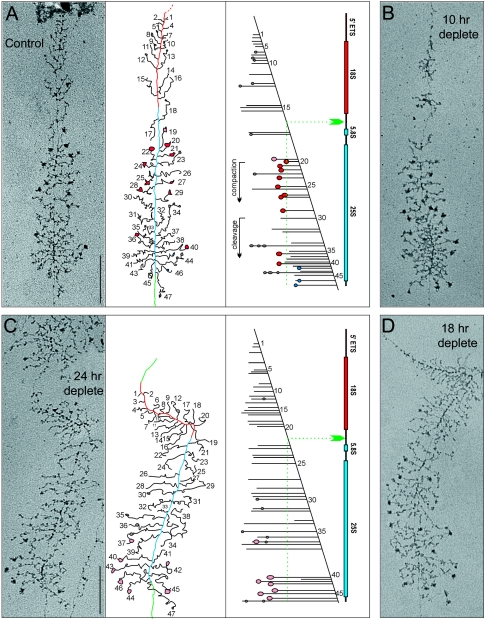
Esf2p is required for terminal knob deposition and SSU processome assembly. Yeast rRNA genes are shown as visualized by chromatin spread. Cells were grown to mid-log phase in YPD (control) or YPD plus DOX (10-h, 18-h, and 24-h depletion time points) and spreads made according to reference . For the control and 24-h depletion time points (panels A and C), interpretive tracing of the genes and transcript mapping are provided. DNA is color coded as follows: the 5′ end to A2 is red, A2 to the 3′ end is blue, and the intergene spacer is green. Particles that appear on the transcripts are shown on the tracing as follows: gray particles correspond to the initial small 5′ terminal knobs, pink to the newly formed (loose) large SSU processomes, red to the mature (tight) SSU processomes, and blue to pre-large-subunit knobs that form at the 5′ end of cleaved transcripts.

References

    1. Andersen, J. S., C. E. Lyon, A. H. Fox, A. K. Leung, Y. W. Lam, H. Steen, M. Mann, and A. I. Lamond. 2002. Directed proteomic analysis of the human nucleolus. Curr. Biol. 12:1-11. - PubMed
    1. Bateman, A., L. Coin, R. Durbin, R. D. Finn, V. Hollich, S. Griffiths-Jones, A. Khanna, M. Marshall, S. Moxon, E. L. Sonnhammer, D. J. Studholme, C. Yeats, and S. R. Eddy. 2004. The Pfam protein families database. Nucleic Acids Res. 32(Database issue):D138-D141. - PMC - PubMed
    1. Bernstein, K. A., and S. J. Baserga. 2004. The small subunit processome is required for cell cycle progression at G1. Mol. Biol. Cell 15:5038-5046. - PMC - PubMed
    1. Bernstein, K. A., J. E. Gallagher, B. M. Mitchell, S. Granneman, and S. J. Baserga. 2004. The small-subunit processome is a ribosome assembly intermediate. Eukaryot. Cell 3:1619-1626. - PMC - PubMed
    1. Billy, E., T. Wegierski, F. Nasr, and W. Filipowicz. 2000. Rcl1p, the yeast protein similar to the RNA 3′-phosphate cyclase, associates with U3 snoRNP and is required for 18S rRNA biogenesis. EMBO J. 19:2115-2126. - PMC - PubMed

Publication types

MeSH terms